
Teachers can assign these Ganita Prakash Class 7 Worksheet and Class 7 Maths Chapter 1 Large Numbers Around Us Worksheet with Answers Pdf Download for daily practice.
Class 7 Maths Chapter 1 Large Numbers Around Us Worksheet with Answers Pdf
Large Numbers Around Us Class 7 Maths Worksheet
Class 7 Maths Chapter 1 Worksheet with Answers – Class 7 Large Numbers Around Us Worksheet
Multiple Choice Questions
Choose the correct option.
Question 1.
The largest 5-digit number is
(a) 99999
(b) 98999
(c) 100001
(d) 90000
Answer:
(a) 99999
Question 2.
If a single sheet of paper weighs 4 grams, then a person can lift 100 thousand sheets of paper together at the same time.
(a) Definitely true
(b) Sometimes true
(c) Never true
(d) Can’t say
Answer:
(c) Never true
Question 3.
The number 3560183 in the American place value system can be written as
(a) 35,60,183
(b) 356,0183
(c) 3,560,183
(d) 35,60,183
Answer:
(c) 3,560,183
Question 4.
Forty-three lakh eighty-two thousand two hundred seventy-four is written in figures as
(a) 43,28,274
(b) 43,82,724
(c) 43,82,274
(d) 48,32,274
Answer:
(c) 43,82,274
Question 5.
The largest 3-digit number that can be made with 20 clicks of +1, +10, +100 buttons is
(a) 980
(b) 990
(c) 992
(d) 999
Answer:
(c) 992

Question 6.
Using all the digits from 0 to 6 exactly once, write the largest multiple of 5. The first digit cannot be 0.?
(a) 1234560
(b) 6054321
(c) 6543210
(d) 1023456
Answer:
(c) 6543210
Question 7.
The number of lakhs required to make 1 billion is
(a) 1 hundred
(b) 1 thousand
(c) Ten thousand
(d) 1 lakh
Answer:
(c) Ten thousand
Question 8.
Given that each coin has a thickness of 1 mm, calculate how many coins would need to be stacked to match the height of a matchbox of 4 cm.
(a) 4
(b) 40
(c) 400
(d) 4000
Answer:
(b) 40
Assertion and Reason-based Questions.
Directions. (For Q.9 – 10): In the following questions, a statement of Assertion (A) is followed by a statement of Reason (R). Choose the correct option as:
(a) Both Assertion (A) and Reason (R) are true and Reason (R) is the correct explanation of Assertion (A).
(b) Both Assertion (A) and Reason (R) are true but Reason (R) is not the correct explanation of Assertion (A).
(c) Assertion (A) is true but Reason (R) is false.
(d) Assertion (A) is false but Reason (R) is true.
Question 1.
Assertion: The sum of 3,63,128 and 2,19,682 is 5,82,810.
Reason: The estimated sum is greater than 5,50,000 and less than 6,00,000.
Answer:
(b) Both Assertion (A) and Reason (R) are true but Reason (R) is not the correct explanation of Assertion (A).
Question 2.
Assertion.: The value of 15,63,128 – 14,60,020 is approximately one lakh.
Reason: The difference is near 1,00,000 and is more than 1,00,000
Answer:
(b) Both Assertion (A) and Reason (R) are true but Reason (R) is not the correct explanation of Assertion (A).
Fill in the blanks
1. If the population of Delhi according to the 2011 census is 1,63,00,000, it is less than 2 crores by __________.
Answer:
37,00,000
2. The number name for the number 5,00,02,888 is __________.
Answer:
Five crore two thousand eight hundred eighty-eight
3. The smallest 3-digit number you can make with 15 clicks of the calculator having buttons of only +1000, +100, +10, and +1 is __________.
Answer:
141
4. 340 lakhs __________ 34 million (<, >, =)
Answer:
=
5. The product of: 25 × 32 × 125 = __________
Answer:
100000
State whether the following statements are true (T) or false (F).
1. 99645 is closest to one lakh, and more than one lakh by 355.
Answer:
False
2. For a person earning ₹ 10,000 every month, it will take 10 months to earn 1 lakh.
Answer:
True
3. The number of zeros in 10 crore is 9.
Answer:
False
4. 36 × 250 = 36 × \(\frac{1000}{8}\)
Answer:
False
5. The product of two 3-digit numbers can only be a 4- or 5-digit number.
Answer:
False
Solve the following.
Question 1.
The estimated population of Delhi in the year 2025 is 3,46,00,000. How much more than 2 crores is 3,46,00,000? Did the population nearly double?
_______________________________________________________
_______________________________________________________
Answer:
1,46,00,000; nearly doubled
Question 2.
Using numbers +1, +10, +100, +1000, and +10000, write expressions in at least two different ways to create the numbers given below.
(a) 40300
_______________________________________________________
_______________________________________________________
Answer:
40300 = (+10000) 4 times and (+100) 3 times
= (+1000) 40 times and (+10) 30 times
(b) 836125
_______________________________________________________
_______________________________________________________
Answer:
836125 = (+10000) 83 times, (+1000) 6 times, (+100) 1 time, (+10) 2 times and (+1) 5 times
= (+10000) 80 times, (+1000) 36 times, (+10) 12 times and (+1) 5 times
Question 3.
Think and answer in which situations it is appropriate to (i) round up, (ii) round down, and (iii) when exact numbers are needed.
(a) 4,75,000 is the number of klrtanas composed by Purandaradasa according to legends.
_______________________________________________________
_______________________________________________________
Answer:
roundup
(b) 40,00,00,000 is the average number of litres of water the Amazon river discharges into the Atlantic Ocean every second.
_______________________________________________________
_______________________________________________________
Answer:
exact number
Question 4.
Write the jive nearest neighbours for the numbers given below:
(a) 63,20,151
(b) 41,09,38,580
Answer:
(a) Nearest ten thousand 63,20,000
Nearest lakh 63,00,000
Nearest ten lakh 60,00,000
Nearest crore 1, 00,00,000
(b) Nearest thousand 41,09,39,000
Nearest ten thousand 41,09,40,000
Nearest lakh 41,09,00,000
Nearest ten lakh 41,10,00,000
Nearest crore 41,00,00,000
Question 5.
Strike out 12 digits from the number 437894378943789437894 so that the remaining number is as small as possible.
Answer:
333437894
Question 6.
Using the numbers in the box, get as close as you can to the 20 300 below numbers using any operation you want. Each card can be 15000 used only once for making a particular number. 7000 50000
(a) 7400
Answer:
15000 + 20 + 7000 – 300 – 5 = 7445
(b) 86500
Answer:
5 × 7000 + 50000 + 15000 + 20 + 300 = 86050
Question 7.
Following the multiplication pattern, complete two more steps:
(a) 6 × 6 = 36
60 × 6 = 360
600 × 6 = 3600
Answer:
6000 × 6 = 36000, 60000 × 6 = 360000
(b) 101 × 101 = 10201
102 × 102 = 10404
103 × 103 = 10609
Answer:
104 × 104 = 10816, 105 × 105 = = 11025
Question 8.
You are given two sets of number cards numbered from 1-7. Place a number card in each box below to get the:
(a) smallest possible sum
(b) largest possible difference of the two resulting numbers.
Answer:
(a) 1123456 + 23456
Smallest sum = 1146912
(b) 7766554-11223
Greatest difference = 7755331
Activity
Numbers with Matchsticks
Suppose the teacher used some matchsticks to create the digits 0-9 and divided the class into two teams, Team A and Team B. Each team has been given a chit with questions to solve.

| Chit for Team A | Chit for Team B |
| 1. Write the number 31076 using matchsticks. | It would need exactly 22 sticks or lines. Make any number using exactly 26 sticks. |
| 2. Starting from the number 31076, add two more sticks to make a bigger number. | What is the largest number you can make using 26 sticks? |
| 3. Starting with 31076, rearrange exactly 4 sticks to make a bigger number. | What is the smallest number you can make using 26 sticks? |
A LAKH VARIETIES!
Three friends, Shradha, Komal and Shray, are interested in the fascinating size of planets in our solar system. They visited the Grand Cosmic Carnival in their town to explore more about planets.
Shradha: Let’s visit the Grand Comic Carnival!
Komal: What will we do there?
Shray: We will see how different all the planets are in size. Jupiter is the largest of them, with a diameter of 139820 km, and Mercury is the smallest, with a diameter of 4,879 km.
Question 1.
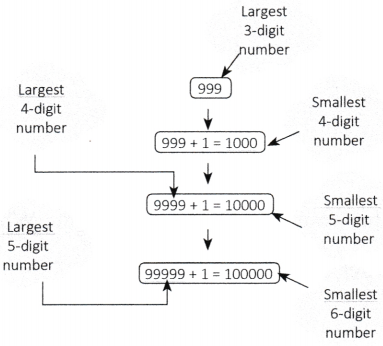
Komal wondered after knowing the diameter of Jupiter (139820 km). It is in lakhs. Do you know, how much one lakh is? Observe the pattern and fill in the blanks given below:
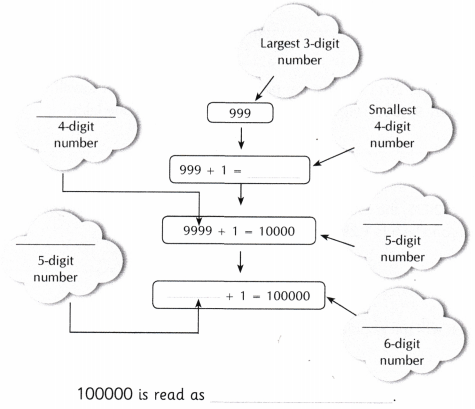
100000 is read as _______________________
Answer:
Question 2.
Nivu and Ziva are playing a number game. Observe the pattern arid help them to fill in all the boxes given below.
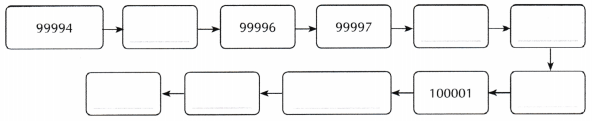
Answer:

Question 3.
Aanav and Meera dreamt oj visiting every village in Uttar Pradesh. They Jound out that Uttar Pradesh has about 1 lakh villages. Aarnav said, “IJ we visit one village every day, we’ll never Jinish visiting them all in our lifetime!”
(a) What if someone visits 3 villages every day? Will that be enough to cover all 1 lakh villages in 100 years? Give reason.
_____________________________________________________
_____________________________________________________
Answer:
Yes, 109500 > 100000
(b) The number of days in x years is given by 365 x x. Choose a number x. How close to one lakh is the number of days in x years, for the x of your choice
_____________________________________________________
_____________________________________________________
Answer:
Do it yourself
Question 4.
(a) According to the 2011 census, the population of the town of Kavali in Andhra Pradesh was approximately 90,099. How much less is it compared to one lakh?
_____________________________________________________
_____________________________________________________
Answer:
9901
(b) By the year 2025, the estimated population of Kavali is projected to be 1,29,000. How much more than one lakh is 1,29,000?
_____________________________________________________
_____________________________________________________
Answer:
29000
(c) How much will the population increase from 2011 to 2025?
_____________________________________________________
_____________________________________________________
Answer:
38901
Question 5.
The teacher pasted three pictures on the class bulletin board. One picture is oj Nohkalikai Falls in Meghalaya, where water jails jrom a height oj 340 m; the second picture is oj the Spring Temple Buddha statue in China, which is 128 m tall; and the third picture on the right is oj a building in which each jloor is jive times the height oj Joe (Joe is 1 m tall).

Based on the above information answer the jollowing questions,
(a) What is the approximate height of the building?
_____________________________________________________
Answer:
65 m
(b) Which is taller: the Spring Temple Buddha statue or this building? And by how much?
_____________________________________________________
Answer:
The Spring Temple Buddha, 63 m
(c) How tall is Nohkalikai Falls compared to the building?
_____________________________________________________
Answer:
275 m
(d) How many floors does Joe’s building need to be as tall as the Spring Temple Buddha statue?
_____________________________________________________
Answer:
Approximately 26 floors
(e) Bats can fly as high as 3000 metres, and Mount Elbrus is 5642 metres tall. How many times taller are these heights compared to those of Joe’s building?
Is One LakK a Very Large Number?
_____________________________________________________
Answer:
nearly 46 times; nearly 87 times
Question 6.
How do you view a lakh: a big or a small number? Below are some examples with indications on how to view each:
If you earn T10,000 every month, it will take you 10 months to earn 1 lakh.
If you save T500 each month, it will take you 200 months (more than 16 years) to save 1 lakh.
Write some more similar situations on your own that can help to understand how big or small one lakh is. ,. -¬
(a) _____________________________________________________
_______________________________________________________
(b) _____________________________________________________
_______________________________________________________
(c) _____________________________________________________
_______________________________________________________
(d) _____________________________________________________
_______________________________________________________
(e) _____________________________________________________
_______________________________________________________
Answer:
Do it yourself.
Reading and Writing Numbers
Question 7.
Write the number names Jor the given numbers:
(a) 2,00,900
_______________________
Answer:
Two lakh nine hundred
(b) 6,05,096
_______________________
Answer:
Six lakh five thousand ninety-six
(c) 52,80,000
_______________________
Answer:
Fifty-two lakh eighty thousand
(d) 80,67,129
_______________________
Answer:
Eighty lakh sixty-seven thousand one hundred twenty nine
Question 8.
Write the Jollowing numbers injigures:
(a) Three lakh forty-five thousand six hundred seventy-eight
Answer:
3,45,678
(b) One lakh seven thousand seven hundred five
Answer:
1,07,705
(c) Seventy lakh seven thousand seventy
Answer:
70,07,070
(d) Sixty lakh seven hundred eighty-nine
Answer:
60,00,789
LAND OF TENS
Question 9.
One day, the teacher organised a surprise test. She brought in three buzzers, each with a unique number written on it. The teacher divided the class into three groups and assigned one buzzer to each group. Group A received a buzzer with a +1000 button, Group B received a buzzer with a +100 button, and Group C received a buzzer with a +10 button.

(a) The teacher then presented each group with a set of questions. The group that answers all the questions correctly first will be declared the winner. – – ”
Questions for Group A: How many times should the buzzer be pressed to get:
(I) Two thousand? __________ times
(ii) 30,000? __________
(iii) Eighty-six thousand? __________
(iv) One l? __________
(v) __________ ? 141 times
(vi) How many thousands are required to make one lakh? __________
Answer:
(i) 2
(ii) 30 times
(iii) 86 times
(iv) 100 times
(v) 1,41,000
(vi) 100
Questions for Group B: How many times should the buzzer be pressed to get:
(i Eight thousand? __________ times
(iii 3400? __________
(iii) Thirty-one thousand? __________
(iv) 78,400? __________ ; 1 ,00,000? __________
(v) __________ ? 372 times
(vi) How many hundreds are required to make one lakh? __________
Answer:
(i) 80
(ii) 34 times
(iii) 310 times
(iv) 784 times; 1000 times
(v) 37,200
(vi) 1000
(b) Now the teacher asked the whole class, “If we have buzzers with numbers +1, +10, + 100, + 1000, and + 10000, how many times and which buzzers should we press to get the number 522? Write in different ways.
_______________________________________________________
_______________________________________________________
_______________________________________________________
_______________________________________________________
Answer:
(i) 60
(ii) 48 times
(iii) 200 times
(iv) 690 times
(v) 1000 times; 10,000 times
(vi) 3540
Question 10.
For each number given below, write expressions in at least two different wags to create that number bg pressing the buzzers witH numbers +10000, +1000, +100, +10, +1.
(a) 2300
_____________________________________________________
Answer:
(+1000) 2 times and (+100) 3 times; or (+1000) 2 times, (+100) 1 time, and (+10) 20 times
(b) 40357
_____________________________________________________
Answer:
(+10000) 4 times, (+100) 3 times, (+10) 5 times and (+1) 7 times; or (+10000) 3 times, (+1000) 10 times, (+100) 2 times, (+10) 15 times and (+1) 7 times
(c) 77777
_____________________________________________________
Answer:
(+10000) 7 times, (+1000) 7 times, (+100) 7 times, (+10) 7 times and (+1) 7 times; or (+1000) 77 times, (+10) 77 times and (+1) 7 times
(d) 863912
_____________________________________________________
Answer:
(+10000) 86 times, (+1000) 3 times, (+100) 9 times, (+10) 1 time and (+1) 2 times; or (+10000) 86 times, (+100) 39 times, (+10) 1 time and (+1) 2 times
Question 11.
Answer the following questions:
(a) What is the largest 3-digit number you can make with 20 buzzer presses?
Answer:
992
(b) What is the smallest 3-digit number you can make with 15 buzzer presses?
Answer:
105
(c) 993 can be made using 21 buzzer presses. What other number of clicks can make 993?
Answer:
39 clicks (Answer may vary)
Question 12.
For each number in question 10, determine Kow to create tke number using the fewest buzzer presses. Write the expression for this solution.
(a) _______________________________________________________
(b) _______________________________________________________
(c) _______________________________________________________
(d) _______________________________________________________
Answer:
(a) 5 buzzer presses; (+1000) 2 times and (+100) 3 times
(b) 19 buzzer presses; (+10000) 4 times, (+100) 3 times, (+10) 5 times and (+1) 7 times
(c) 35 buzzer presses; (+10000) 7 times, (+1000) 7 times, (+100) 7 times, (+10) 7 times and (+1) 2 times;
(d) 101 buzzer presses; (+10000) 86 times, (+1000) 3 times, (+100) 9 times, (+10) 1 time and (+1) 2 times;
Question 13.
Viraaj has a calculator with only two buttons: ‘1000’ and ‘10’. Find out which button should be clicked and how many times to get the desired numbers given below:
(a) 4070
(b) 9120
(c) 38050
(d) 81520
Answer:
(a) 1000—4 times and 10—7 times
(b) 1000—9 times and 10—12 times
(c) 1000—38 times and 10–5 times
(d) 1000—81 times and 10—52 times
OF CRORES AND CRORES!
Question 14.
(a) How many zeroes does a hundred crore have?
Answer:
9
(b) How many zeroes does a ten million have?
Answer:
7
Question 15.
Write the number names of the following given numbers in both the Indian and International systems (American system):
(a) 7560983
_______________________
_______________________
_______________________
_______________________
Answer:
Seventy five lakh sixty thousand nine hundred eighty three; Seven million five hundred sixty thousand nine hundred eighty three
(b) 58382793
_______________________
_______________________
_______________________
_______________________
Answer:
Five crore eighty three lakh eighty two thousand seven hundred ninety three; Fifty eight million three hundred eighty two thousand seven hundred ninety three
(c) 123065628
_______________________
_______________________
_______________________
_______________________
Answer:
Twelve crore thirty lakh sixty-five thousand six hundred twenty- eight; One hundred twenty-three million sixty five thousand six hundred twenty-eight
(d) 9080706050
_______________________
_______________________
_______________________
_______________________
Answer:
Nine arab eight crore seven lakh six thousand fifty; Nine billion eighty million seven hundred six thousand fifty
Question 16.
Read the following numbers given below and write the numerals /orm for each ojthe Jollowing:
(a) 3 crore 70 lakh 2 thousand 968
(b) 95 million 234 thousand 481
(c) 15 crore 80 lakh 75 thousand 93
(d) 8 billion 8 million 8 thousand 8
Answer:
(a) 3,70,02,968
(b) 95,234,481
(c) 15,80,75,093
(d) 8,008,008,008
Question 17.
The number 2,80,134, when written in words, is ‘Two lakh eighty thousand one hundred thirty- four’, which has 41 letters. Write a 7-digit number name that has the most letters.
Answer:
Seventy-eight lakh seventy-three thousand eight hundred seventy-eight; 60 letters
Question 18.
Compare and write ‘<’, ‘>’ or ‘=’
(a) 9 million __________ 900
Answer:
<
(b) 20 lakhs __________ 200 thousand
Answer:
>
(c) 524 thousand __________ 5 million
Answer:
<
(d) 600 crores __________ 6 billion
Answer:
=
Question 19.
How many thousands make a billion?
Answer:
1 million thousand
EXACT AND APPROXIMATE VALUES
Question 20.
Think and answer in which situations it is appropriate to: (i) round up, (ii) round down, and (iii) when exact numbers are needed.
(a) A total of 4789 students participated in a competitive exam.
(b) 67,835 spectators attended the match at the stadium.
(c) 218 people lost their lives in the fire.
(d) The distance between Delhi and Goa is 1504 km.
(e) Shreya takes approximately 18 minutes to walk to school.
Answer:
(a) Round up
(b) Round up
(c) Round down
(d) Exact number is needed
(e) Round up
Nearest Neighbours
Question 21.
Write the Jive nearest neighbours For the numbers given below:
(a) 4,63,27,158
(b) 71,69,42,583
Answer:
(a) 4,63,27,000; 4,63,30,000; 4,63,00,000; 4,60,00,000; 5,00,00,000
(b) 71,69,43,000; 71,69,40,000,71,69,00,000; 71,70,00,000; 72,00,00,000
(Answer may vary)
Question 22.
I have a number for which all five nearest neighbours are 3,00,00,000. What could the number be?
Answer:
2,99,99,999
Question 23.
Naina and Sunaina are estimating the values of the fuel expenses of a company, where the expenses are ₹ 2,73,892 in January and ^2,13,218 in February, as per their workers’ daily travel.
Naina: The sum is near ₹ 4,00,000 and is more than ₹ 4,00,000.
Sunaina: The sum is near ₹ 5,00,000 and is less than ₹ 5,00,000.
Answer the following questions based on the above information:
(a) Are these estimates correct? Whose estimate is closer to the sum?
(b) Is the sum less than ₹ 4,50,000 or more than ₹ 4,50,000? Why do you think so?
(c) Is the sum less than ₹ 4,92,218 or more than ₹ 4,92,218? Why do you think so?
(d) Exact value of 2,73,892 + 2,13,218 = __________
Answer:
(a) Yes, Sunaina
(b) More than 4,50,000
(c) Less than 4,92,218
(d) 4,87,110
Question 24.
Now, NldKl and Robin are estimating the values of the fuel expenses of the company, where the expenses are ₹ 12,36,821 in March and ₹ 7,14,020 in April, as per their workers’ daily travel.
NidKi: The difference is near ₹ 6,00,000 and is more than ₹ 6,00,000.
Robin: The difference is near ₹ 5,00,000 and is more than ₹ 5,00,000.
Answer the following questions based on the above information:
(a) Are these estimates correct? Whose estimate is closer to the difference?
(b) Is the difference less than ₹ 5,00,000 or more than ₹ 5,00,000? Why do you think so?
(c) Is the difference less than ₹ 5,14,020 or more than ₹ 5,14,020? Why do you think so?
(d) Exact value of 12,36,821 – 7,14,020 = __________
Answer:
(a) Yes, Robin
(b) More than 5,00,000
(c) More than 5,14,020
(d) 5,22,801
Populations of Cities
Question 25.
Observe the population of some Indian cities in the table given below and answer the following questions using approximation.
| City | Population (2011) | Population (2001) |
| 1. Warangal | 8,11,844 | 5,30,636 |
| 2. Thiruvananthapuram | 7,52,490 | 7,44,983 |
| 3. Guntur | 7,43,354 | 5,14,461 |
| 4. Bhiwandi | 7,11,329 | 5,98,741 |
| 5. Saharanpur | 7,03,345 | 4,55,754 |
| 6. Gorakhpur | 6,71,048 | 6,22,701 |
| 7. Bikaner | 14,47,804 | 12,63,690 |
| 8. Amravati | 6,46,801 | 5,79,510 |
(a) Suggest a suitable title for the given data.
_____________________________________________________
Answer:
Population of some Indian cities in the years 2001 and 2011
(b) What was the population of Saharanpur in 2011? Approximately how much did it increase compared to 2001 ?
_______________________________________________________
Answer:
7,03,345; 2,00,000
(c) Identify the city with the highest population growth between 2001 and 2011.
_______________________________________________________
Answer:
Warangal
(d) Are there any cities whose population has nearly doubled? If yes, name them.
_______________________________________________________
Answer:
None
(e) How many times will the Warangal’s population make it close to the population of Bikaner in 2001?
_______________________________________________________
Answer:
Nearly two times
Patterns In Product A Multiplication Shortcut
Question 26.
Find out the products of the following in quick ways:
(a) 2 × 1456 × 5
(b) 104 × 125
(c) 125 × 40 × 16 × 25
Answer:
(a) 14,560
(b) 13,000
(c) 20,00,000
Question 27.
Find out the products given below without multiplying the two numbers directly.
(a) 25 × 16 =
(b) 25 × 320 =
(c) 250 × 160 =
(d) 2500 × 16 =
(e) 2500 × 1600 =
(f) x = 160000000
How Long to the Product?
Answer:
(a) 400
(b) 8,000
(c) 40,000
(d) 40,000
(e) 40,00,000
(f) 2500 × 64000
Question 28.
Solve to find the patterns and extend the multiplication to two more steps:
(a) 19 × 5 = __________
199 × 5 = __________
1999 × 5 = __________
Answer:
19 × 5 = 95
199 × 5 = 995
1999 × 5 = 9995
19999 × 5 = 99995
199999 × 5 = 999995
(b) 37 × 3 = __________
37 × 6 = __________
37 × 9 = __________
Answer:
37 × 3 = 111
37 × 6 = 222
37 × 9 = 333
37 × 12 = 444
37 × 15 = 555
(c) 3 × 60 = __________
33 × 60 = __________
333 × 60 = __________
Answer:
3 × 60=180
33 × 60 = 1980
333 × 60 = 19980
3333 × 60= 199980
33333 × 60= 1999980
(d) 6 × 7 = __________
66 × 67 = __________
666 × 667 = __________
Answer:
6 × 7 = 42
66 × 67 = 4422
666 × 667 = 444222
6666 × 6667 = 44442222
66666 × 66667 = 4444422222
Question 29.
Can multiplying a 4-digit number by another 4-digit number give a 5-digit number? Write down the patterns when a 4-digit number is multiplied by a 2-digit, a 3-digit, a 4-digit and a 5-digit number. What patterns do you notice and extend them jor 5-digit x 5-digit, 8-digit x 3-digit and 12-digit x 11-digit, also?
_______________________________________________________
_______________________________________________________
_______________________________________________________
_______________________________________________________
Answer:
No,
4-digit x 2-digit = 5-digit or 6-digit
4-digit x 3-digit = 6-digit or 7-digit
4-digit x 4-digit = 7-digit or 8-digit
4-digit x 5-digit = 8-digit or 9-digit
5-digit x 5-digit = 9-digit or 10-digit
8-digit x 3-digit = 10-digit or 11-digit
12-digit x 11-digit = 22-digit or 23-digit
Fascinating Facts About Large Numbers
Question 30.
\(\frac{253080}{60}\) = __________ is the distance (in km) of the longest train route in India. The train runs jrom Dibrugarh to Kanyakumari. The journey takes the train through 8 states, and the duration oj: this journey is about 76 hours.

Answer:
4218 km
Did You Ever Wonder…?
Question 31.
Make necessary reasonable assumptions and answer the questions given below:
(a) If one apple weighs 200 grams, can you carry 500 apples at the same time? Give reason.
(b) If a person drinks 2 litres of water every day, can they drink 100 litres of water in 2 months? Give reason.
(c) If you bake 10 cakes in an hour, can you bake 100 cakes in a day? Assume you can work for 12 hours a day. Give reason.
Answer:
(a) No
(b) Yes
(c) Yes
Question 32.
Write a 9-digit number, where exchanging any 2 digits results in a smaller number. How many such numbers exist?
_______________________________________________________
_______________________________________________________
_______________________________________________________
Answer:
987654321; 10
Question 33.
Strike out 12 digits jrom the number 5678956789567895678956789 so that the remaining number is as small as possible.
Answer:
5555678956789
Question 34.
Using all the digits jrom 0 to 7 exactly once, write the largest multiple oj 5. The Jirst digit cannot be 0.
Answer:
76543210
Question 35.
Using the numbers in tke box, get as close as gou can to tke below numbers using any operation. Each number can be used only once to make a particular number.

(a) 21600
(b) 9800
(c) 64500
Answer:
(a) 21000 + 700 – 20 × 5
(b) 8000 + 50000 + 20 – 700
(c) 50000 + 21000 – 8000 + 1500
Question 36.
During roll call, the teacher noticed that:
- Roll numbers one and two share the letter “o”
- Roll numbers two and tkree share the letter “t”
- Roll numbers tkree and Jour share the letter “r” and so on.
Find two consecutive numbers (written in words) that do not share any common English letter
_______________________________________________________
_______________________________________________________
_______________________________________________________
Answer:
There is no such consecutive numbers.
Question 37.
Imagine writing down the numbers in order 1, 2, 3, 4, ….. 9, 10, 11,…. The tenth digit ‘ you write will be ‘V and the eleventh will be ‘O’, which together form the number 10. Now, answer the followiag questions:
(a) What would the 700th digit be? At what number would it occur?
(b) What number would contain the 10,000th digit
Answer:
(a) 2; 270
(b) 2777
Question 38.
The world’s longest train journey, from Sintra to Singapore, is 18,755 km long and takes 21 days to complete. It passes through 13 countries. Find out the approximate distance the train travels each day. Find out the approximate distance the train travels every hour.
Answer:
893 km; 37 km
Question 39.
Given that each coin has a thickness of 1 mm, calculate how many coins would need to be stacked to match the height of the Spring Temple Buddha statue.
_______________________________________________________
_______________________________________________________
_______________________________________________________
Answer:
128000 coins
The post Large Numbers Around Us Class 7 Worksheet with Answers Maths Chapter 1 appeared first on Learn CBSE.
📚 NCsolve - Your Global Education Partner 🌍
Empowering Students with AI-Driven Learning Solutions
Welcome to NCsolve — your trusted educational platform designed to support students worldwide. Whether you're preparing for Class 10, Class 11, or Class 12, NCsolve offers a wide range of learning resources powered by AI Education.
Our platform is committed to providing detailed solutions, effective study techniques, and reliable content to help you achieve academic success. With our AI-driven tools, you can now access personalized study guides, practice tests, and interactive learning experiences from anywhere in the world.
🔎 Why Choose NCsolve?
At NCsolve, we believe in smart learning. Our platform offers:
- ✅ AI-powered solutions for faster and accurate learning.
- ✅ Step-by-step NCERT Solutions for all subjects.
- ✅ Access to Sample Papers and Previous Year Questions.
- ✅ Detailed explanations to strengthen your concepts.
- ✅ Regular updates on exams, syllabus changes, and study tips.
- ✅ Support for students worldwide with multi-language content.
🌐 Explore Our Websites:
🔹 ncsolve.blogspot.com
🔹 ncsolve-global.blogspot.com
🔹 edu-ai.blogspot.com
📲 Connect With Us:
👍 Facebook: NCsolve
📧 Email: ncsolve@yopmail.com

😇 WHAT'S YOUR DOUBT DEAR ☕️
🌎 YOU'RE BEST 🏆