⚙️
Welcome to NCSOLVE — National Curriculum Solver of Learning Volume Environment! Explore Free NCERT Solutions, CBSE Sample Papers, and AI Tools! Empowering Education Worldwide with Advanced AI Technology! Access Cultural Insights, AI-Based Learning, and Free Hidden Books! Prepare for NEET, JEE, UPSC, and Other Competitive Exams with Exclusive Resources! Learn Smarter, Faster, and Better with NCSOLVE Today!

Select Class

Bees may survive a swim by heading for the dark [COMIC] - #NCSOLVE 📚

0

Bees may be best known for buzzing through the air. But they are surprisingly good swimmers, too. The insects can paddle through the water using the bottoms of their wings. And a new study shows that waterborne bees prefer to swim toward dark areas. This strategy might save them from drowning.

Zach Huang and others studied this behavior in honeybees and mason bees. Huang is a bee researcher at Michigan State University in East Lansing. The team shared its findings February 10 in Communications Biology.

illustrated text reads "Wild Things: A graphic tale" with animals drawn around the letters
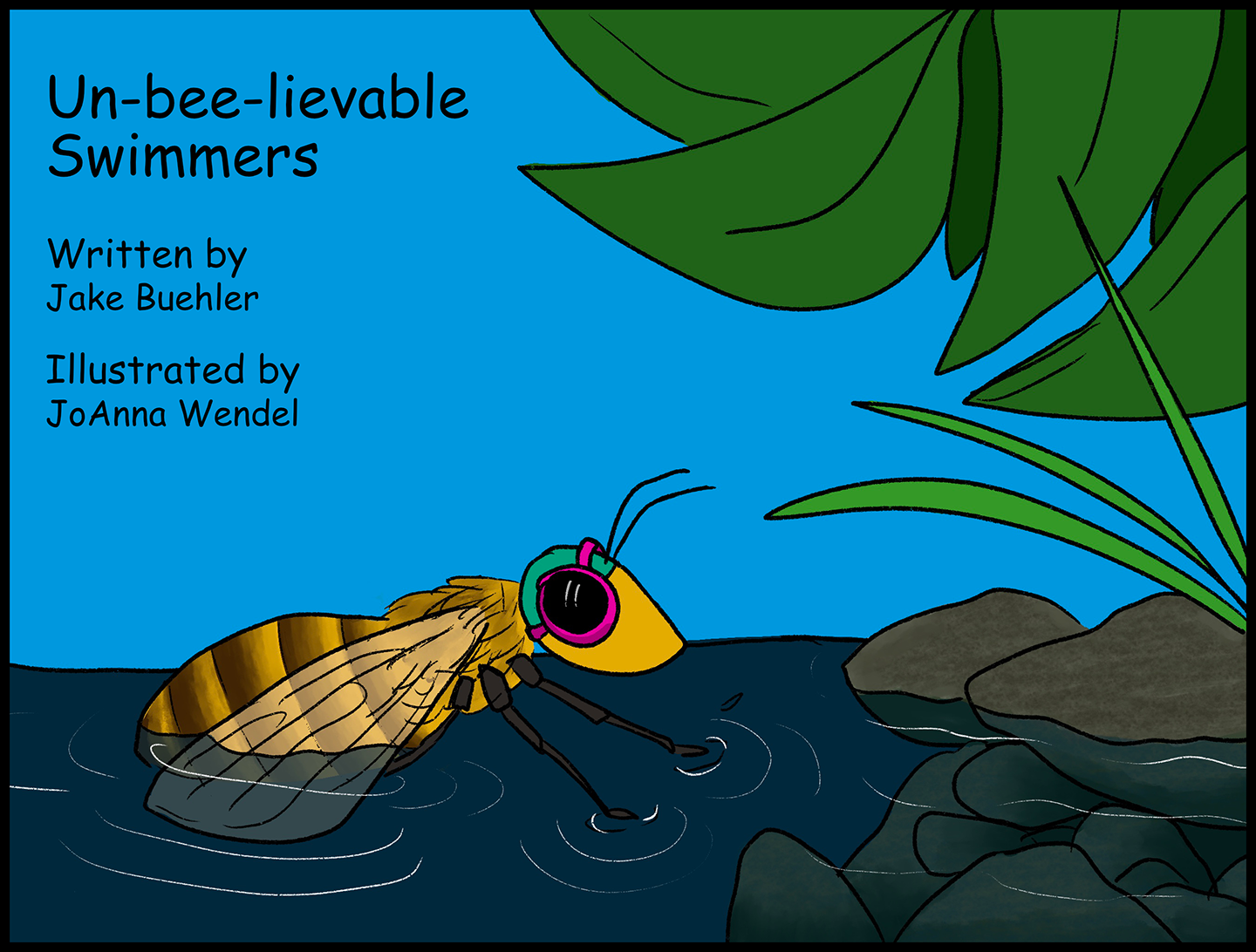
Text (above image): Un-bee-lievable Swimmers. Written by Jake Buehler. Illustrated by JoAnna Wendel. Image: a bee wearing pink goggles swims across a shallow pool toward a rocky shore.
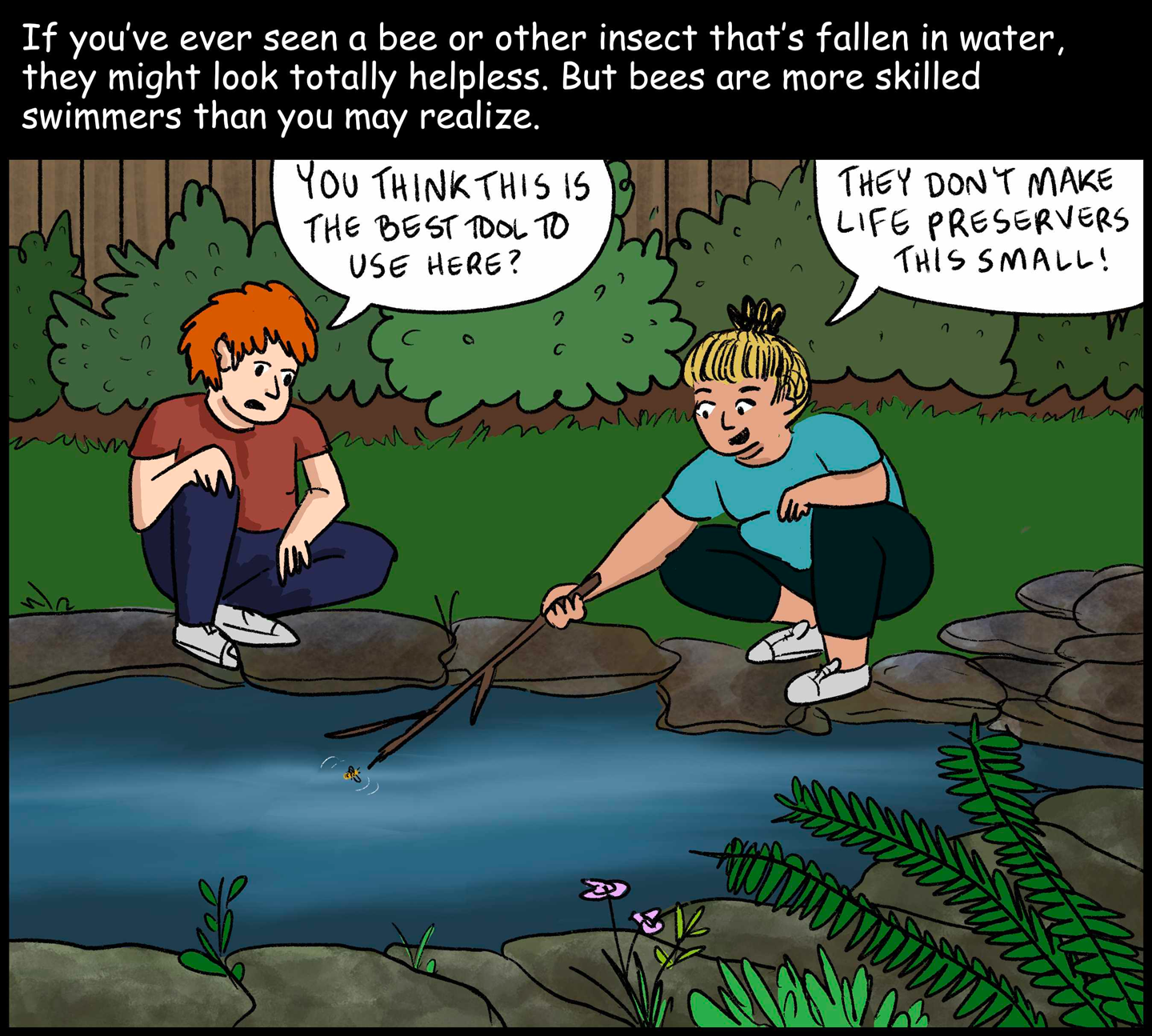
Text (above image): If you’ve ever seen a bee or other insect that’s fallen in water, they might look totally helpless. But bees are more skilled swimmers than you may realize. Image: Two children sit at the edge of a pond. One child holds out a stick toward an insect that has fallen in the water. The one not holding a stick says: “You think this is the best tool to use here?” The one holding the stick says: “They don’t make life preservers this small!”
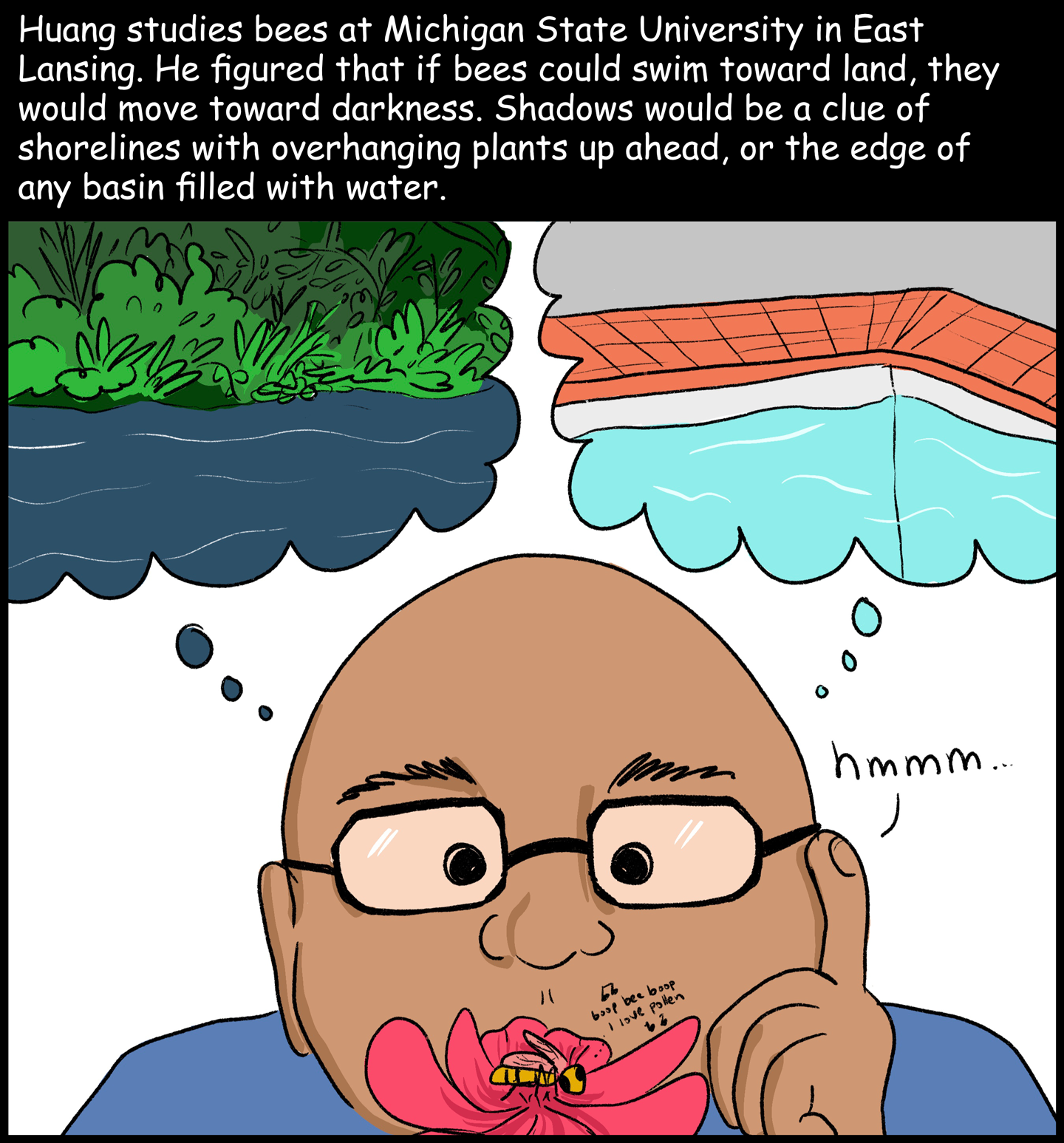
Text (above image): Huang studies bees at Michigan State University in East Lansing. He figured that if bees could swim toward land, they would move toward darkness. Shadows would be a clue of shorelines with overhanging plants up ahead, or the edge of any basin filled with water. Image: A bald man with glasses looks at a bee perched on a flower. The man is picturing the plants at the edge of a pond, or the lip at the edge of a pool. The bee is singing quietly: “Beep, boop, I love pollen!”
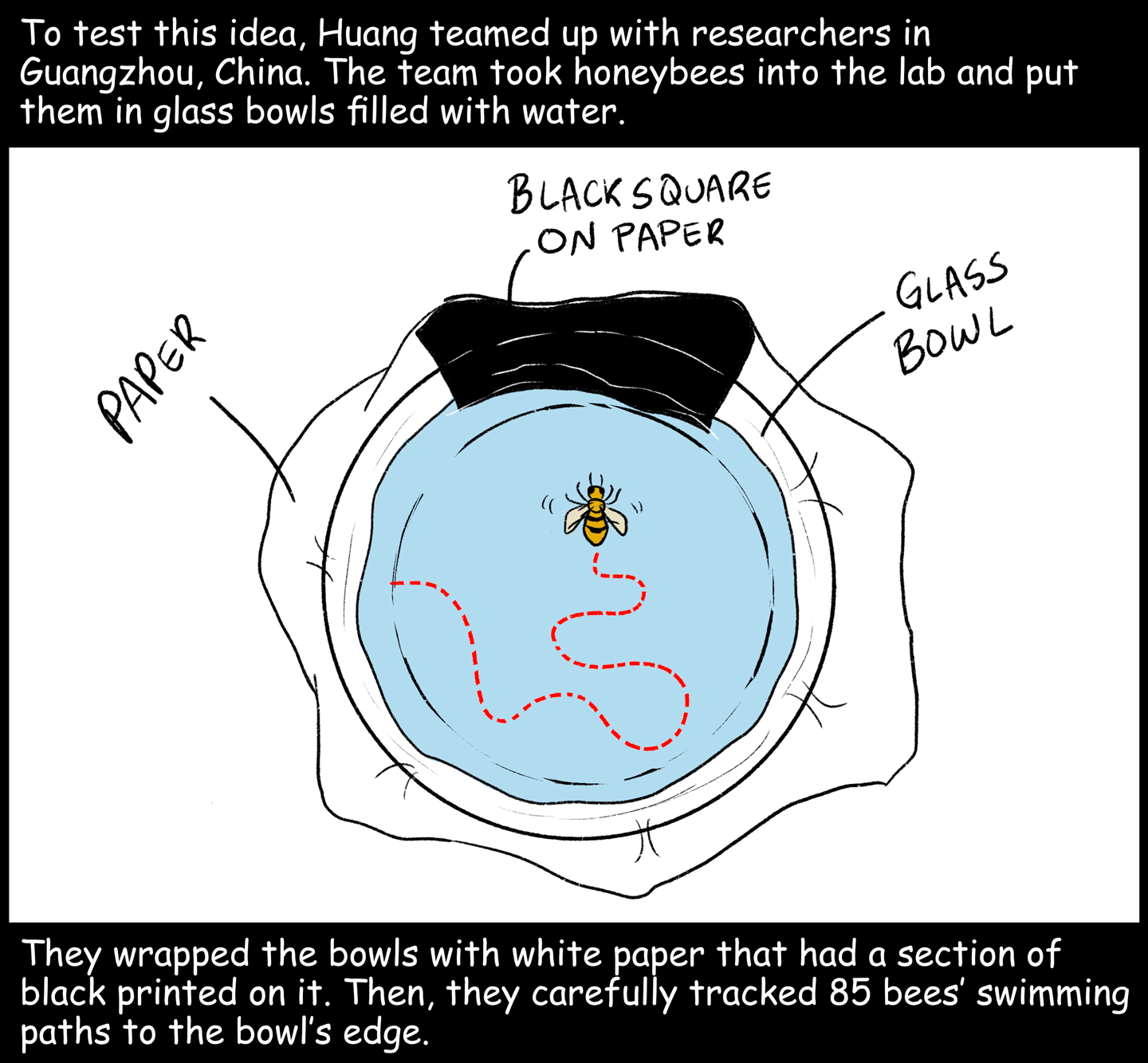
Text (above image): To test this idea, Huang teamed up with researchers in Guangzhou, China. The team took honeybees into the lab and put them in glass bowls filled with water. Image: Top view of a glass bowl filled with water. Around the bowl is a piece of white paper. One patch of the white paper is colored black. A bee swims in the water bowl toward the black patch. Text (below image): They wrapped the bowls with white paper that had a section of black printed on it. Then, they carefully tracked 85 bees’ swimming paths to the bowl’s edge.
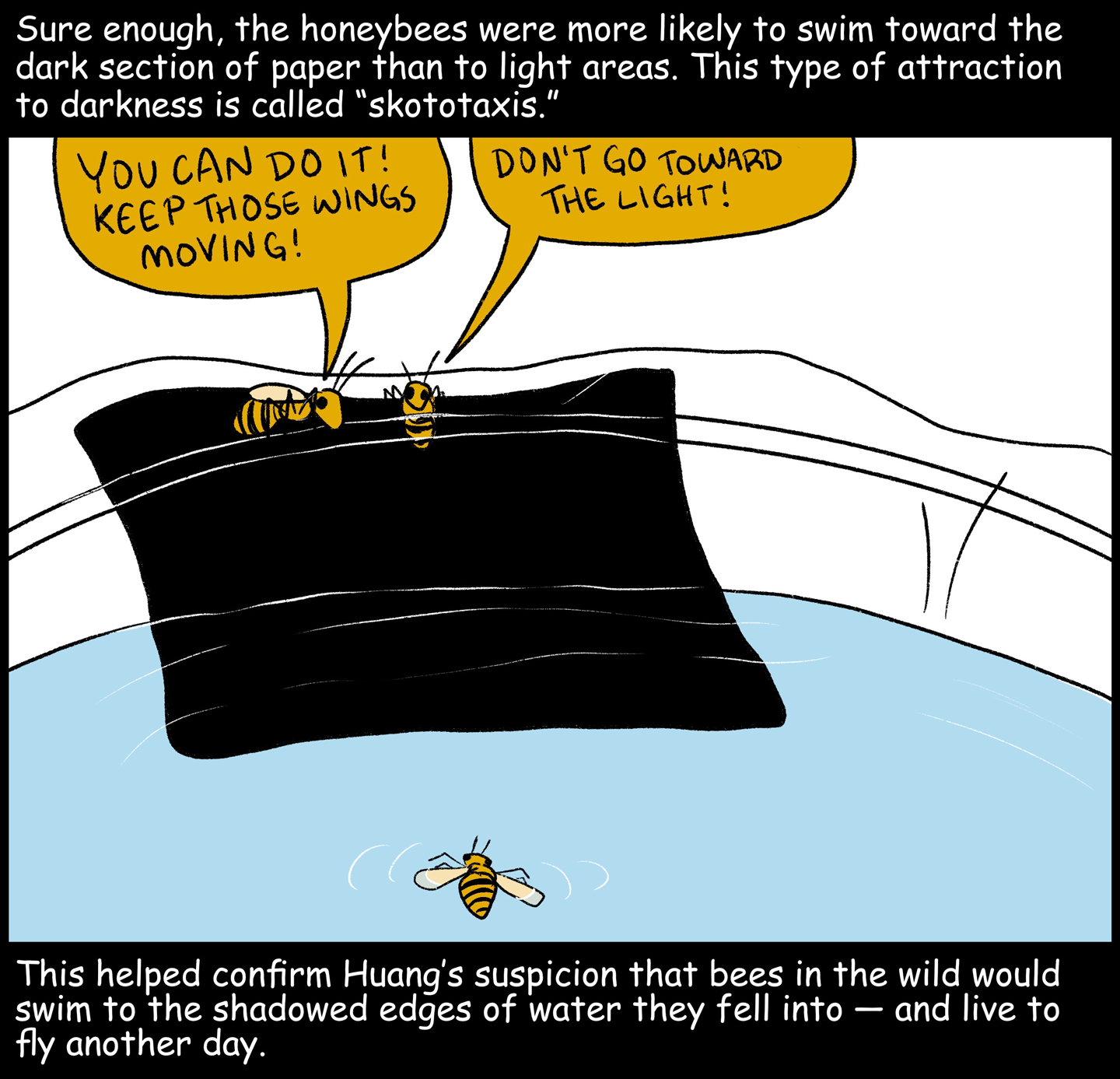
Text (above image): Sure enough, the honeybees were more likely to swim toward the dark section of paper than to light areas. This type of attraction to darkness is called “skototaxis.” Image: Two bees sit on the edge of the bowl while another swims toward the black patch of paper. One of the watching bees yells: “You can do it! Keep those wings moving!” The other watching bee yells: “Don’t go toward the light!” Text (below image): This helped confirm Huang’s suspicion that bees in the wild would swim to the shadowed edges of water they fell into — and live to fly another day.
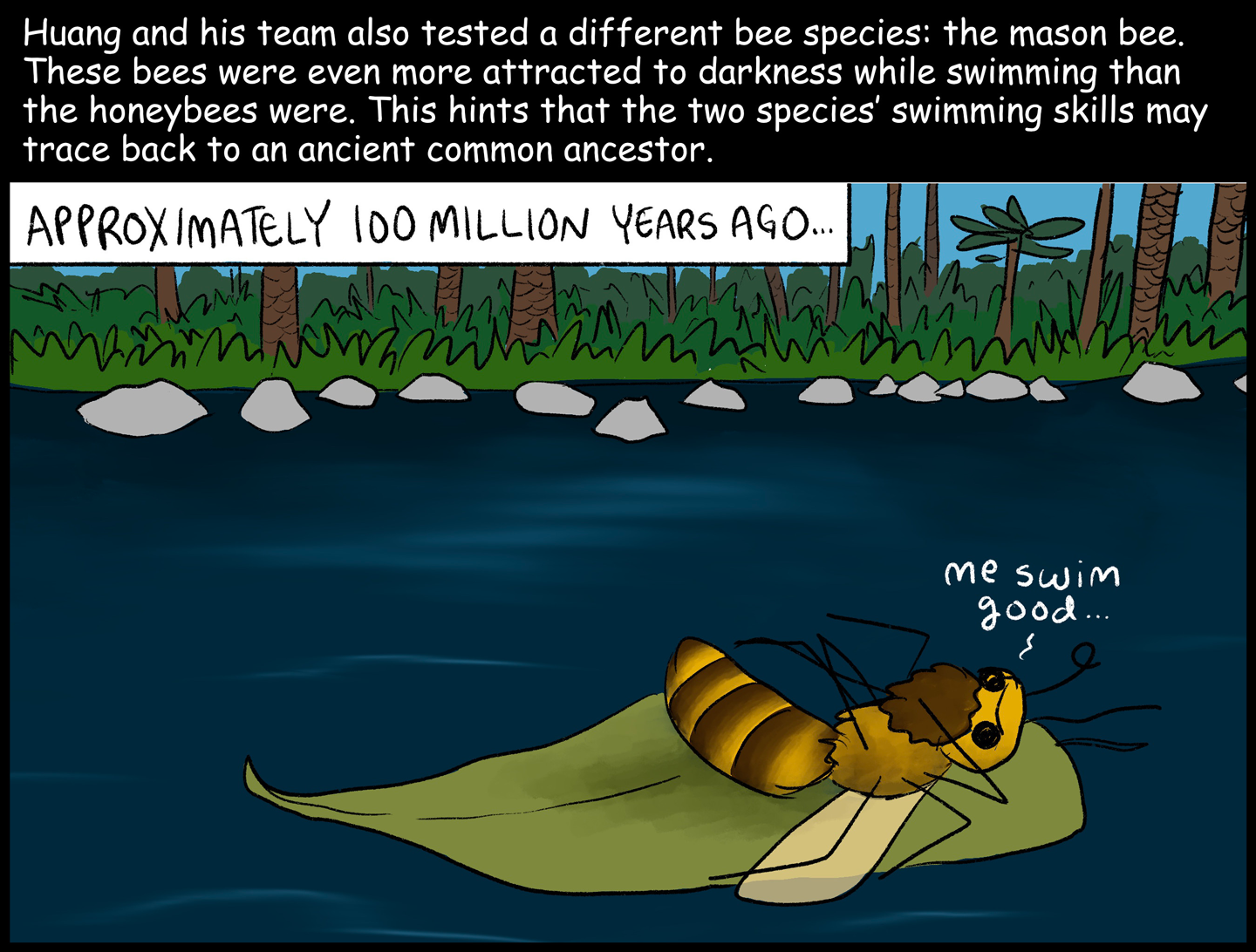
Text (above image): Huang and his team also tested a different bee species: the mason bee. These bees were even more attracted to darkness while swimming than the honeybees were. This hints that the two species’ swimming skills may trace back to an ancient common ancestor. A box with the text “Approximately 100 million years ago…” appears at the top of an image. Image: A cave-bee with a long beard floats on his back on a leaf, thinking: “Me swim good…”
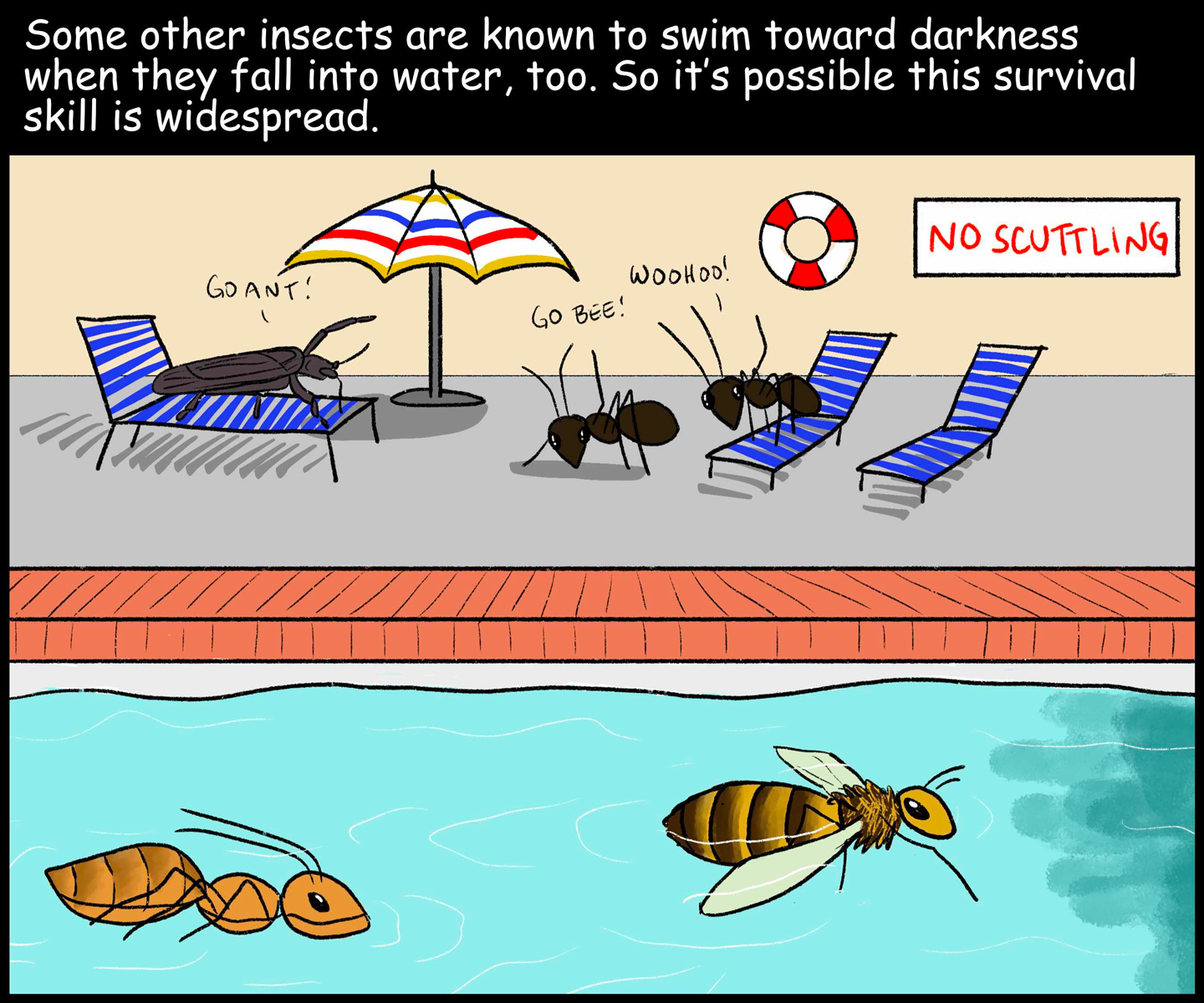
Text (above image): Some other insects are known to swim toward darkness when they fall into water, too. So it’s possible this survival skill is widespread. Image: Several insects mill about a tiny pool. On the pool deck, a few insects sit in lounge chairs. In the water, a bee races against an ant. A beetle from the sidelines yells: “Go ant!” An ant on the sidelines yells: “Go bee!” Another yells “Woohoo!”
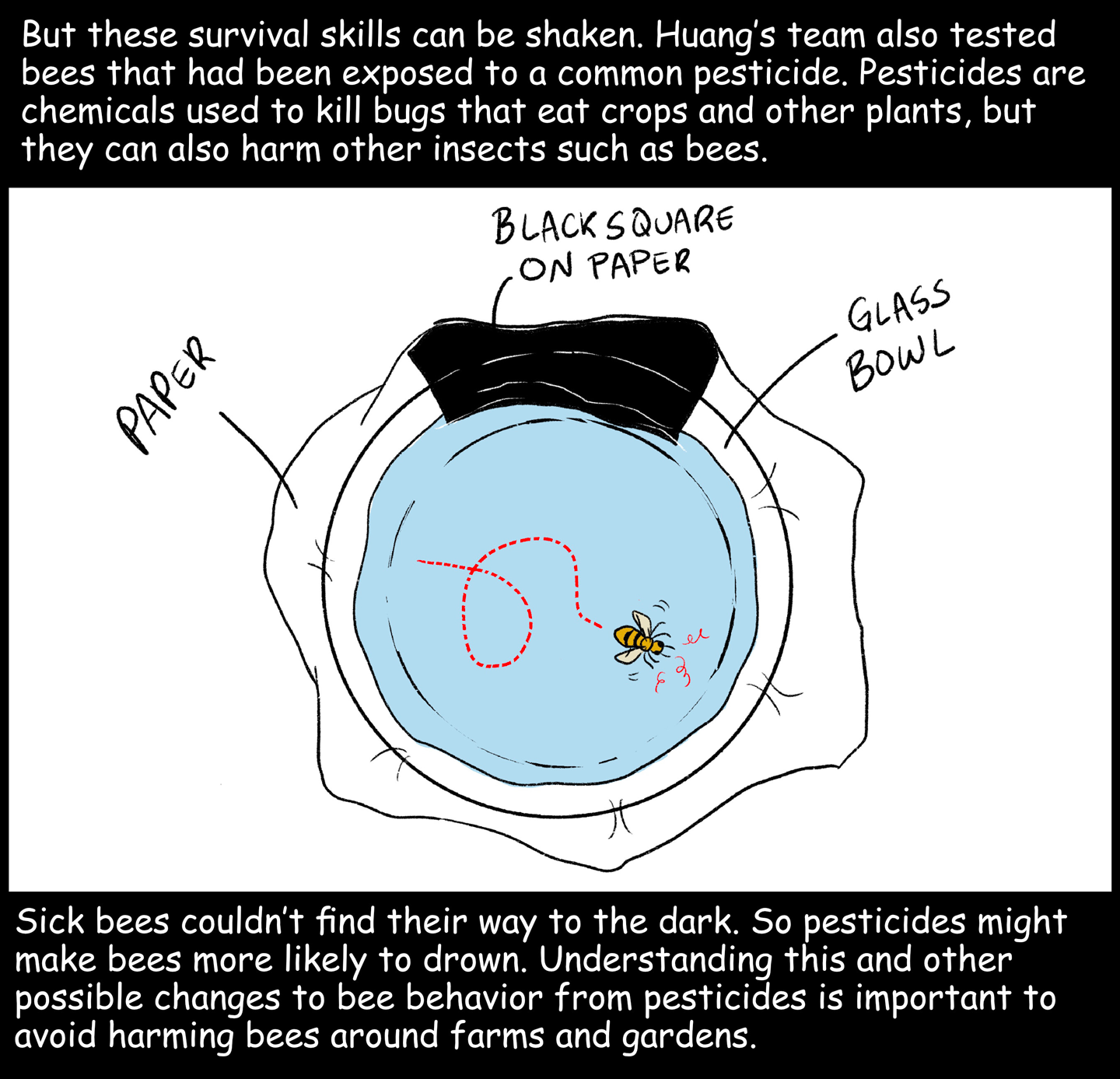
Text (above image): But these survival skills can be shaken. Huang’s team also tested bees that had been exposed to a common pesticide. Pesticides are chemicals used to kill bugs that eat crops and other plants, but they can also harm other insects such as bees. Image: Top view of glass bowl with white paper and a black patch. A bee in the water swims around in confusion. Text (below image): Sick bees couldn’t find their way to the dark. So pesticides might make bees more likely to drown. Understanding this and other possible changes to bee behavior from pesticides is important to avoid harming bees around farms and gardens.
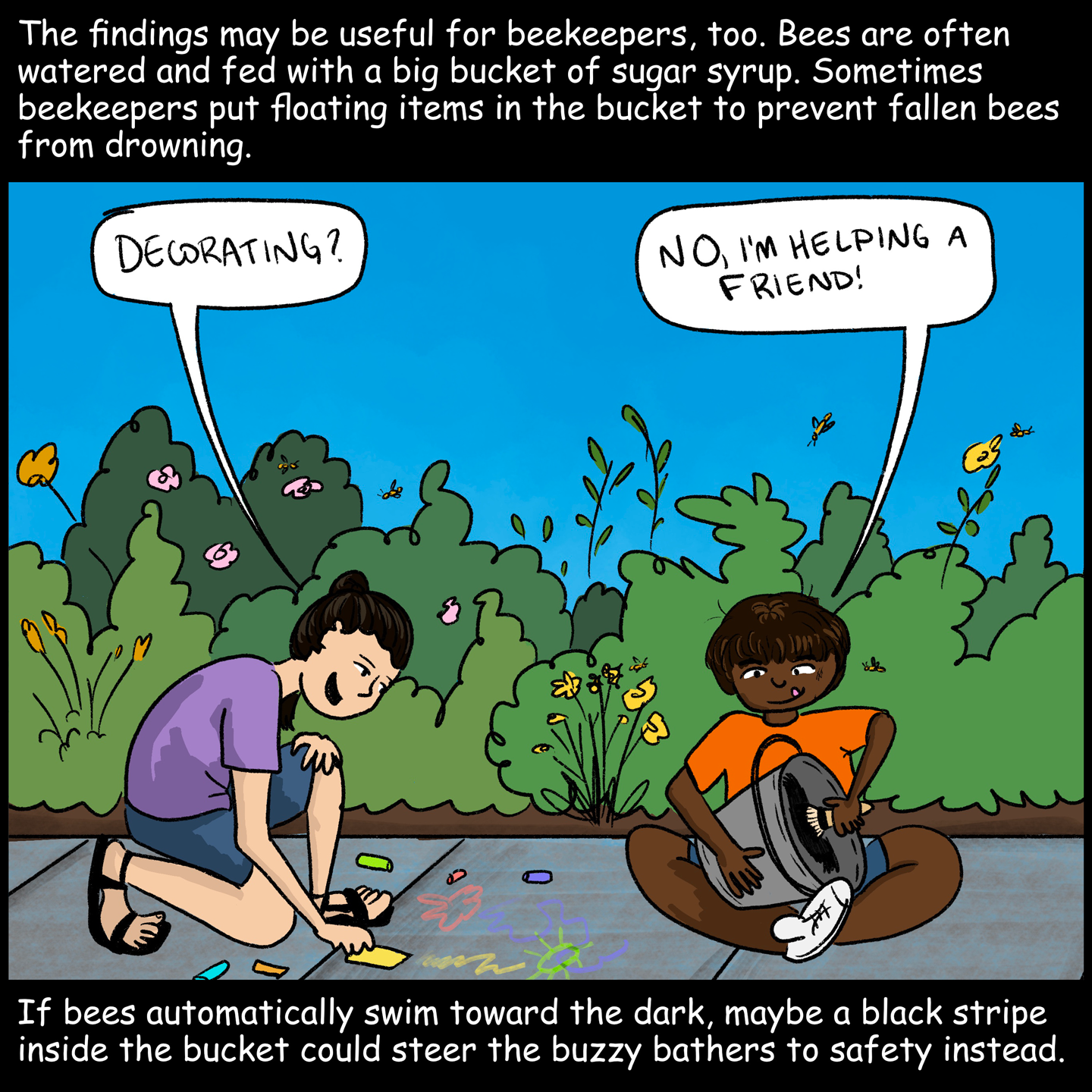
Text (above image): The findings may be useful for beekeepers, too. Bees are often watered and fed with a big bucket of sugar syrup. Sometimes beekeepers put floating items in the bucket to prevent fallen bees from downing. Image: Two kids sit on a sidewalk. One is drawing on the sidewalk with chalk. The other is painting a black patch onto a bucket. The one coloring the sidewalk asks: “Decorating?” The one painting the bucket says, “No, I’m helping a friend!” Text (below image): If bees automatically swim toward the dark, maybe a black stripe inside the bucket could steer the buzzy bathers to safety instead.


📚 NCsolve - Your Global Education Partner 🌍

Empowering Students with AI-Driven Learning Solutions

Welcome to NCsolve — your trusted educational platform designed to support students worldwide. Whether you're preparing for Class 10, Class 11, or Class 12, NCsolve offers a wide range of learning resources powered by AI Education.

Our platform is committed to providing detailed solutions, effective study techniques, and reliable content to help you achieve academic success. With our AI-driven tools, you can now access personalized study guides, practice tests, and interactive learning experiences from anywhere in the world.

🔎 Why Choose NCsolve?

At NCsolve, we believe in smart learning. Our platform offers:

  • ✅ AI-powered solutions for faster and accurate learning.
  • ✅ Step-by-step NCERT Solutions for all subjects.
  • ✅ Access to Sample Papers and Previous Year Questions.
  • ✅ Detailed explanations to strengthen your concepts.
  • ✅ Regular updates on exams, syllabus changes, and study tips.
  • ✅ Support for students worldwide with multi-language content.

🌐 Explore Our Websites:

🔹 ncsolve.blogspot.com
🔹 ncsolve-global.blogspot.com
🔹 edu-ai.blogspot.com

📲 Connect With Us:

👍 Facebook: NCsolve
📧 Email: ncsolve@yopmail.com

#NCsolve #EducationForAll #AIeducation #WorldWideLearning #Class10 #Class11 #Class12 #BoardExams #StudySmart #CBSE #ICSE #SamplePapers #NCERTSolutions #ExamTips #SuccessWithNCsolve #GlobalEducation

Post a Comment

0Comments

😇 WHAT'S YOUR DOUBT DEAR ☕️

🌎 YOU'RE BEST 🏆

Post a Comment (0)