
The stratosphere is both beautiful and deadly — a boundary between Earth and space, between life and death.
Hover within it, some 30 kilometers (almost 20 miles) above the ground, and you’d be nearly twice as high as any rain cloud. You would actually see the edges of Earth curve beneath you. And the sky above? It would look black — like outer space.
The air pressure here is just one percent of that at sea level. You’d never survive in such thin air. As you gasped for oxygen, this super-low pressure would cause your blood to boil inside you.
With temps as low as −60° Celsius (−76° Fahrenheit) and intense, DNA-damaging ultraviolet (UV) radiation, the conditions here would kill most life as we know it. Yet some living things persist in the stratosphere. A surprising number of one-celled microbes somehow survive its extremes.
“If you took a microbe from [Earth’s stratosphere] and you put them on the surface of Mars, they wouldn’t even know the difference.”
Brent Christner
“If you took a microbe from those altitudes and you put them on the surface of Mars, they wouldn’t even know the difference,” says Brent Christner. A microbiologist, he works at the University of Florida in Gainesville.
His team began looking for life in the atmosphere back in 2008. They were hunting for the upper limits of Earth’s habitable zone. This, they hoped, might reveal whether life could persist on the cold, near-airless, radiation-pummeled surface of Mars.
Noelle Bryan, Christner’s graduate student at the time, sent sampling balloons as high as 38 kilometers (24 miles) into the air. What she found utterly shocked her: “We did not hit an altitude where we couldn’t find something [alive].”
In 2025, Christner’s team reported something that proved even more surprising. These microbes weren’t ones we usually imagine living in extreme conditions, such as volcanic hot springs. In fact, they were some of the same microbes found living on our crops, in our gardens and even on our skin.
Normally Earth-dwellers, these microbes seem to live a secret double life — sailing around the world at up to two or three times the height of a passenger jet.
For them, Christner says, the atmosphere “is like a highway.” It allows them “to move globally in periods of weeks.” From there, they can cross oceans to find new homes.
These discoveries could reshape what we know about how pathogens spread across our planet. They also could transform where we look for life on other worlds — from Mars to exoplanets light-years away.
Hunting for microbes in the sky
There’s a long history of looking for high-flying life.
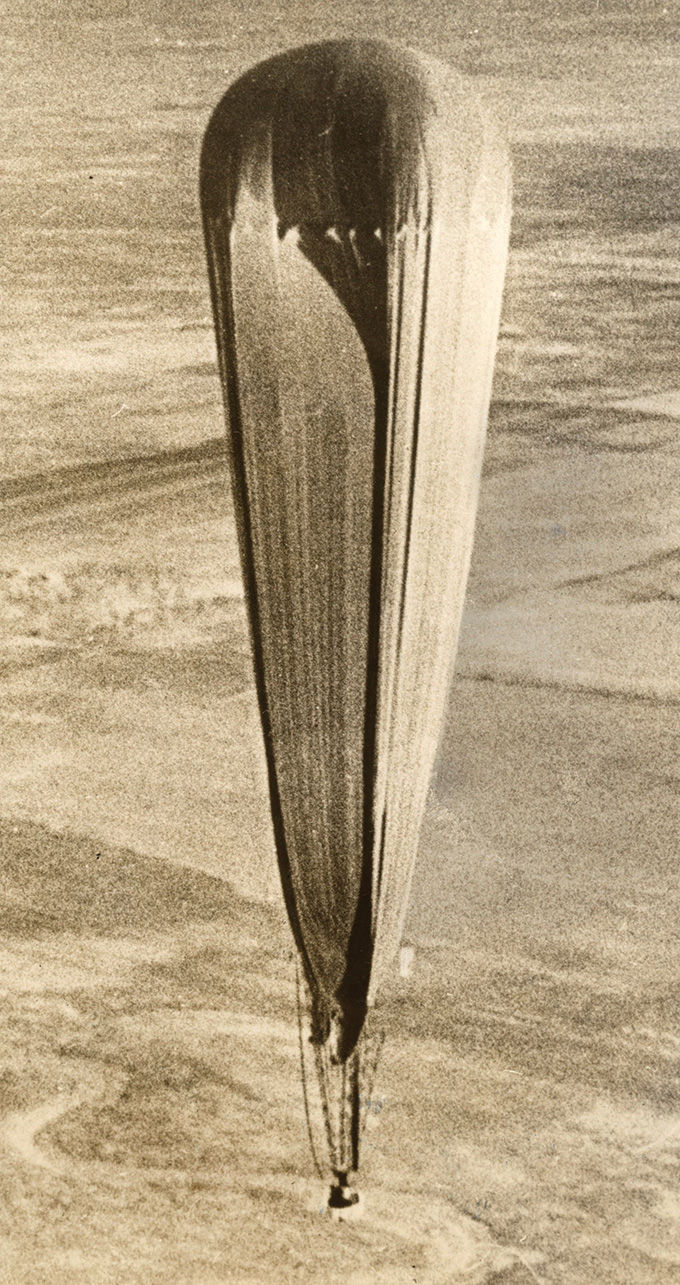
In 1935, the U.S. Army Air Corps launched a helium balloon over the Black Hills in South Dakota. It reached 22 kilometers (14 miles) high, a world record. Two pilots went along in a pressurized gondola. They recorded air temperatures, magnetic fields, radiation levels and more. They also dropped a sterile sampling device designed to collect airborne microbes on its way down. After falling halfway, it closed and parachuted the rest of the way to Earth.
Scientists later grew 10 types of bacteria and fungi from that sample. But this was before scientists discovered DNA. So they never learned much more than the shapes of these mystery cells, the conditions they had survived and what nutrients they needed to grow.
Nearly four decades later, Soviet scientists launched rockets with sticky microbe collectors 48 to 77 kilometers (30 to 48 miles) into the mesosphere. It’s the layer just above the stratosphere. Those collectors parachuted back with a few living cells stuck on them. These, too, grew in the lab.
“But there’s just no way to know what [the Soviets had] sampled,” Christner says. The microbes could have been contamination from the ground. He doesn’t believe that the scientists actually found something alive at that altitude.
More recent U.S. studies started in the early 2000s.
NASA was flying a plane 20 kilometers (12 miles) up to collect cosmic dust. Its goal was to study the history of our solar system. Microbiologist Dale Griffin then worked for the U.S. Geological Survey in St. Petersburg, Fla. He arranged for sticky microbe-catchers to fly on several missions between 2003 and 2008.
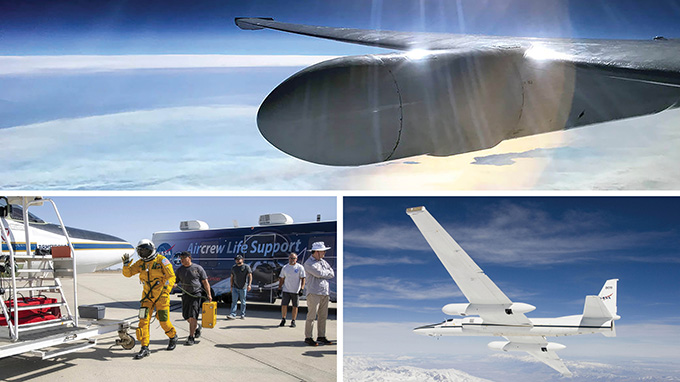
Griffin grew several types of bacteria from those samples. He also performed a simple test on them, called genetic barcoding. It looks at a short part of a single gene. From this, biologists can get a general idea of a life form’s family or genus. And these microbes, he realized, were related to several known from remote islands and volcanic soils.
Perhaps, Griffin thought, eruptions lofted them high into the air.
The Russian and NASA findings were based on what they learned from growing sampled microbes in the lab. Yet scientists can’t grow 99 percent of the microbes that exist most places. They just can’t recreate the environments these cells need to grow.
As such, those early tests couldn’t measure how many living cells were in the stratosphere. They usually couldn’t identify the species. The scientists didn’t even test whether these microbes could survive stratosphere-like temps, dryness or UV radiation.
And they never learned the lifestyles of these microbes on Earth’s surface — whether they lived on plants, slurped raw sewage or grew in the armpits of NFL linebackers.
At last: Tallying living space microbes
Christner was at Louisiana State University in Baton Rouge (LSU) when he and Bryan began their search for life in the stratosphere. They planned to start low and sample higher and higher. They would try to grow the cells they collected, as others had. But they would also do something new: count the total number of living cells at these altitudes.
They expected that at some height, the number of living cells would drop to zero. This would mark the outer limit of life on Earth.
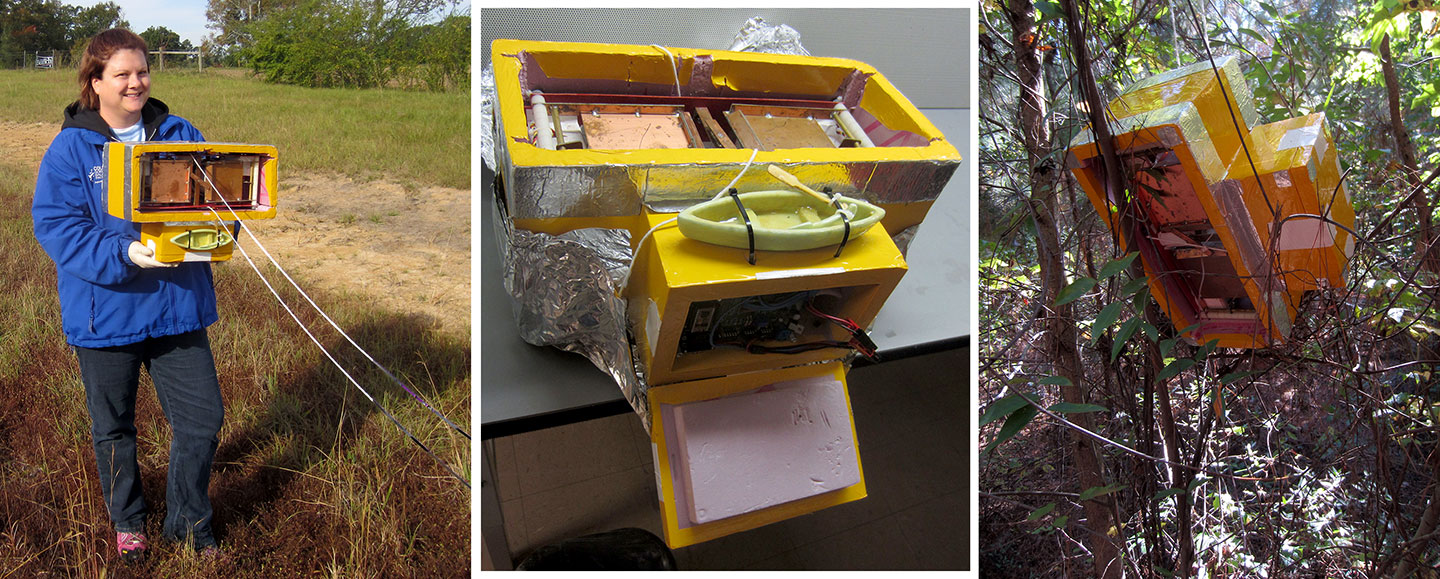
Bryan built her first collectors from Styrofoam and balsa wood, purchased at hobby and hardware stores. She dangled these homemade gizmos from helium balloons launched in Texas and Louisiana. Each collector had a control chamber that didn’t open during the flight. This helped her estimate how much her samples were contaminated with ground-level germs. Eventually, she got that contamination down to almost zero.
Launch and landing
Noelle Bryan (left) preparing to launch one of her early germ catchers on a balloon over Louisiana on October 30, 2011. She built this early device mostly with foam and balsa wood (middle), making it light enough that even small balloons could lift it as high as 24 kilometers (15 miles). The model boat was added for good luck (in case her package landed in a lake, as sometimes happened.) On this day, it landed in a tree (right), with its sample safe inside.
In 2013, Bryan started using a more advanced system. It was developed by LSU engineer T. Gregory Guzik. Its sturdy circuits allowed it to reach even greater heights. (In the mid-stratosphere, electricity can arc from one wire to another, damaging circuits.)
Bryan and Guzik used this system in a key series of balloon launches over Fort Sumner. This little town crouches amid a dry plain of grass and yucca in eastern New Mexico. The 19th-century gunslinger Billy the Kid is buried in a cemetery at one end of town.
The samples that Bryan collected here would be the final ones for her PhD research. They would also reveal some major surprises.
On the morning of August 21, 2013, Bryan, Guzik and several others wore hard hats as they emerged from a hangar at the local airport. They grasped the tether of a round, white helium balloon the size of a small elephant. It bobbed and tugged impatiently as they walked into an open field.
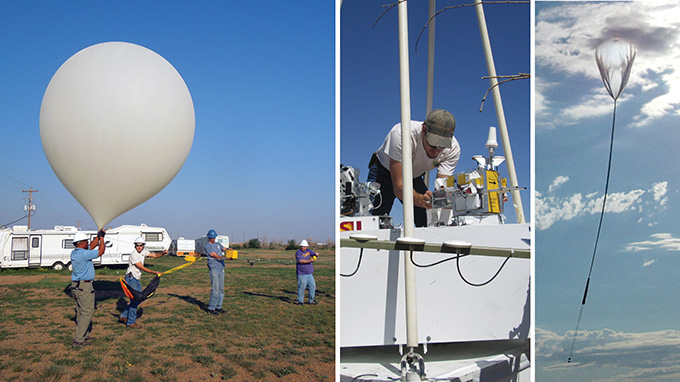
Then, they let it go.
A downward-pointing camera captured video as it surged upward.
At one point, a large jet streaked by far below, tiny and silent.
Later, the balloon was tossed by violent winds as it entered the stratosphere. At 18 kilometers (11 miles), an electric motor opened one of two collectors. It exposed a sticky surface to the air.
Catch!
Left: A germ catcher Bryan used in 2013 (captured here by a downward-pointing camera during a flight over Fort Sumner, N.M.). The device has two identical sealed boxes, one on each side. One opens and closes at preset altitudes to collect microbes. The other doesn’t open. That way, scientists could later see if their boxes had any contamination before launch.
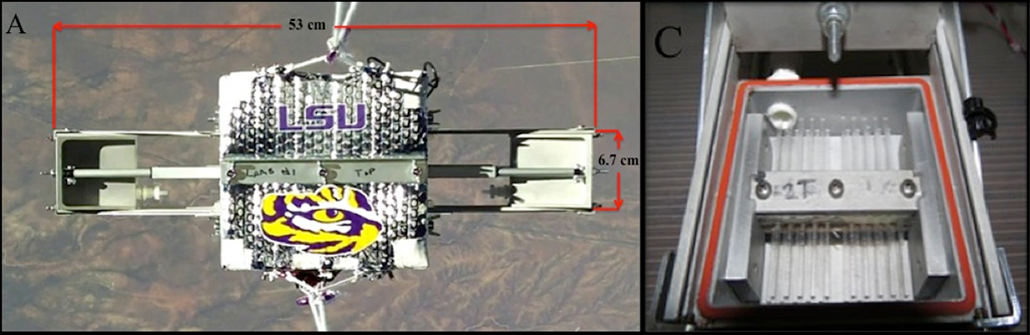
Right: A view inside one of Bryan’s germ collectors shows two rows of small plastic rods coated in oil. That oil captures airborne cells that bump into it on its way down through the atmosphere.
Minutes later, as the balloon ascended past 23 kilometers (14 miles), the collector closed. An electric heating coil severed the tether. This sent the balloon’s payload parachuting back to Earth. Using a GPS tracker, Bryan drove to where the collector had landed between a yucca and a prickly pear cactus.
In all, the team launched six balloons over three weeks. Some reached as high as 29 kilometers (18 miles). A seventh launch, on a larger NASA balloon, reached 38 kilometers (24 miles).
Microbes in living color
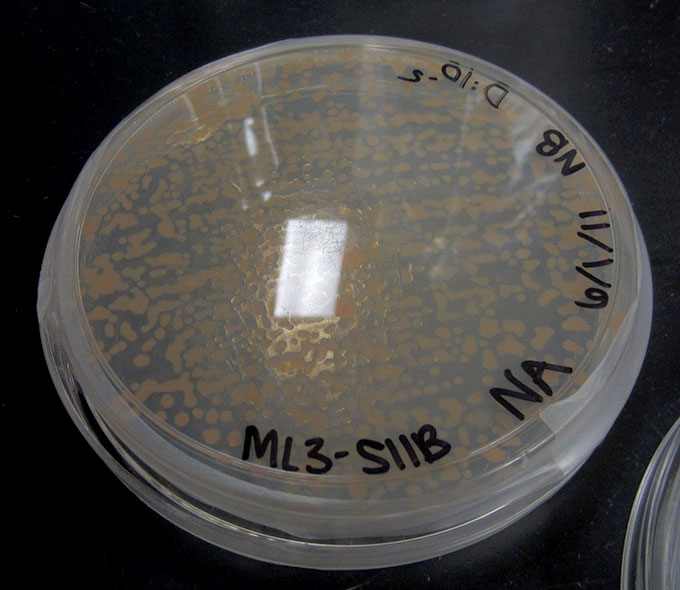
Bryan spent months growing her samples. The one from August 21 spawned a glistening orange colony of bacteria. She named it L6-1.
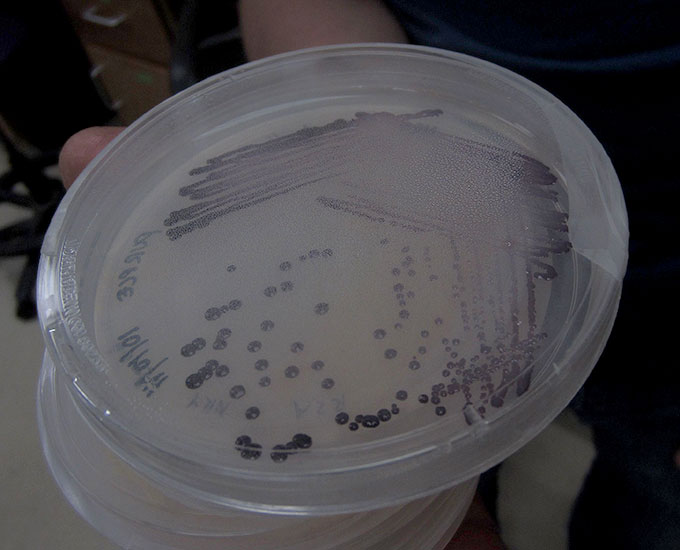
Samples from other launches grew into yellow, pink and black colonies. The colors likely came from protective pigments that shield the microbes against harmful UV light.
Bryan assumed that these still-unidentified cells would turn out to be tough cookies. For example, some bacteria can form dry spores that survive boiling. But as she isolated and barcoded the cells’ DNA, a very different picture emerged.
These cells “should have been nothing but spore-formers,” Bryan says. They “should have been nothing but extremophiles.” But only one out of a dozen or so bacteria were.
L6-1 and several others belonged to a genus often found on plants: Curtobacterium. Others belonged to groups that live in soil. The fact that these critters came from such everyday places posed a mystery that Bryan desperately wanted to solve.
Stratosphere samples
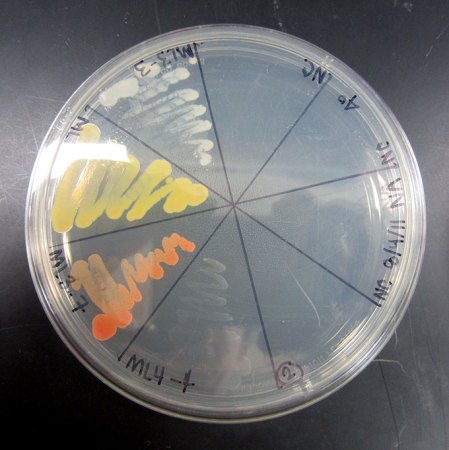
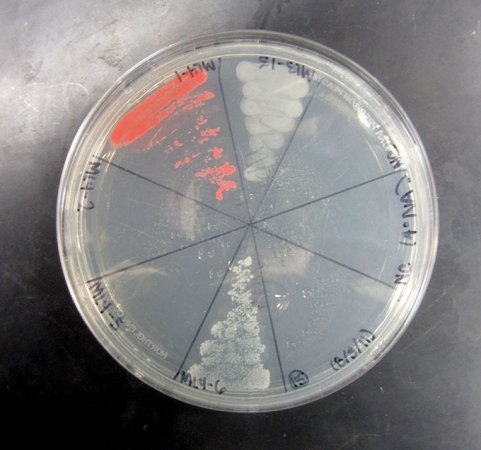
Petri dishes of bacteria that Bryan initially isolated from altitudes of 18 to 24 kilometers (11 to 15 miles). These colonies are often either brightly colored or dark colored. Their hues reveal pigments that the cells use to avoid harm from intense ultraviolet radiation, which is plentiful in Earth’s stratosphere.
Radiation? No biggie
Bryan spent most of 2014 and 2015 running lab experiments. From these, she estimated that at 24 kilometers (15 miles) up, each cubic meter (m3) of air held about 100,000 living cells. At 36 kilometers (22 miles), the air still held nearly 8,000 cells/m3.
In 2016, Bryan exposed her stratospheric cells to UV-C radiation to see how tough they were. These wavelengths of ultraviolet light kill cells better than the UV-A and UV-B types that cause sunburns. UV-C is absent at Earth’s surface, because the ozone layer blocks it. But this radiation is plentiful in the mid-stratosphere.
In these experiments, Bryan compared her stratospheric germs to a bacterium called Deinococcus radiodurans (Dye-noh-KOK-us Ray-dee-oh-DUR-uns). It is said to be the toughest organism on Earth. It can survive roughly 1,000 times the gamma radiation needed to kill a human. It’s also uniquely resistant to UV-C radiation.
Tough stuff
Some microbes found living in the stratosphere proved about as resistant to ultraviolet radiation as the hardy bacterium Deinococcus radiodurans (left).
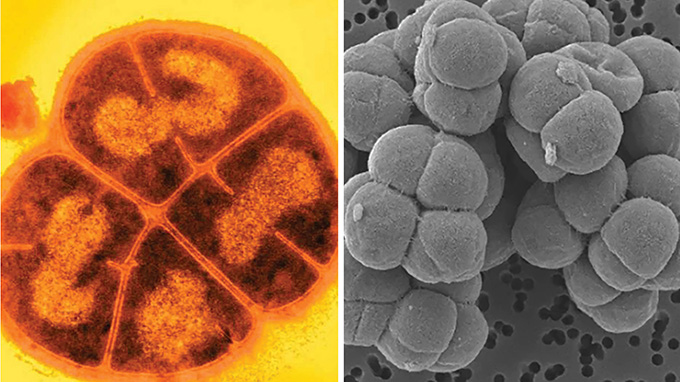
None of the germs isolated from Earth’s stratosphere would likely survive on Mars. They need oxygen, which Mars’ atmosphere lacks. But Methanosarcina barkeri (right) might make it on the Red Planet. It thrives without oxygen in sewage and landfills. In the lab, it can tolerate extremely low-pressure and oxygen-free conditions, like those on Mars.
Surprisingly, her L6-1 cells tolerated UV-C just as well as D. radiodurans did. Some of her other plant and soil bacteria from the stratosphere weren’t far behind. Bryan was shocked to see this. “I [fudged] up,” she remembers thinking.
Bryan repeated the experiments over many months, looking for mistakes she might have made. But her results never changed.
As the team realized the results were actually correct, it “all sort of came together,” Christner recalls. These plant-dwelling bacteria had a secret talent: They could survive, at least briefly, on the edge of space.
Were these cells infectious?
Bryan got her PhD in 2017. (She now works at Mass General Brigham in Boston, Mass.) Around that same time, Christner moved to the University of Florida. There, he began looking into a strange question.
Bryan’s DNA barcoding had showed that L6-1 and several of the other stratospheric bacteria were closely related to a germ that sickens crops. It’s called Curtobacterium flaccumfaciens. From the 1920s to the 1970s, it had browned and wilted Midwestern bean fields. After disappearing for a while, C. flaccumfaciens reemerged around 2003.
Christner and Bryan wondered: Did L6-1 also cause disease?
“Plant pathogens in the stratosphere — that was the furthest thing that
Brent Christner
we expected to run into.”
To find out, Christner teamed up with two plant pathologists. Brian Kvitko works at the University of Georgia in Athens. Robert Harveson is at the University of Nebraska in Scottsbluff. Last year, they reported that L6-1 really does cause bean plants to yellow and wilt. So do two other Curtobacterium microbes that Bryan collected from as high as 29 kilometers (18 miles).
Adam Ellington was a graduate student in Christner’s lab in Florida. In 2020, he sequenced the full genome of L6-1. This showed it to be a new species. It also was a genetic match for an unidentified germ that Harveson had isolated from diseased millet years earlier.
Christner’s group described it in Microbiology Spectrum in 2025. They named it C. aetherium.
“Plant pathogens in the stratosphere — that was the furthest thing that we expected to run into,” Christner says.
Harveson, a Curtobacterium expert, had long thought this germ spread through infected seeds. Learning that at least some members of its genus could survive high in the atmosphere stunned him. This discovery, he says, could “change our thought processes about movement of diseases.”
Do you have a science question? We can help!
Submit your question here, and we might answer it an upcoming issue of Science News Explores
Life finds a way
By flying through the atmosphere, a microbe could cross oceans and drop into new ecosystems. A pathogen like C. aetherium could escape regions where plants had become resistant to it and land on new hosts.
Leaf-dwelling bacteria are known to experience frequent drying. This can damage their DNA in a manner similar to radiation. So some of these microbes have evolved ways to repair their DNA fairly well. Such tricks might help them survive other harsh conditions, too.
Leaf bacteria can also enter the air with surprising ease.
One 1982 study showed that during each hour on a warm day, 20 billion or so cells per hectare (50 billion per acre) enter the air from an alfalfa field. Breezes and rising warm air may loft most of these. Bacteria may even encourage this by clumping onto tiny leaf hairs where air currents can more easily lift them.
Once microbes are aloft, big thunderstorms, dust storms, hurricanes and volcanic eruptions can lift them into the upper atmosphere. Smoke plumes from large wildfires can also ferry billions of live cells into the air.
Ellington’s work suggested that C. aetherium could have started as one of these leaf-squatters. Over time, as it got lofted higher, it could have evolved new traits to survive extreme altitudes.
He learned this by studying a Curtobacterium species that has never been found in the atmosphere. When exposed to UV-C, it quickly adapted. This indicates that some plant-dwelling bacteria already have a flair for evolving strong radiation resistance.
Ellington also found that UV-C radiation turns on several DNA-repair enzymes in C. aetherium. One of them repaired an unusual type of UV damage. This type occurs only when a cell is so dehydrated that its DNA folds into a somewhat different structure. Cells drifting in the stratosphere are very dried out. So their DNA might actually fold this way, Ellington notes. Having this enzyme might allow them to repair a type of DNA damage that often happens up there.
Still, many mysteries remain.
Bryan was able to grow only 12 or so species of bacteria from the stratosphere. For every type that did grow in the lab, 100 to 1,000 others might have also been present and alive. They might not have grown for Bryan simply because she didn’t provide them with the right conditions.
Burak Erkorkmaz wonders about these other microbes.
“The next question would be to understand the whole community” up there, he says. He’s a microbiologist at the University of Gothenburg in Sweden. He’d like to take those thousands of live cells per cubic meter of stratospheric air and sequence all of their genomes. It would provide a fuller picture of the diversity of species there. It also could hint at whether they, too, carry genes for surviving high altitudes.
Erkorkmaz and other scientists have already started doing this with airborne cells caught a few meters above the ground.
Most aerial microbes likely never reach the stratosphere. They probably travel at lower altitudes, where conditions are milder. But finding even a few microbes alive in the stratosphere has huge implications. It might hint at whether microbes can survive in other worlds (see sidebar).
Many years may pass before these lessons from Earth’s stratosphere are applied to the search for extraterrestrial life. But for Bryan, the excitement of it began years ago when she made her first shopping trips to buy materials for her germ catchers.
“It was space exploration,” she says. “It was uncharted territory.”
📚 NCsolve - Your Global Education Partner 🌍
Empowering Students with AI-Driven Learning Solutions
Welcome to NCsolve — your trusted educational platform designed to support students worldwide. Whether you're preparing for Class 10, Class 11, or Class 12, NCsolve offers a wide range of learning resources powered by AI Education.
Our platform is committed to providing detailed solutions, effective study techniques, and reliable content to help you achieve academic success. With our AI-driven tools, you can now access personalized study guides, practice tests, and interactive learning experiences from anywhere in the world.
🔎 Why Choose NCsolve?
At NCsolve, we believe in smart learning. Our platform offers:
- ✅ AI-powered solutions for faster and accurate learning.
- ✅ Step-by-step NCERT Solutions for all subjects.
- ✅ Access to Sample Papers and Previous Year Questions.
- ✅ Detailed explanations to strengthen your concepts.
- ✅ Regular updates on exams, syllabus changes, and study tips.
- ✅ Support for students worldwide with multi-language content.
🌐 Explore Our Websites:
🔹 ncsolve.blogspot.com
🔹 ncsolve-global.blogspot.com
🔹 edu-ai.blogspot.com
📲 Connect With Us:
👍 Facebook: NCsolve
📧 Email: ncsolve@yopmail.com

😇 WHAT'S YOUR DOUBT DEAR ☕️
🌎 YOU'RE BEST 🏆