
Each summer, some people seem to get eaten alive by mosquitoes. Others sail through the season with nary a bite. Who those bloodsuckers prefer could trace to our body chemistry and which microbes live on our skin, a new study finds. And their taste preferences seem to vary by species.
Knowing how mosquitoes pick their human snacks could help prevent disease. With each bite, mosquitoes can spread illnesses that they may have picked up from an earlier blood meal, such as dengue and Zika.
“We want to understand what people’s risks are for being bitten,” says Matthew DeGennaro. He thinks the answer might be in the molecules — and the bacteria — found on our skin. DeGennaro works at Florida International University in Miami. There he studies how genetics influences the nervous system.
Scientists might use information from the new study to one day make someone’s smell less attractive to mosquitoes. Indeed, this could lead to new types of mosquito repellents, says DeGennaro.
A human buffet
Mosquitoes find meals using visual and scent cues (as well as their victims’ heat signatures). More than a thousand chemicals can go into making an individual’s scent. So it’s hard to know which most affect mosquitoes’ preferences as they search for their next blood meal. To figure this out, DeGennaro and his co-workers recruited 119 human targets.
Three species of mosquitoes sampled each volunteer’s unique scent. Scientists used a device that let caged mosquitoes smell these people but not bite them.
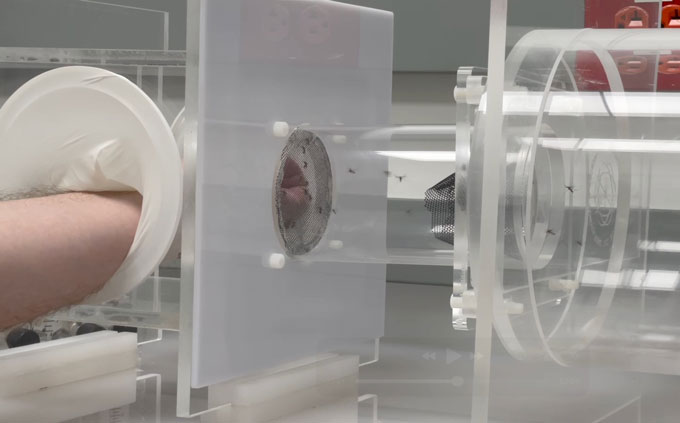
Aedes aegypti and Aedes albopictus mosquitoes feed by day. So volunteers could come to the lab during the day, place their arm inside the device and get sniffed. That wouldn’t work for Culex quinquefasciatus. Those bloodsuckers come out to feed only at night. To collect the volunteers’ scent for this species, each recruit had to wear a nylon sleeve for several hours. Then, at night, the researchers placed that sleeve into the device.
Scientists counted how many mosquitoes of each species entered the device to check out each person’s scent. That let them gauge how attracted they were to each human’s smell. They shared their findings August 21 in the journal iScience.
A matter of taste
Each species preferred a different mix of volunteers. Some people were attractive to more than one species of mosquito. But no one person was the favorite of all three species.
Scientists have wondered why we might smell tasty to one mosquito species but not another. So the Florida group sampled chemical vapors in the air around each person’s arm. Then, they looked for which ones were found on the volunteers who were most attractive — or least attractive — to each species.
Ae. aegypti and C. quinquefasciatus were more attracted to people who had less skin odor. Ae. albopictus was attracted to 13 chemicals that smell like plants. The different preferences suggest each species might have evolved its own way of finding a meal.
Many things could have influenced this, says Alicia Showering. These might include which animal hosts each species feeds on or what time of day the mosquitoes look for food. Showering runs BugBiome, a company based in Norwich, England. It develops insecticides from microbes that live on plants.
Human odor is very complex. That makes it difficult to detect every chemical in it, says Maria Elena De Obaldia. So there might be other attractive compounds the scientists didn’t turn up here, she says. In the past, De Obaldia has studied mosquitoes’ attraction to human scents. Now she works at Regeneron Pharmaceuticals. That’s a drug company in Tarrytown, N.Y. (Regeneron is a major financial supporter of the Society for Science, which publishes Science News Explores.)
A whiff of bacteria
Microbes produce many of the chemicals that make up our scent. So DeGennaro’s team also swabbed each volunteer’s skin for some of the bacteria living on it. Certain of these bacteria were attractive to all three species, they found.
The team now wants to focus on these skin bacteria, says Kaylee Marrero. She studies mosquito behavior at Florida International University and was the new study’s lead author. Her group wants to learn how skin bacteria make those smelly compounds that affect mosquitoes’ preferences. That might lead to microbe-based repellents. Or, Marrero adds, the most attractive chemicals could help design scented lures to bring mosquitoes into traps.
“We’re all trying to figure out how to stop people from getting sick,” Marrero says. “Figuring out why [mosquitoes] are biting people is the best way to do that.”
📚 NCsolve - Your Global Education Partner 🌍
Empowering Students with AI-Driven Learning Solutions
Welcome to NCsolve — your trusted educational platform designed to support students worldwide. Whether you're preparing for Class 10, Class 11, or Class 12, NCsolve offers a wide range of learning resources powered by AI Education.
Our platform is committed to providing detailed solutions, effective study techniques, and reliable content to help you achieve academic success. With our AI-driven tools, you can now access personalized study guides, practice tests, and interactive learning experiences from anywhere in the world.
🔎 Why Choose NCsolve?
At NCsolve, we believe in smart learning. Our platform offers:
- ✅ AI-powered solutions for faster and accurate learning.
- ✅ Step-by-step NCERT Solutions for all subjects.
- ✅ Access to Sample Papers and Previous Year Questions.
- ✅ Detailed explanations to strengthen your concepts.
- ✅ Regular updates on exams, syllabus changes, and study tips.
- ✅ Support for students worldwide with multi-language content.
🌐 Explore Our Websites:
🔹 ncsolve.blogspot.com
🔹 ncsolve-global.blogspot.com
🔹 edu-ai.blogspot.com
📲 Connect With Us:
👍 Facebook: NCsolve
📧 Email: ncsolve@yopmail.com

😇 WHAT'S YOUR DOUBT DEAR ☕️
🌎 YOU'RE BEST 🏆