
The secret to making some household products more eco-friendly may lurk in our own guts.
Many medicines, cosmetics and cleaning products are made with medium-chain carboxylic acids, or MCCAs. These chemical ingredients usually come from palm and coconut oil. But growing those crops has downsides for the environment. It often requires chopping down trees to clear land for farming. That destroys the homes of many wildlife species, leading to biodiversity loss.
“The major problem right now is how unsustainable the production of these chemicals are,” says Ian Gois. He’s a microbiologist at the University of Toronto in Canada. But some bacteria that dwell in the guts of humans and other animals produce MCCAs, Gois notes. They could be harnessed to make these chemicals in a greener way.
One group of handy microbes are chain-elongating bacteria. These microbes can munch on small molecules and spit out bigger ones. But they don’t always spit out compounds big enough to be MCCAs. Those molecules all feature strings of six to eight carbon atoms.
The compounds that the bacteria pump out depend on what foods the microbes consume. And the ratio, or relative amounts, of different foods can impact the lengths of the molecules they create, Gois says. The exact conditions to coax bacteria into making MCCA-length molecules haven’t been clear.
Gois’ team set out to investigate this. They fed microbes different ratios of foods. Then, they tracked what molecules the microbes made. The two foods the team focused on were acetate and lactate. These small molecules form when organic, or carbon-based, materials break down. They can come from plant or animal matter that gets tossed in the trash.
With lower amounts of acetate, some bacteria made longer molecules, including MCCAs. The team watched how the process played out in cells. They made some acetate with carbon atoms that are heavier than usual. That allowed them to track where the acetate went. It showed that one type of chain-elongating bacteria grabbed less acetate from the environment. This microbe could use lactate to make acetate, Gois says. When it did, this microbe made more MCCAs.
The scientists shared their findings in the June issue of Nature Microbiology.
This knowledge could help people put chain-elongating bacteria to work, Gois says. It could also help engineers tweak the genes of microbes to make them even better at making useful molecules.
In this study, the researchers fed their bacteria specific amounts of certain molecules. But others on Gois’ team are now studying how microbes could make valuable chemicals from food waste. These waste-fed microbes might not only be able to make MCCAs typically drawn from palm and coconut oil. They might also be used to make chemicals that normally come from fossil fuels, Gois says. That could help reduce the use of fossil fuels that contribute to climate change.
Microbes are “cool and versatile,” Gois says — and we’re going to need them as our allies in dealing with climate change.
Busy bacteria
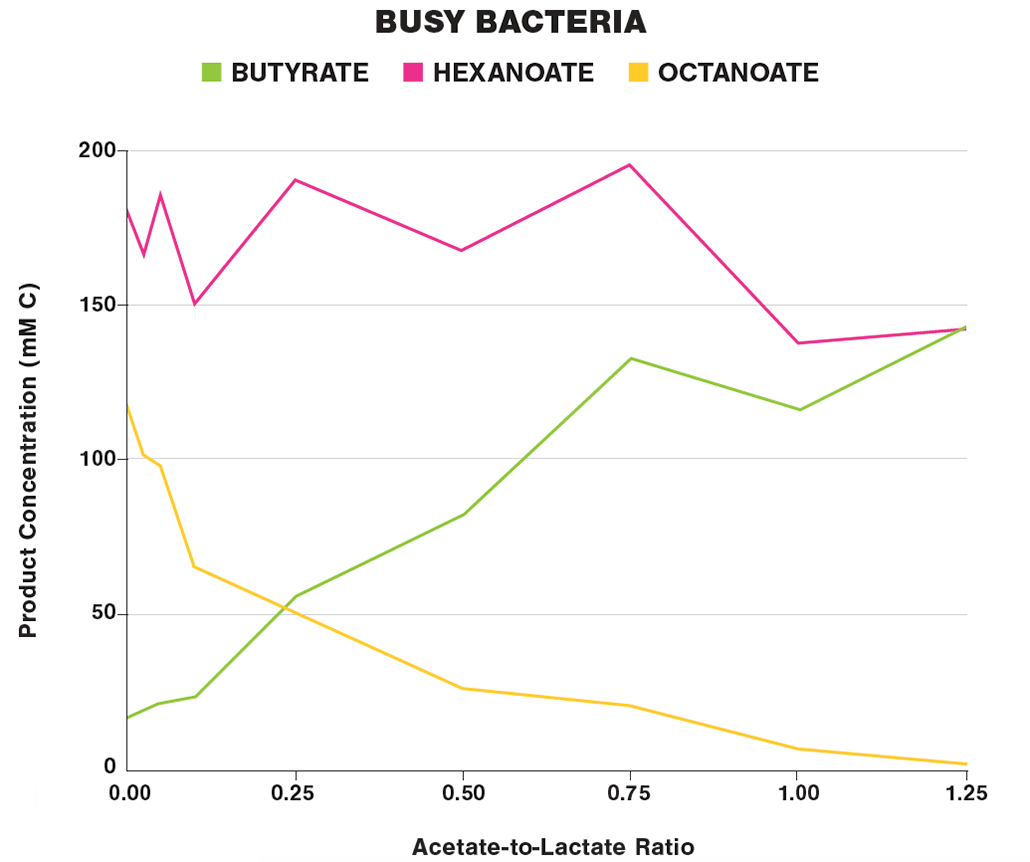
Pseudoramibacter alactolyticus bacteria can use small molecules — such as acetate and lactate — to make larger molecules. Butyrate has four carbons. Hexanoate has six. Octanoate has eight. That makes hexanoate and octanoate MCCAs, which are valuable ingredients for making household products. Researchers fed P. alactolyticus different amounts of acetate and lactate. On the graph, the lowest amount of acetate is on the left and increases along the x-axis. The y-axis shows the concentration of carbon contributed by each compound produced by bacteria (in millimoles of carbon).
I.M. Gois et al/Nature Microbiology 2026
Data Dive:
- At what acetate-to-lactate ratio is the most hexanoate made?
- As the ratio increases, what happens to the concentration of butyrate?
- As the ratio increases, what happens to the concentration of octanoate?
- If researchers wanted to get the most octanoate and hexanoate, what ratio of microbe foods should they use?
📚 NCsolve - Your Global Education Partner 🌍
Empowering Students with AI-Driven Learning Solutions
Welcome to NCsolve — your trusted educational platform designed to support students worldwide. Whether you're preparing for Class 10, Class 11, or Class 12, NCsolve offers a wide range of learning resources powered by AI Education.
Our platform is committed to providing detailed solutions, effective study techniques, and reliable content to help you achieve academic success. With our AI-driven tools, you can now access personalized study guides, practice tests, and interactive learning experiences from anywhere in the world.
🔎 Why Choose NCsolve?
At NCsolve, we believe in smart learning. Our platform offers:
- ✅ AI-powered solutions for faster and accurate learning.
- ✅ Step-by-step NCERT Solutions for all subjects.
- ✅ Access to Sample Papers and Previous Year Questions.
- ✅ Detailed explanations to strengthen your concepts.
- ✅ Regular updates on exams, syllabus changes, and study tips.
- ✅ Support for students worldwide with multi-language content.
🌐 Explore Our Websites:
🔹 ncsolve.blogspot.com
🔹 ncsolve-global.blogspot.com
🔹 edu-ai.blogspot.com
📲 Connect With Us:
👍 Facebook: NCsolve
📧 Email: ncsolve@yopmail.com

😇 WHAT'S YOUR DOUBT DEAR ☕️
🌎 YOU'RE BEST 🏆