
Students often refer to Class 9 Maths Notes and Chapter 12 Quadrilaterals Class 9 Ganita Manjari Notes during last-minute revisions.
Class 9 Maths Chapter 12 Quadrilaterals Notes
Class 9 Maths Ganita Manjari Chapter 12 Notes
Ganita Manjari Class 9 Chapter 12 Notes
→ Quadrilateral: For four distinct points A, B, C, D in a plane with no three collinear, the quadrilateral ABCD is a collection of all points on segments AB, BC, CD, DA provided every point other than A, B, C, and D lies on exactly one of these four segments.
→ A quadrilateral is convex when all of its internal angles are less than 180°, or equivalently, when its diagonals intersect.
→ The following converse statements about parallelograms are true:
→ If the opposite sides of a 4-gon are equal, then it is a parallelogram.
→ If the opposite angles of a 4-gon are equal, then it is a parallelogram.
→ If the diagonals of a 4-gon bisect each other, then it is a parallelogram.
→ If a pair of opposite sides of a 4-gon are equal and parallel, then it is a parallelogram.

→ The Midpoint Theorem: the line joining the two midpoints of any two sides of a triangle is parallel to the third side and has half the length of the third side.
→ A Converse to the Midpoint Theorem: the line passing through the midpoint of a side of a triangle and parallel to a second side bisects the third side.
→ Medians of a triangle are concurrent and the point of concurrence, called the centroid, divides each median in a 2 : 1 ratio.
→ The 4-gon formed by joining the midpoints of a given 4-gon is always a parallelogram.
→ The plane can be tiled with any given 4-gon.
→ Suppose A, B, C, D are four points not lying in the same plane. Then the points on the four segments AB, BC, CD and DA are said to form non-planar quadrilateral ABCD.
→ Suppose A, B, C, D are four points in a plane. Then the points on the four segments AB, BC, CD and DA is called a planar quadrilateral.
→ A quadrilateral is called a simple quadrilateral if every point on the quadrilateral, other than the vertices, lies on exactly one of the sides of the quadrilateral.
→ A quadrilateral is called a self-intersecting quadrilateral if there exists a point on the quadrilateral, other than the vertices, which lies on more than one side of the quadrilateral.
→ A quadrilateral is called a convex quadrilateral if its each internal angle is less than 180°.
→ A quadrilateral is called a non-convex quadrilateral if it has one internal angle more than 180°.
→ A quadrilateral is a parallelogram if its opposite sides are parallel.
→ Properties of Parallelograms
(a) The opposite sides of a parallelogram are equal.
(b) The opposite angles of a parallelogram are equal.
(c) The diagonals of a parallelogram bisect, each other.
The converses of above properties are true.
→ A pantograph is a mechanical linkage system shaped like a parallelogram that copies lines, drawings or movements at a larger, smaller or identical scale.
→ Midpoint Theorem: The segment joining the midpoints of two sides of a triangle is parallel to the third side and has half the length. The converse of the Midpoint Theorem is also true.
→ Centroid Theorem: The three medians of ΔABC pass through a common point, which divides each of the medians in the ratio 2 : 1, with the longer part connecting the vertex. This common point is called the centroid of the ΔABC.
→ The quadrilateral formed by joining the midpoints of a given quadrilateral is always a parallelogram. This parallelogram is called the Varignon parallelogram of the given quadrilateral.
→ Any plane surface can be tiled with any number of quadrilateral tiles of identical shape.
What Exactly is A Quadrilateral?
Suppose A, B, C, D are four distinct points not lying in a same plane. Then the points on the four segments AB, BC, CD and DA are said to form non-planar or skew quadrilateral ABCD. The points A, B, C and D are called the vertices of the quadrilateral ABCD. The segments AB, BC, CD and DA are called the sides or edges of the quadrilateral ABCD. For example, ABCD is a non-planar quadrilateral in Figure.
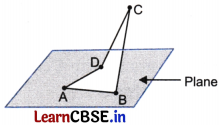
Here points A, B, and D are in. a plane and the point C is not in the plane of A, B and D. Suppose A, B, C, D are four distinct points in a plane. Then the points on the four segments AB, BC, CD and DA are said to form planar quadrilateral ABCD.
Let ABCD be a planar quadrilateral. The shape of the quadrilateral ABCD can be any one of the following:
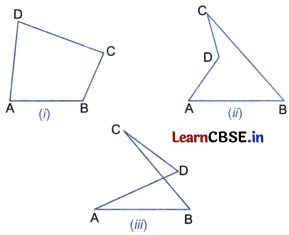
In the rest of the chapter, we shall be confining only to planar quadrilaterals.
Thus, we shall write the word ‘quadrilateral’ to mean a ‘planar quadrilateral’.
Types of Quadrilaterals
The quadrilaterals are of two types:
(i) Simple Quadrilateral: A quadrilateral is called a simple quadrilateral if every point on the quadrilateral, other than the vertices, lies on exactly one of the four sides of the quadrilateral.
For example, ABCD is a simple quadrilateral in figure.
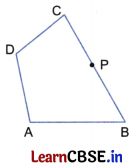
In this simple quadrilateral, the point P of the quadrilateral is only on one side BC.
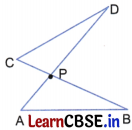
(ii) Self-intersecting Quadrilateral: A quadrilateral is called a Self-intersecting Quadrilateral if there exists a point on the quadrilateral, other than the vertices, which lies on more than one side of the quadrilateral.
For example, ABCD is a self-intersecting quadrilateral in figure.
In this self-intersecting quadrilateral, the point P of the quadrilateral lies on two sides BC and DA.
In general, we shall be considering only simple quadrilaterals.
Thus, for all practical purposes, ‘simple quadrilateral’ is just referred as ‘quadrilateral’.
Parts of a Quadrilateral
Let ABCD be a quadrilateral i.e. a simple quadrilateral. We know that A, B, C and D are the vertices of the quadrilateral ABCD and AB, BC, CD and DA are the sides or edges of the quadrilateral ABCD.
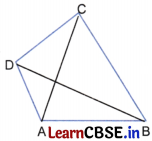
Segment AC and BD are called the diagonals of the quadrilateral ABCD.
Two endpoints of a side are called adjacent vertices.
For example, A and B are adjacent vertices.
Two sides with a common end-point are called adjacent sides.
For example, AB and BC are adjacent sides.
The angle formed at a vertex by a pair of adjacent sides is called an internal angle.
For example, ∠ABC is an internal angle. A quadrilateral has four internal angles.
Internal angles at adjacent vertices are called a pair of adjacent angles.
For example, ∠ABC and ∠BCD is a pair of adjacent angles.
A quadrilateral can be described by writing its vertices in various clockwise or anticlockwise orders.
For example, the quadrilateral ABCD can also be denoted as BCDA, CDAB, DABC, ADCB, BADC, CBAD or DCBA.
Convex Quadrilateral
A quadrilateral is called a convex quadrilateral if its each internal angle is less than 180°.
For example, ABCD is a convex quadrilateral in figure.
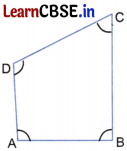
Here the internal angles ∠DAB, ∠ABC, ∠BCD and ∠CDA are all less than 180°.
Non-Convex (or Concave) Quadrilateral
A quadrilateral is called a non-convex (or concave) quadrilateral if it has one internal angle more than 180°.
For example, ABCD is a non-convex quadrilateral in figure.
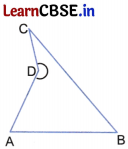
Here the internal angle ∠ADC is more than 180°.
Venn Diagram Representing Quadrilaterals
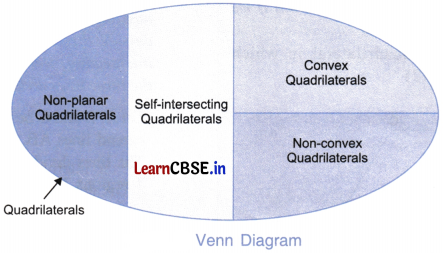
We know that a quadrilateral is either non-planar or planar. Also, a planar quadrilateral is either self-intersecting or simple. A simple quadrilateral is either convex or non-convex. Thus, the quadrilaterals can be classified as shown in the following diagram:
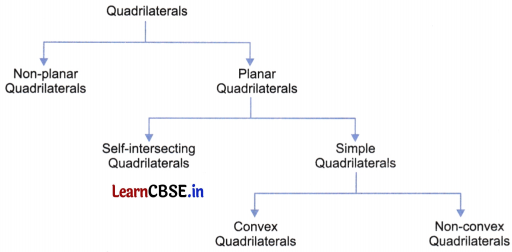
This classification of quadrilaterals can also be shown by using Venn diagram as follows:
Parallelograms
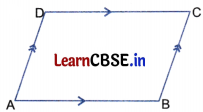
We know that a quadrilateral is called a parallelogram if its opposite sides are parallel.
In the figure, ABCD is a quadrilateral in which AB || DC and BC || AD and hence a parallelogram.
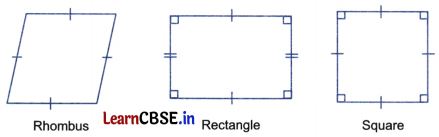
We also know that the class of parallelograms includes rhombuses, rectangles and squares as shown in Figure.
In the following theorem, we prove some properties of parallelograms.
Theorem 1:
(a) The opposite sides of a parallelogram are equal.
(b) The opposite angles of a parallelogram are equal.
(c) The diagonals of a parallelogram bisect each other.
Proof:
Transversal is a line that intersects two or more lines at different points.

(a) Let ABCD be a parallelogram.
Here, AB || DC and AC is a transversal.
∴ ∠BAC = ∠DCA (Alternate angles)
Also, BC || AD and AC is a transversal.
∴ ∠ACB = ∠CAD (Alternate angles)
In ∆ABC and ∆CDA, we have
∠BAC = ∠DCA, ∠ACB = ∠CAD and side AC is common.
∴ By ASA rule, ∆ABC ≅ ∆CDA
∴ AB = DC and BC = AD.
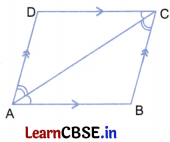
∴ Opposite sides are equal.
(b) Let ABCD be a parallelogram.
Here, AB || DC and AD is a transversal.
∴ ∠A + ∠D = 180° (Sum of adjacent angles of parallelogram is 180°)
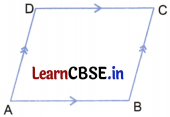
Also, BC || AD and AB is a transversal.
∴ ∠A + ∠B = 180° (Sum of adjacent angles of parallelogram is 180°)
∠A + ∠D = ∠A + ∠B
i.e. ∠D = ∠B
Similarly, ∠A = ∠C.
∴ Opposite angles are equal.
(c) Let ABCD be a parallelogram.
Join diagonals to meet at P.
AB || DC and AC is a transversal.
∴ ∠BAP = ∠DCP
Also, AB || DC and BD is a transversal.
∴ ∠ABP = ∠CDP
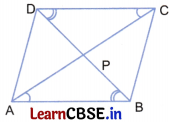
In ∆ABP and ∆CDP, we have
∠BAP = ∠DCP, AB = CD (By part (a))
and ∠ABP = ∠CDP.
∴ By ASA rule, ∆ABP ≅ ∆CDP.
∴ AP = CP i.e., P is the mid point of AC.
Similarly P is the mid point of BD.
∴ Diagonals AC and BD bisect each other.
Theorem 2:
If the opposite sides of a quadrilateral are of equal lengths, then it is a parallelogram (Converse of Theorem 1(a)).
Proof:
Let ABCD be a quadrilateral such that AB = DC and BC = AD.
In ∆ABC and ∆CDA, we have AB = DC, BC = AD and AC is common.
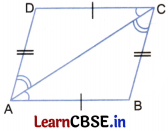
∴ By SSS congruence, ∆ABC ≅ ∆CDA.
∴ ∠BAC = ∠DCA
Since AC is a transversal, the lines AB and DC are parallel.
Also, ∠BCA = ∠DAC
Since AC is a transversal, the lines BC and AD are parallel.
∴ Opposite sides of the quadrilateral ABCD are parallel.
∴ ABCD is a parallelogram.
Theorem 3:
If the opposite angles of a quad-rilateral are equal, then it is a parallelogram. (Converse of Theorem 1(b)).
Proof:
Let ABCD be a quadrilateral such that ∠A = ∠C and ∠B = ∠D.
Let ∠A = x° and ∠B = y°
∴ ∠C = r° and ∠D = y°
We have ∠A + ∠B + ∠C + ∠D = 360°
∴ x° + y° + x° + y° = 360°
∴ 2(x° + y°) = 360° or x° + y° = 180°
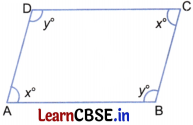
Since AB is a transversal and ∠A + ∠B = 180°, the lines AD and BC are parallel.
Also, BC is a transversal and ∠C + ∠B = 180°, the lines CD and AB are parallel.
∴ Opposite sides of the quadrilateral are parallel.
∴ ABCD is a parallelogram.
Theorem 4:
If the diagonals of a quadrilateral bisect each other, then it is a parallelogram. (Converse of Theorem 1(c)).
Proof:
Let ABCD be a quadrilateral and the diagonals AC and BD bisect each other at point P, say.
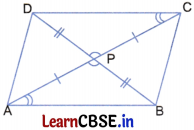
∴ AP = CP and BP = DP
Also, ∠APB = ∠CPD (Vertically opposite angles)
In ∆ABP and ∆CDP, we have
AP = CP, ∠APB = ∠CPD and BP = DP.
∴ By SAS rule, ∆ABP ≅ ∆CDP.
∴ ∠PAB = ∠PCD
Since AC is a transversal and ∠PAB = ∠PCD, lines AB and DC are parallel.
Similarly, we can show that the lines BC and AD are parallel by considering ∆BPC and ∆DPA.
∴ Opposite sides of the quadrilateral are parallel.
∴ ABCD is a parallelogram.
Theorem 2, Theorem 3 and Theorem 4 are respectively the converse of parts (a), (b), (c) of Theorem 1.
Theorem 5 (Equal parallel sides test):
A quadrilateral with one pair of equal and parallel opposite sides is a parallelogram.
Proof:
Let ABCD be a quadrilateral, where AB = DC and AB || DC.
Let the diagonals intersect at P.
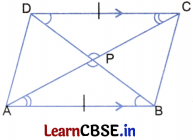
We have ∠ABP = ∠CDP (Alternate angles)
and ∠BAP = ∠DCP (Alternate angles)
In ∆APB and ∆CPD, we have
∠BAP = ∠DCP, AB = DC and ∠ABP = ∠CDP.
∴ By ASA rule, ∆APB ≅ ∆CPD.
∴ AP = CP and BP = DP
∴ Diagonals AC and BD bisect each other.
By using Theorem 4, the quadrilateral ABCD is a parallelogram.
Applications of Parallelograms
We have seen that parallelograms have very nice and important properties. In physics, very important results involving velocities and forces are derived by using parallelograms. The concept of parallelogram is also used in mechanical linkage system known as pantograph. Let us define a pantograph in a formal manner. A pantograph is a mechanical linkage system shaped like a parallelogram that copies lines, drawings or movements at a larger, smaller or identical scale.
A pantograph is a traditional manual tool made of four jointed arms used by map makers and artists to accurately enlarge or reduce drawings. The arms of a pantograph form a linked four-bar parallelogram for scissor-like mechanism designed to expand or compress.
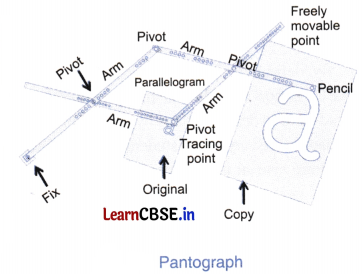
Parallelograms also serve as a powerful tool for proving very important properties of triangles.
An Important Property of Triangles
Draw a triangle ABC.
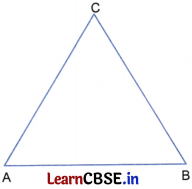
By using a tracing paper, draw a copy DEF of this triangle on another paper.
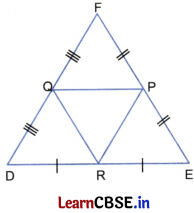
Using paper folding technique, find the midpoints of the sides of the triangle DEF.
Let the midpoints be P, Q and R. Join lines PQ, QR and PR.
Cut the triangle DEF along the lines to get 4 small triangles as shown in figure.

We observe the following properties:
1. All the four small triangles are congruent to each other.
2. The small triangles are similar to ∆ABC i.e. their angles are equal.
Theorem 6 (Midpoint Theorem):
The segment joining the midpoints of two sides of a triangle is parallel to the third side and has half the length.
Proof:
Let ABC be any triangle. Let P and Q be the midpoints of the sides AB and AC respectively.
Join PQ. We shall prove that PQ || BC and PQ = \(\frac {1}{2}\)BC.
From C, draw a line l parallel to BA.
Let line l intersect PQ produced at R.
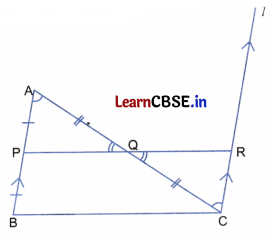
In ∆APQ and ∆CRQ, we have
∠PAQ = ∠RCQ (Alternate angles),
∠PQA = ∠RQC (Vertically opposite angles)
and AQ = CQ.
∴ By ASA rule, ∆APQ ≅ ∆CRQ.
∴ PQ = QR
∴ Q is the midpoint of PR and so PQ = \(\frac {1}{2}\)PR.
Also, CR = AP
∴ CR = BP (∵ AP = BP)
∴ BP || CR and BP = CR
∴ By equal parallel sides test, the quadrilateral BCRP is a parallelogram.
∴ PR || BC and PR = BC
∴ PQ || BC and PQ = \(\frac {1}{2}\)BC. (∵ PQ = \(\frac {1}{2}\)PR)
Hence the result holds.
Theorem 7 (Converse of the Midpoint Theorem):
The line drawn through the midpoint of one side of a triangle and parallel to another side bisects the third side (and the resulting segment has half the length of the parallel side).
Proof:
Let ABC be any triangle. Let P be the midpoint of the side AB.
Through P, draw a line parallel to BC and meeting AC at point Q.
We shall prove that AQ = QC and PQ = \(\frac {1}{2}\)BC.
From C, draw a line l parallel to BA.
Let line l intersect PQ produced at R.
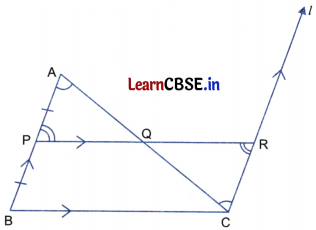
In quadrilateral BCRP, opposite sides are parallel.
∴ BCRP is a parallelogram.
∴ BP = CR and BC = PR
In ∆APQ and ∆CRQ, we have
AP = CR (∵ AP = BP = CR)
∠PAQ = ∠RCQ (Alternate angles)
∠APQ = ∠CRQ (Alternate angles)
∴ By ASA rule, ∆APQ ≅ ∆CRQ.
∴ AQ = QC, Q is the midpoint of AC.
Also, PQ = QR i.e. PQ = \(\frac {1}{2}\)PR.
∴ PQ = \(\frac {1}{2}\)BC. (∵ PR = BC)
∴ The result holds.
A Surprising Property of Medians
In a triangle, the line segment joining a vertex and the midpoint of the opposite side of the triangle is called a median of the triangle.
In the figure, ABC is a triangle. Let P, Q and R be the midpoints of the sides BC, CA and AB respectively. Join AP, BQ and CR.
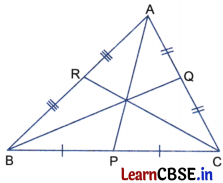
By definition, AP, BQ and CR are medians of ∆ABC. Every triangle has three medians. Students are advised to draw medians by taking different types of triangles. Every time, students would observe the following special properties of medians.
1. In any triangle, the three medians always pass through a common point i.e. the medians are always concurrent.
2. In any triangle, the point of concurrence of the medians divides each of the medians in the ratio 2 : 1, with the longer part connecting the vertex.
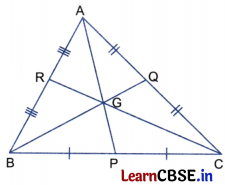
In ∆ABC, the medians are AP, BQ and CR.
We observe that all medians pass through a common point G, say.
Also, by measuring the segments, we can verily that AG is double of GP, BG is double of GQ and CG is double of GR.
In other words, \(\frac {AG}{GP}\) = 2, \(\frac {BG}{GQ}\) = 2, and \(\frac {CG}{GR}\) = 2
or AG : GP :: 2 : 1, BG : GQ :: 2 : 1, and CG : GR :: 2 : 1
Thus it is verified that the point of concurrence of medians G divides each of the medians in the ratio 2 : 1, with the longer part connecting the vertex.
Now we shall prove our observation of special properties of medians using geometrical reasoning.
Theorem 8 (Centroid Theorem):
The three medians of ∆ABC pass through a common point, which divides each of the medians in the ratio 2 : 1, with the longer part connecting the vertex. This point is called the centroid of ∆ABC.
Proof:
Let ABC be a triangle. Let P, Q and R be the midpoints of AB, AC and BC respectively.
Join CP and BQ. Let these lines meet at M.
Let X and Y be the midpoints of BM and CM respectively.
Join PQ and XY.
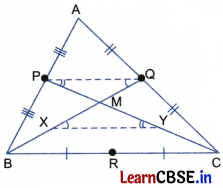
Using Midpoint theorem in ∆ABC, we get
PQ || BC and PQ = \(\frac {1}{2}\)BC.
Using midpoint theorem in ∆MBC, we get
XY || BC and XY = \(\frac {1}{2}\)BC.
∴ We get PQ || XY and PQ = XY.
PQ || XY ⇒ ∠MXY = ∠MQP (Alternate angles)
and ∠MYX = ∠MPQ (Alternate angles)
In ∆MXY and ∆MQP, we have
∠MXY = ∠MQP, XY = QP
and ∠MYX = ∠MPQ.
∴ By ASA rule, ∆MXY ≅ ∆MQP.
∴ MX = MQ and MY = MP
∴ MQ = MX = \(\frac {1}{2}\)MB (∵ X is midpoint of MB)
∴ MB : MQ :: 2 : 1
Also MP = MY = \(\frac {1}{2}\)MC (∵ Y is midpoint of MC)
∴ MC : MP :: 2 : 1
∴ The point M divides the medians BQ and CP in the ratio 2 : 1, with longer part connecting the vertex.
Using a tracing paper, draw a replica of ∆ABC with midpoints P, Q and R.
Join AR and BQ.
Let these lines meet at N.
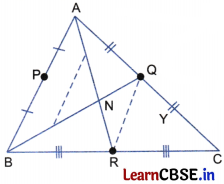
Proceeding as above, we get
NB : NQ :: 2 : 1 and NA : NR :: 2 : 1.
MB : MQ :: 2 : 1 and NB : NQ :: 2 : 1
Implies that M and N are same point, because there is only one point which divides BQ in the ratio 2 : 1.
∴ The point M (or N) is on each median and it divides each median in the ratio 2 : 1 with longer part connecting the vertex.
In other words, the medians of a triangle pass through a common point called centroid and the centroid divides each median in the ratio 2 : 1 with longer part connecting the vertex.
Hence the result holds.
Theorem 9 (Midpoint Theorem for Quadrilaterals):
The midpoints of the four sides of a quadrilateral are the vertices of a parallelogram. This is called the Varignon parallelogram of the original quadrilateral.
Proof:
Let ABCD be a quadrilateral.
Let P, Q, R and S be the midpoints of the sides AB, BC, CD and DA respectively.
Join PQ, QR, RS and SP.
Also, join the diagonals AC and BD.
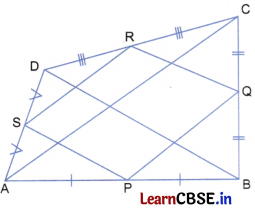
By Midpoint Theorem in ∆ABC, we get PQ || AC.
By Midpoint Theorem in ∆ADC, we get SR || AC.
∴ PQ || SR
By Midpoint Theorem in ∆BAD, we get PS || BD.
By Midpoint Theorem in ∆BCD, we get QR || BD.
∴ PS || QR
∴ In quadrilateral PQRS, we have PQ || SR and S || QR
i.e. opposite sides are parallel.
∴ By definition, PQRS is a parallelogram.
∴ The result holds.
Tiling the Plane Using any 4-Gon
We know that a quadrilateral is also known as a 4-gon.
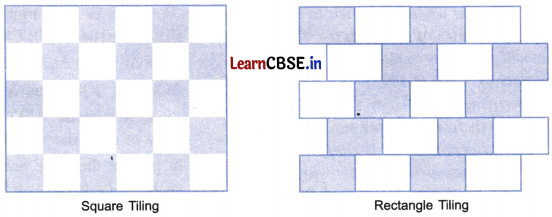
Tiling a plane is defined as the process of covering a flat surface completely using identical geometric shapes (called tiles) so that there are no gaps and no overlaps. This process is also known as tessellation.
For example, a flat surface can be very easily covered by using square or rectangle tiles as shown below:
Rules of Tiling
1. There should be no gaps. In other words, every part of the flat surface must be covered by a tile.
2. There should not be overlaps. In other words, tiles must not cross over or cover one another.
3. The pattern of tiling should be able to cover an infinite plane.
4. At any point where the comers of tiles meet, the touching angles must sum to exactly 360°. If the sum of angles is less than 360°, then there will be gaps in the tiling and in case sum of angles is more than 360° then there will be overlaps of tiles.
Types of Tiling
1. Regular Tiling
Tiling is called a regular tiling if the tiles are only copies of a regular polygon.
For regular tiling, there are only three regular polygons that can be used for tiling.
(i) Equilateral triangles: In this case, six tiles meet at every vertex, because 6 × 60° = 360°.
(ii) Squares In this case, four tiles meet at every vertex, because 4 × 90° = 360°.
(iii) Regular hexagons In this case, three tiles meet at every vertex, because 3 × 120° = 360°.
2. Semi-regular Tiling
Tiling is called semi-regular tiling if the tiles are combination of two or more regular polygons and used in such a manner that at every vertex, the arrangement of shapes is identical.
3. Periodic Tiling
Tiling is called periodic tiling if the tiling has a repeating pattern that can be translated in two different directions without changing the design.
4. Aperiodic Tiling
Tiling is called aperiodic tiling if the tiling uses a fixed set of shapes to cover the plane completely and the pattern never repeats periodically.
Tiling the Plane Using any 4-GON
In this section, we shall show that any plane can be tiled by using any 4-gon i.e., any quadrilateral.
1. Two Methods of Drawing Tiling Pattern Using any Quadrilateral
Let ABCD be any quadrilateral. We shall draw a tiling pattern using this quadrilateral.
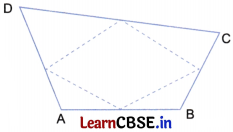
Cut this quadrilateral along sides and also form some copies, say 4, of this quadrilateral.
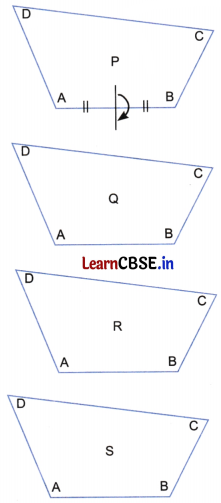
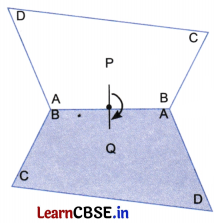
We shall arrange these 4 copies of quadrilateral to form a tiling pattern. Paste quadrilateral P on a plane paper. Place quadrilateral Q exactly above quadrilateral P. Rotate copy Q by 180° around the midpoint of AB of copy P. The rotated copy Q aligns with the copy P perfectly along the shared edge AB as shown in Figure. Paste copy Q at its position.
Place copy R exactly above copy P. Rotate copy R by 180° around the midpoint of BC of copy P. The rotated copy R aligns with the copy P perfectly along the shared edge BC as shown in Figure. Paste copy R at its position.
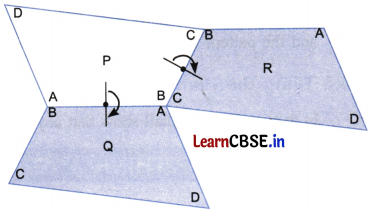
Place copy S exactly above copy R. Rotate copy S by 180° around the midpoint of CD of copy R. The rotated copy S aligns with the copy R perfectly along the shared edge CD as shown in Figure. Paste copy S at its position.
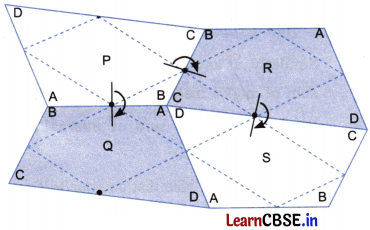
This shows the tiling pattern using 4 identical quadrilaterals. Similarly, we can arrange any number of identical quadrilaterals to this pattern. In Figure, we draw the Varignon parallelograms of quadrilaterals P, Q, R and S. We observe that the sides of Varignon parallelograms form a grid of parallel lines. We can also use this type of grid to form tiling pattern.
Let us see how we can do it. In Figure, draw the Varignon parallelogram and using a tracing paper, cut the Varignon parallelogram and paste it on a paper as shown in Figure.

On this paper, make a grid of parallel lines which are parallel to the sides of the Varignon parallelogram.
Now place copies P, Q, R and S on this grid so that we get tiling pattern as obtained in Figure.
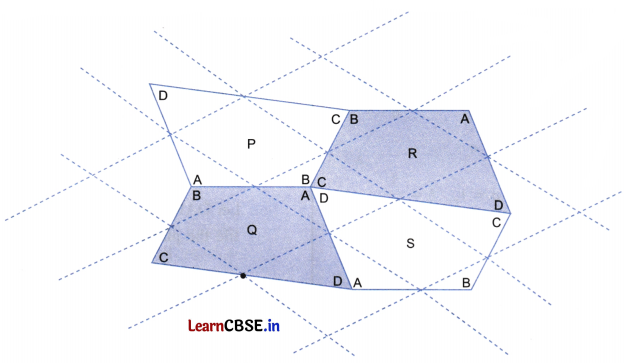
Thus, we conclude that qny quadrilateral can be used to form a tiling pattern and the grid of lines parallel to the sides of the Varignon parallelogram of the quadrilateral can also be used to form the tiling pattern. Thus, there are two methods of drawing tiling pattern using any quadrilateral.
2. A Cutting-edge Discovery
The following shape—the first of its kind!—that leads to aperiodic tilings was discovered only recently in 2023 by a team of four mathematicians (Smith, Myers, Kaplan and Goodman-Strauss). Cut out 15 identical copies of the following shape (known as the ‘hat’) and start to tile with it. Do you see any pattern? You will find that the hat shape will tile the plane endlessly, but without ever quite repeating the same pattern. That is why it is called an ‘aperiodic’ tiling.

We shall study the formation of tiling pattern of above given ‘hat’ as a mathematical activity.
The post Quadrilaterals Class 9 Notes Maths Chapter 12 appeared first on Learn CBSE.
📚 NCsolve - Your Global Education Partner 🌍
Empowering Students with AI-Driven Learning Solutions
Welcome to NCsolve — your trusted educational platform designed to support students worldwide. Whether you're preparing for Class 10, Class 11, or Class 12, NCsolve offers a wide range of learning resources powered by AI Education.
Our platform is committed to providing detailed solutions, effective study techniques, and reliable content to help you achieve academic success. With our AI-driven tools, you can now access personalized study guides, practice tests, and interactive learning experiences from anywhere in the world.
🔎 Why Choose NCsolve?
At NCsolve, we believe in smart learning. Our platform offers:
- ✅ AI-powered solutions for faster and accurate learning.
- ✅ Step-by-step NCERT Solutions for all subjects.
- ✅ Access to Sample Papers and Previous Year Questions.
- ✅ Detailed explanations to strengthen your concepts.
- ✅ Regular updates on exams, syllabus changes, and study tips.
- ✅ Support for students worldwide with multi-language content.
🌐 Explore Our Websites:
🔹 ncsolve.blogspot.com
🔹 ncsolve-global.blogspot.com
🔹 edu-ai.blogspot.com
📲 Connect With Us:
👍 Facebook: NCsolve
📧 Email: ncsolve@yopmail.com

😇 WHAT'S YOUR DOUBT DEAR ☕️
🌎 YOU'RE BEST 🏆