
Solving questions with the help of Ganita Manjari Class 9 Solutions and Part 2 Class 9 Maths Chapter 11 The World of Algorithms NCERT Solutions improves confidence.
Ganita Manjari Class 9 Chapter 11 Solutions
Class 9 Ganita Manjari Chapter 11 Solutions
Class 9 Maths Ganita Manjari Chapter 11 Solutions The World of Algorithms
Think and Reflect (NCERT Textbook Page No. 39)
Question 1.
See if you can complete the argument about grouping by units, tens, hundreds,… to justify why the addition algorithm works.
Solution:
Every number can be split into a units group, a tens group, a hundreds group, and so on — this is exactly what the Indian place-value system records. Adding two numbers means adding each of these groups separately: the units of one number with the units of the other, the tens with the tens, and so on. The only complication is that a group’s sum can itself reach or exceed ten of that unit. For instance, if the units digits add to 14, that is 1 ten and 4 units — the 4 units stay in the units place, and the 1 ten must be moved over and combined with the tens group, since a “ten of the units” is worth exactly one unit of the next group up. This is precisely what “carry” does: it moves the newly-formed larger unit into the next column so it is counted in the right group. Since every column is handled this way, from the smallest place value to the largest, the final combined answer correctly represents the sum, grouped and re-grouped consistently at every place value.

Question 2.
How would you modify the algorithm to add two decimdl fractions?
Solution:
The key idea — aligning quantities of the same place value — extends naturally to decimals: we -now align both the decimal points and the digits, so that tenths line up with tenths, hundredths with hundredths, and so on (padding the shorter decimal part with trailing zeros if the two numbers have a different number of decimal places). We then add right to left exactly as before, starting from the smallest place value, carrying between columns in exactly the same way, and finally placing the decimal point in the answer directly below the aligned decimal points.
For example, to add 4.7 and 12.85, we treat 4.7 as 4.70, align:
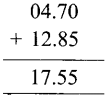
add right to left as 470 + 1285 = 1755, and place the decimal point back two digits from the right: 17.55.
The algorithm works because carrying correctly moves a “full ten” of one place value into the next; for decimals, we simply align the decimal points (padding with trailing zeros where needed) and then add exactly as before.
Ex 11.1 Class 9 Ganita Manjari Solutions – Ganita Manjari Class 9 Exercise 11.1 Solutions
Exercise 11.1 Class 9 Ganita Manjari Solutions – Ganita Manjari Class 9 Ex 11.1 Solutions
Question 1.
Add two 4-digit numbers using the steps we have written down. Make sure you follow the steps precisely; do not perform any action that is not explicitly mentioned. Are you able to obtain the correct result?
Solution:
Let us take two 4-digit numbers 3473 and 2695.
Write the numbers one below the other, aligning the digits from the right:

Step 1: The digits are aligned from right to left.
Step 2: Add the units digits: 3 + 5 = 8
Write 8 in the units place.
Step 3: Add the tens digits: 7 + 9 = 16
Write 6 in the tens place and carry 1.
Step 4: Add the hundreds digits along with the carry: 4 + 6 + 1 = 11
Write 1 in the hundreds place and carry 1.
Step 5: Now add the thousands digits along with the carry: 3 + 2 + 1 = 6
Write 6 in the thousands place.
Therefore,
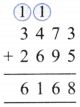
Yes, the algorithm gives the correct result.
Question 2.
What happens if you add a 5-digit number to a 3-digit number? Do our steps handle this situation correctly?
Solution:
Let’s check it with a 5-digit no. 45678 and a 3-digit no. 325 and add the 5-digit no. to a 3-digit no.
Correct alignment is:

The rightmost 3 columns have a digit from both numbers, so steps 2-3 work exactly as written:
units 5 + 8 = 13 → write 3, carry 1;
tens 7 + 2 + 1 = 10 → write 0, carry 1;
hundreds 6 + 3 + 1 = 10 → write 0, carry 1.
But once we move further left, the 3-digit number has run out of digits — there is no digit of 325 in the thousands or ten-thousands column.
The algorithm as literally written only says “add the two digits and the current value of carry” — it never says what to do when one number has no digit in that column.
In practice, we handle this by silently treating a missing digit as 0 (thousands: 5 + 0 + 1 = 6; ten-thousands: 4 + 0 + 0 = 4), which gives the correct answer 46003.
But this is an extra rule we are implicitly assuming, not one of the 5 steps as written.
The steps get the correct answer, 46003, but only if we silently assume a missing digit counts as 0 — the written algorithm does not explicitly say this, so strictly speaking it is incomplete for numbers of different lengths.
Question 3.
Why is it important to align the columns from right to left?
Solution:
It is important to align the columns from right to left because the rightmost digits represent the units, the next digits represent tens, then hundreds, thousands, and so on.
For example:

Correct alignment is:

This ensures that units are added to units, tens to tens, hundreds to hundreds, thousands to thousands.
If the numbers are not aligned from the right, digits having different place values would be added together, giving an incorrect result.
Therefore, right-to-left alignment preserves the place values of the digits.
Question 4.
In Step 3 why cannot the value of carry be more than I?
Solution:
At any column, we add:
one digit from the first number,
one digit from the second number, and
the carry from the previous column.
The largest possible sum is: 9 + 9 + 1 = 19
Since 19 is less than 20, the carry can only be 1.
For example: 9 + 9 + 1 = 19
We write 9 in the current column and carry 1 to the next column.
Hence, the carry can never be more than 1.
Question 5.
What happens if we do not include the fifth step in the algorithm above? Give examples where the algorithm will work correctly and where it will fail to work.
Solution:
Step 5 says: If the value of carry is 1, write 1 to the left of the bottom row.
If this step is omitted, the algorithm works correctly when there is no carry left after adding the leftmost digits.
(i) Example where it works
Consider: 123 + 456

There is no carry after the final column, so Step 5 is not needed.
Thus, the algorithm works correctly.
(ii) Example where it fails
Consider: 678 + 567
Working from right to left:
8 + 7 = 15: write 5, carry 1
7 + 6 + 1 = 14: write 4, carry 1
6 + 5 + 1 = 12: write 2, carry 1
We get:

But the correct answer is: 678 + 567 = 1245
The final carry 1 has not been written.
If we perform Step 5, we put the final carry 1 to the left:

Therefore, without Step 5, the algorithm fails whenever the addition of the leftmost digits produces a final carry of 1.
Ex 11.2 Class 9 Ganita Manjari Solutions – Ganita Manjari Class 9 Exercise 11.2 Solutions
Exercise 11.2 Class 9 Ganita Manjari Solutions – Ganita Manjari Class 9 Ex 11.2 Solutions
Question 1.
Suppose List 1 and List 2 are two lists of numbers in increasing order.
(i) Write an algorithm to find elements in List 1 that are not present in List 2.
(ii) Write an algorithm to find elements in List 2 that are not present in List 1.
Solution:
Suppose, List 1: L1, and List 2: L2
Both lists are in increasing order.
(i) Algorithm to find elements in List 1 that are not present in List 2
We can use two positions, one for each list.
Algorithm I:
1. Start with the first element of List 1 and the first element of List 2.
2. Compare the current elements of the two lists.
3. If the element in List 1 is smaller than the element in List 2, add the List 1 element to the answer list and move to the next element of List 1.
4. If the two elements are equal, do not add the element and move to the next element in both lists.
5. If the element in List 1 is greater than the element in List 2, add it to the answer list and move to the next element of List 1.
6. Repeat Steps 2-5 until either list is exhausted.
7. If elements of List 1 are still left, add all of them to the answer list.
Example: Let L1 = [1, 3, 5, 7, 11] and L2 = [2, 3, 6, 9]
The elements of L1 not present in L2 are: [1, 5, 7, 11]
(ii) Algorithm to find elements in List 2 that are not present in List 1
The same idea can be reversed.
Algorithm II:
1. Start with the first element of List 2 and then the first element of List 1.
2. Compare the current elements.
3. If the element in List 2 is smaller, add it to the answer list and move to the next element of List 2.
4. If the two elements are equal, do not add the element and move to the next element in both lists.
5. If the element in List 2 is greater than the element of List 1, add it to the answer list and move to the next element of List 2.
6. Repeat until either list is exhausted.
7. If elements of List 2 are still left, add all of them to the answer list.
For the same example:
L1 = [1, 3, 5, 7, 9, 11]
L2 = [2, 3, 6, 9]
The elements of L2 not present in L1 are: [2, 6]
Question 2.
Describe an algorithm to compute the least common multiple (1 cm) of two numbers.
Solution:
Let the two numbers be m and n.
One direct algorithm is to generate their multiples and find the first common multiple.
Algorithm to find 1 cm (m, n)
1. Start with j = 1
2. Compute j × m
3. Check whether j × m is divisible by n.
4. If it is divisible by n, report j × m as the LCM and stop.
5. Otherwise, increase j by 1.
6. Repeat Steps 2-5.
Example: Find the LCM of 12 and 18.
Here m = 12, n = 18
According to Algorithm
1. Let l = 1
2. Now compute l × m
1 × 12 = 12
3. Check if l × m is divisible by n
12 ÷ 18 = \(\frac{12}{18}=\frac{2}{3}\)
4. l × m is not divisible by n.
5. Now increase l.
Let l = 3
6. Compute l × m
3 × 12 = 36
7. Check if l × m is divisible by n
36 ÷ 18 = \(\frac {36}{18}\) = 2
Yes, it is divisible by n.
8. So, 36 is the LCM of 12 and 18.
Therefore, LCM(12, 18) = 36.
Question 3.
Divisors occur in pairs. For instance, the divisors of 18 are (1, 18), (2, 9) and (3, 6).
(i) If we write out divisors in pairs, how many numbers do we have to examine between 1 and n to find all the divisors of n?
(ii) If we list out the divisors in pairs, will our gcd algorithm still work in the manner we have described?
Solution:
(i) Suppose d is a divisor of n. Then its paired divisor is n/d.
Once we find a divisor d, we automatically know its partner.
The pairs meet when d = n/d, which gives d2 = n, and hence d = √n.
Therefore, we only need to examine the numbers from 1 to √n, rather than all the numbers from 1 to n.
Example: For the divisors of 18, n = 18, √18 ≈ 4.24.
Solution:
So we need to examine only: 1, 2, 3, 4….
We find:
18 → pair (1, 18)
18 → pair (2, 9)
18 → pair (3, 6)
Thus, all the divisors are obtained, i.e., 1, 2, 3, 6, 9, 18.
(ii) No, not in the exact manner described earlier in the chapter. The earlier gcd algorithm depends on the divisor lists being in increasing order and finding the rightmost common element.
For example, if the divisors of 18 are written in pairs as (1, 18), (2, 9), (3, 6), the resulting list could be written as 1, 18, 2, 9, 3, 6, which is not in increasing order. Therefore, simply using the paired order would break the assumption the original gcd algorithm relies on. However, we could modify the algorithm— for example, by keeping track of the largest common divisor found so far. Then we could use the paired method successfully.
Ex 11.3 Class 9 Ganita Manjari Solutions – Ganita Manjari Class 9 Exercise 11.3 Solutions
Exercise 11.3 Class 9 Ganita Manjari Solutions – Ganita Manjari Class 9 Ex 11.3 Solutions
Question 1.
How would our original algorithm change if we computed the divisors of n by examining the numbers from 1 to n in reverse order, from n down to 1?
Solution:
In the original algorithm, we examine 1, 2, 3,…, n and add a number to the divisor list whenever it divides n.
Therefore, the divisors are obtained in increasing order.
If we instead examine the numbers in reverse: n, n-1, n-2,…, 1, the divisors will be obtained in decreasing order.
For example, for n = 18, we would obtain: 18, 9, 6, 3, 2, 1.
So the modified algorithm to find the divisors of n in decreasing order.
1. Start with an empty list of lists of divisors.
2. For each number j in the sequence n, n – 1, n – 2,….
If j divides n, add j to list-of-divisors.
3. The resulting list contains all divisors of n in decreasing order.
Thus, the main change is simply the direction in which the numbers are examined.
Question 2.
What about the last algorithm described above? What happens when we look at common divisors starting from min(m, n) and work backwards to 1?
Solution:
The important observation is that the largest possible common divisor of m and n cannot be greater than min(w, n).
Therefore, if we examine possible divisors starting from min(m, n) and move backwards, the first number that divides both m and n must be their greatest common divisor.
Modified algorithm:
1. Let k = min (m, n).
2. Check whether k divides both m and n.
3. If it does, report k as the gcd and stop.
4. If it does not, decrease k by 1.
5. Repeat Steps 2-4 until k = 1.
Example: Find GCD (375, 825).
Here, min(375, 825) = 375
We examine: 375, 374, 373,…
The first number that divides both 375 and 825 is 75.
Therefore, GCD (375, 825) = 75
Ganita Manjari Class 9 Maths Chapter 11 End of Chapter Exercise Solutions
The World of Algorithms End of Chapter Exercise Solutions
Question 1.
Compute the following using the improved version of Euclid’s algorithm.
(i) gcd(375, 825)
(ii) gcd(51000, 81000)
(iii) gcd(1789287, 237656)
(iv) gcd(2587392, 157656)
Solution:
The improved algorithm for gcd (m, n) is:
If m < n, interchange m and n and compute gcd(m, n)
If n = 0, report the answer as m.
Otherwise, replace the problem by gcd (n, m-n)
Repeat.
(i) Here, gcd (375, 825)
Applying Euclid’s algorithm:
Since 375 < 825, we interchange the numbers and compute gcd (825, 375)
Now, 825 = 2(375) + 75
Therefore, gcd (825, 375) = gcd (375, 75)
Again, 375 = 5(75) + 0
Therefore, gcd (375, 825) = 75
(ii) gcd (51000, 81000)
Applying Euclid’s algorithm:
Since 51000 < 81000, we interchange the numbers and compute gcd (81000, 51000)
Now, 81000 = 1(51000) + 30000
So, gcd (81000, 51000) = gcd (51000, 30000)
Next, 51000 = 1(30000) + 21000
gcd (51000, 30000) = gcd (30000, 21000)
Next, 30000 = 1(21000) + 9000
gcd (30000, 21000) = gcd (21000, 9000)
Next, 21000 = 2(9000) + 3000
gcd (21000, 9000) = gcd (9000, 3000)
Finally, 9000 = 3(3000) + 0
Hence, gcd (51000, 81000) = 3000
(iii) Here, gcd (1789287, 237656)
Applying Euclid’s algorithm:
1789287 = 7(237656) + 125695
So, gcd (1789287, 237656) = gcd (237656, 125695)
Next, 237656 = 1(125695) + 111961
gcd (237656, 125695) = gcd (125695, 1119961)
Next, 125695 = 1(111961) + 13734
gcd (125695, 111961) = gcd (111961, 13734)
Now, 111961 = 8(13734) + 2089
gcd (111961, 13734) = gcd (13734, 2089)
Next, 13734 = 6(2089) + 1200
gcd (13734, 2089) = gcd (2089, 1200)
Next, 2089 = 1(1200) + 889
gcd (2089, 1200) = gcd (1200, 889)
Next, 1200 = 1(889) + 311
gcd (1200, 889) = gcd (889, 311)
Next, 889 = 2(311) + 267
gcd (889, 311) = gcd (311, 267)
Next 311 = 1(267) + 44
gcd (311, 267) = gcd (267, 44)
Next 267 = 6 (44) + 3
gcd (267, 44) = gcd (44, 3)
Next 44 = 14(3) + 2
gcd (44, 3) = gcd (3, 2)
Next 3 = 1 × 2 + 1
gcd (3, 2) = gcd (2, 1)
Next 2 = 2(1) + 0
Therefore, gcd (1789287, 237656) = 1
(iv) Here, gcd (2587392, 157656)
Applying Euclid’s algorithm:
2587392 = 16(157656) + 64896
gcd(2587392, 157656) = gcd(157656, 64896)
Next, 157656 = 2(64896) + 27864
gcd (157656, 64896) = gcd (64896, 27864)
Next, 64896 = 2(27864) + 9168
gcd (64896, 27864) = gcd (27864, 9168)
Next, 27864 = 3(9168) + 360
gcd (27864, 9168) = gcd (9168, 360)
Next, 9168 = 25(360) + 168
gcd (9168, 360) = gcd (360, 168)
Next, 360 = 2(168) + 24
gcd (360, 168) = gcd (168, 24)
Next, 168 = 7(24) + 0
Therefore, gcd (2587392, 157656) = 24
Question 2.
Assume that m ≥ n. Verify that d divides m and n if and only if d divides both n and m mod n.
Solution:
Assume m ≥ n.
By the division algorithm, m = qn + r, where r = m mod n.
If d divides both m and n, then d divides qn, and hence d divides r = m – qn.
Conversely, if d divides n and r, then d divides qn + r = m.
Therefore: d |m and d| n ≥ d | n and d | (m mod n).
Question 3.
Write an algorithm prime (n) to check if n is prime.
(Hint: A prime number p has exactly two distinct factors, 1 and p. Can you make use of divisors(n) to write out prime(n)?)
Solution:
A prime number has exactly two distinct divisors: 1 and itself.
Compute divisors (n).
If the resulting list has exactly two elements, report True; otherwise report False.
For n < 2, report False.
Pseudocode: prime(n)
1. If n < 2, report False.
2. Let L = divisors(n).
3. If the number of elements in L is exactly 2, report True.
4. Otherwise, report False.
Example: For n = 7, divisors (7) = [1, 7].
There are exactly two divisors.
Therefore, prime (7) = True
For n = 12, divisors (12) = [1, 2, 3, 4, 6, 12]
There are more than two divisors.
Therefore, prime (12) = False
Question 4.
Write an algorithm primedivisors (n) to compute the list of divisors of n that are prime numbers.
(Hint: Compute divisors(n) and then filter out the primes in this list.)
Solution:
1. Let L be the list obtained by computing divisors (n).
2. Start with an empty list prime-divisors.
3. For each number d in L: If prime (d) is True, add d to prime-divisors.
4. Report prime-divisors.
Example: Find prime-divisors (60).
First, divisors (60) = [1, 2, 3, 4, 5, 6, 10, 12, 15, 20, 30, 60]
Now filter the prime numbers.
The prime divisors are: [2, 3, 5]
Thus, prime_divisors (60) = [2, 3, 5]
Question 5.
We can also find the gcd of two numbers by computing the prime factorisation of both numbers. Try to write an algorithm to compute the prime factorisation of a number.
(i) The prime factorisation of 180 is 22 × 32 × 51. How would you represent this?
(ii) How would you compare the prime factorisations of two numbers?
Solution:
(i) We are given: 180 = 22 × 32 × 51.
A convenient representation is as a list of prime-exponent pairs: [(2, 2), (3, 2), (5, 1)]
Here: 2 has exponent 2, 3 has exponent 2, 5 has exponent 1.
Another possible representation is: {2 : 2, 3 : 2, 5 : 1}, where each prime is associated with its exponent.
(ii) Suppose two numbers have prime factorisations:
A = 2a3b5c and B = 2d3e5f
To compare their prime factorisations:
1. List all the primes appearing in either factorisation.
2. For each prime, compare its exponent in the two numbers.
3. Missing primes can be considered to have exponent 0.
4. For finding the GCD, take the smaller exponent for every common prime.
5. For finding the LCM, take the larger exponent for every prime appearing in either number.
Example: Suppose A = 23 × 32 × 5 and B = 22 × 3 × 7.
For the GCD:
| Prime | Exponent in A | Exponent in B | Smaller Exponent |
| 2 | 3 | 2 | 2 |
| 3 | 2 | 1 | 1 |
| 5 | 1 | 0 | 0 |
| 7 | 0 | 1 | 0 |
Therefore, gcd (A, B) = 22 × 3
For prime factorisations:
GCD → take the smaller exponent of each common prime, and
LCM → take the larger exponent of each prime.
These observations provide another way of computing the GCD, alongside Euclid’s algorithm.
The post The World of Algorithms Class 9 Solutions Maths Ganita Manjari Chapter 11 appeared first on Learn CBSE.
📚 NCsolve - Your Global Education Partner 🌍
Empowering Students with AI-Driven Learning Solutions
Welcome to NCsolve — your trusted educational platform designed to support students worldwide. Whether you're preparing for Class 10, Class 11, or Class 12, NCsolve offers a wide range of learning resources powered by AI Education.
Our platform is committed to providing detailed solutions, effective study techniques, and reliable content to help you achieve academic success. With our AI-driven tools, you can now access personalized study guides, practice tests, and interactive learning experiences from anywhere in the world.
🔎 Why Choose NCsolve?
At NCsolve, we believe in smart learning. Our platform offers:
- ✅ AI-powered solutions for faster and accurate learning.
- ✅ Step-by-step NCERT Solutions for all subjects.
- ✅ Access to Sample Papers and Previous Year Questions.
- ✅ Detailed explanations to strengthen your concepts.
- ✅ Regular updates on exams, syllabus changes, and study tips.
- ✅ Support for students worldwide with multi-language content.
🌐 Explore Our Websites:
🔹 ncsolve.blogspot.com
🔹 ncsolve-global.blogspot.com
🔹 edu-ai.blogspot.com
📲 Connect With Us:
👍 Facebook: NCsolve
📧 Email: ncsolve@yopmail.com

😇 WHAT'S YOUR DOUBT DEAR ☕️
🌎 YOU'RE BEST 🏆