
⚙️
Welcome to NCSOLVE — National Curriculum Solver of Learning Volume Environment! Explore Free NCERT Solutions, CBSE Sample Papers, and AI Tools! Empowering Education Worldwide with Advanced AI Technology! Access Cultural Insights, AI-Based Learning, and Free Hidden Books! Prepare for NEET, JEE, UPSC, and Other Competitive Exams with Exclusive Resources! Learn Smarter, Faster, and Better with NCSOLVE Today!

Select Class

Ads 🛡️

They came from other stars! [COMIC] - #NCSOLVE 📚

0
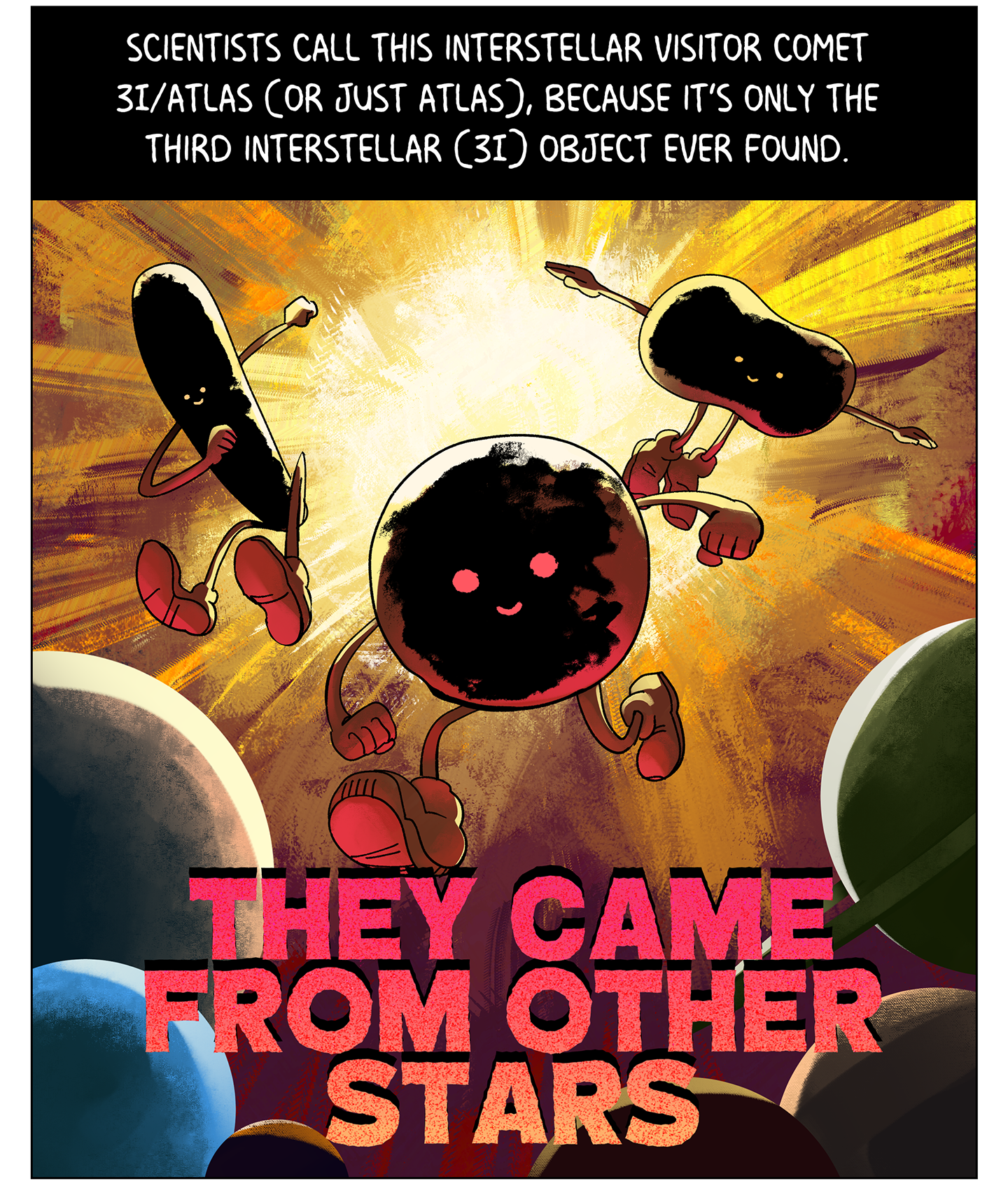
Text (above image): Scientists call this interstellar visitor Comet 3I/ATLAS (or just Atlas), because it’s only the third interstellar (3I) object ever found. Image: Three rock-shaped characters charge toward the planets of our solar system. Text (below image): THEY CAME FROM OTHER STARS.
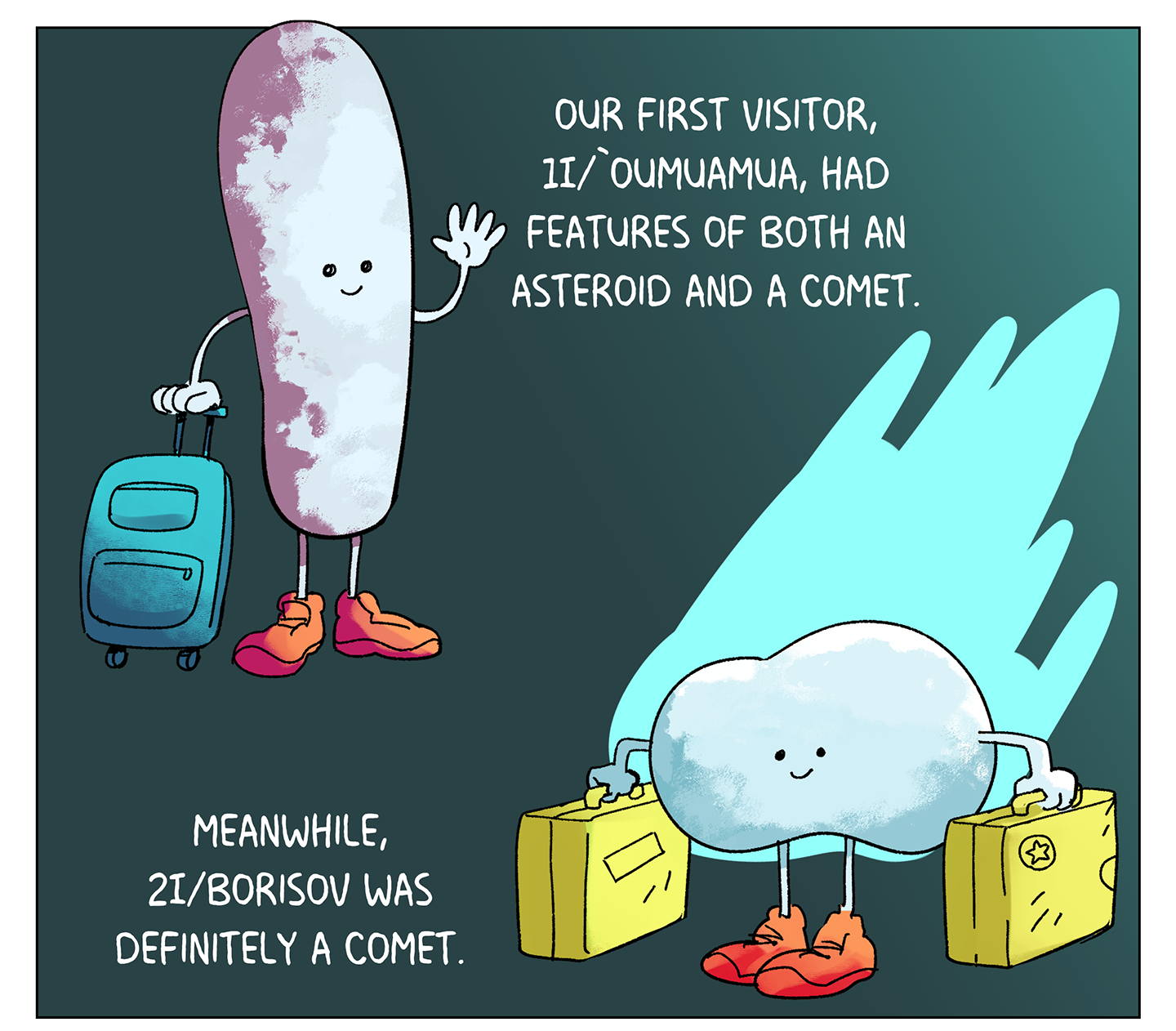
Text (above first image): Our first visitor, 1I/`Oumuamua, had features of both an asteroid and a comet. First image: An oblong rock-like character wearing sneakers and pulling a suitcase smiles and waves. Text (above second image): Meanwhile, 2I/Borisov was definitely a comet. A rounded rock-like character is surrounded by a blue cloud. Also smiling, it wears sneakers and carries a suitcase in each hand.
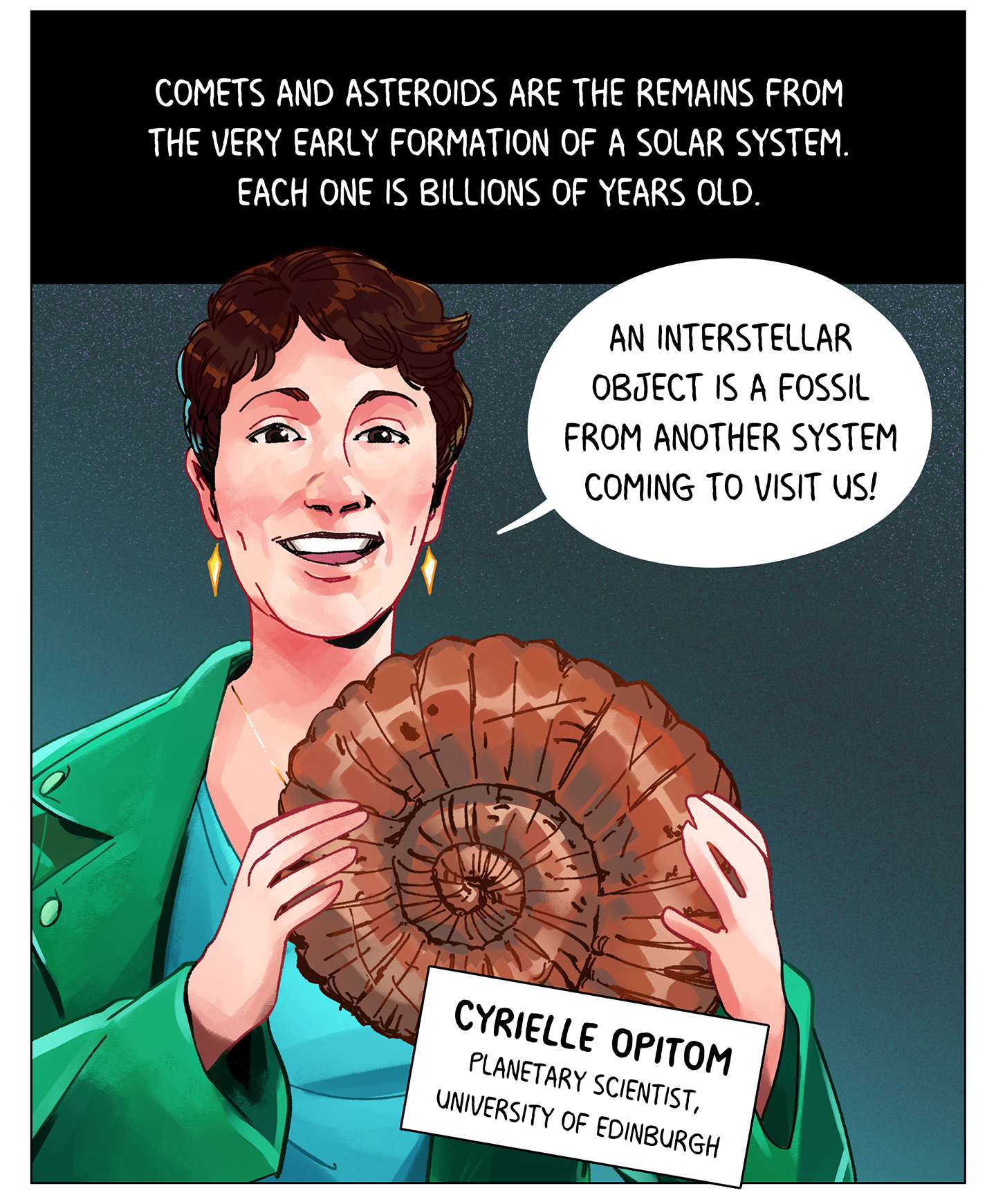
Text (above image): Comets and asteroids are the remains from the very early formation of a solar system. Each one is billions of years old. Image: A white woman with short brown hair and wearing a green jacket smiles and holds up an ammolite fossil shell. She says, “An interstellar object is a fossil from another system coming to visit us!” Her nametag reads: Cyrielle Opitom, planetary scientist, University of Edinburgh.
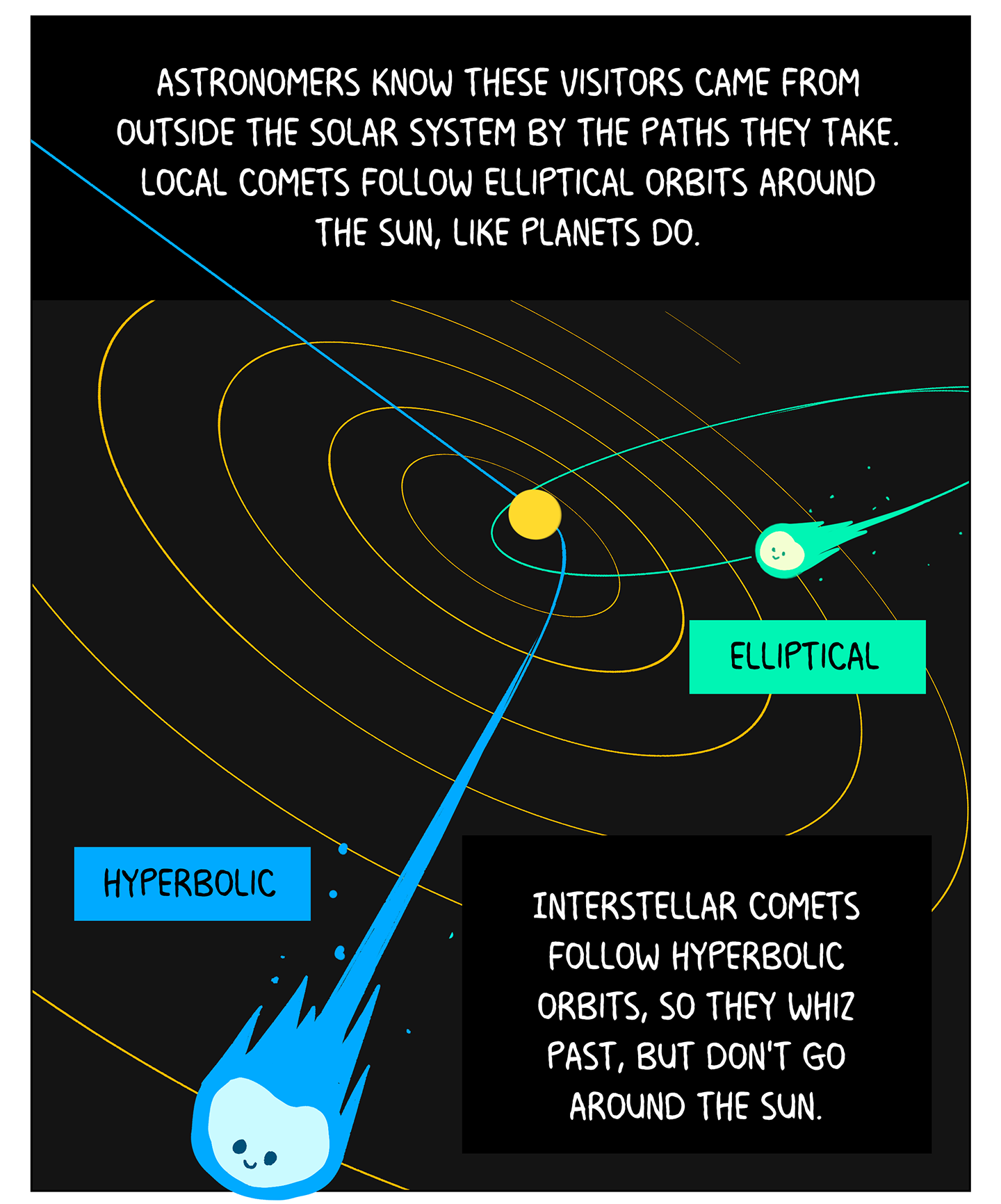
Text (above image): Astronomers know these visitors came from outside the solar system by the paths they take. Local comets follow elliptical orbits around the sun, like planets do. Image: The sun is surrounded by concentric circles showing the orbits of planets in our solar system. One comet follows an oval-shaped path around the sun, labeled “elliptical.” Another follows a boomerang-shaped path past the sun, labeled “hyperbolic.” Text (below image): Interstellar comets follow hyperbolic orbits, so they whiz past but don’t go around the sun.
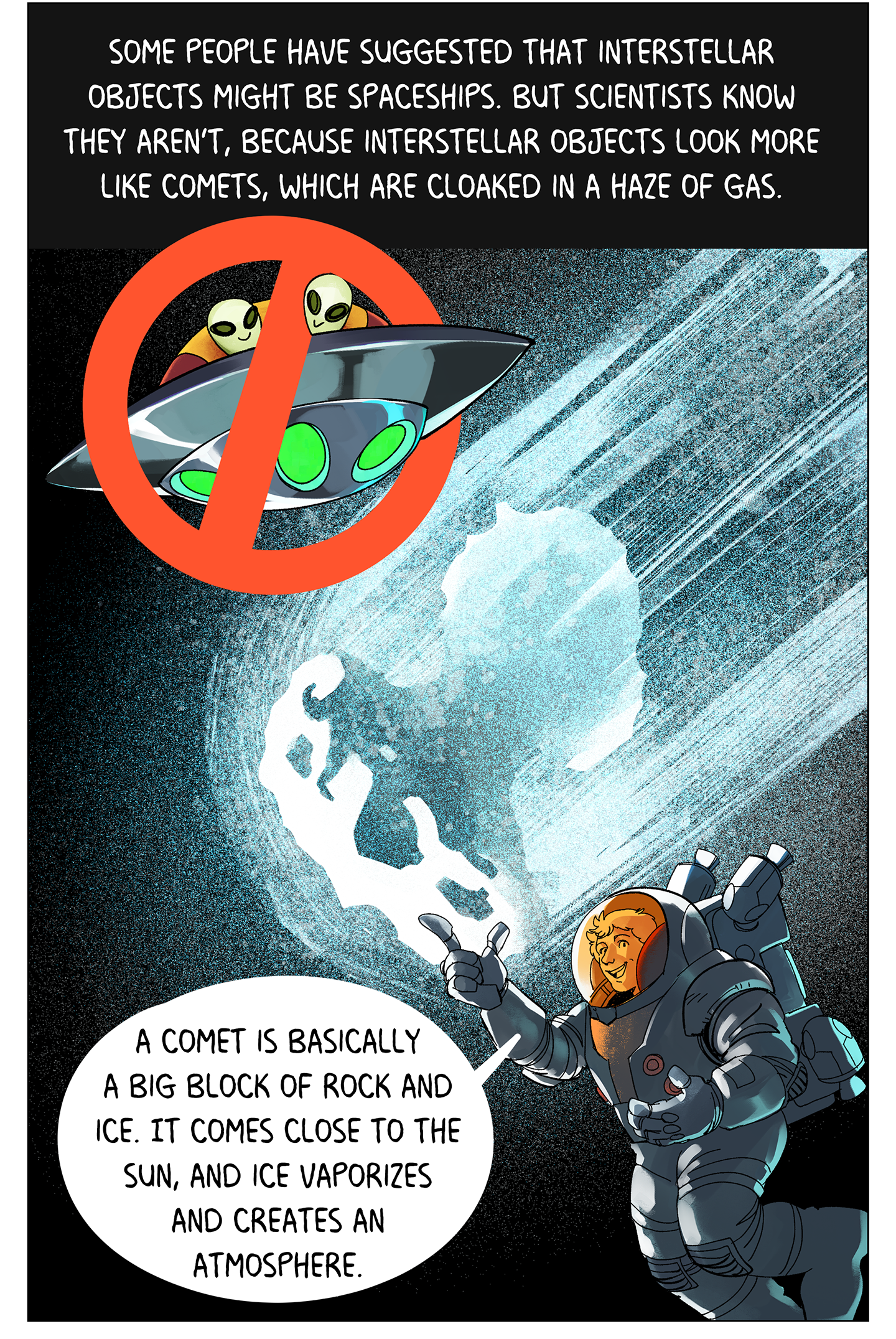
Text (above image): Some people have suggested that interstellar objects might be spaceships. But scientists know they aren’t, because interstellar objects look more like comets, which are cloaked in a haze of gas. Image: The icy, rocky heart of a comet is surrounded by a hazy tail of gas as it streaks through space. Nearby, a picture of aliens driving a spaceship is crossed out with a big red “X.” Cyrielle Opitom floats in space wearing an astronaut suit. She says, “A comet is basically a big block of rock and ice. It comes close to the sun, and ice vaporizes and creates an atmosphere.”
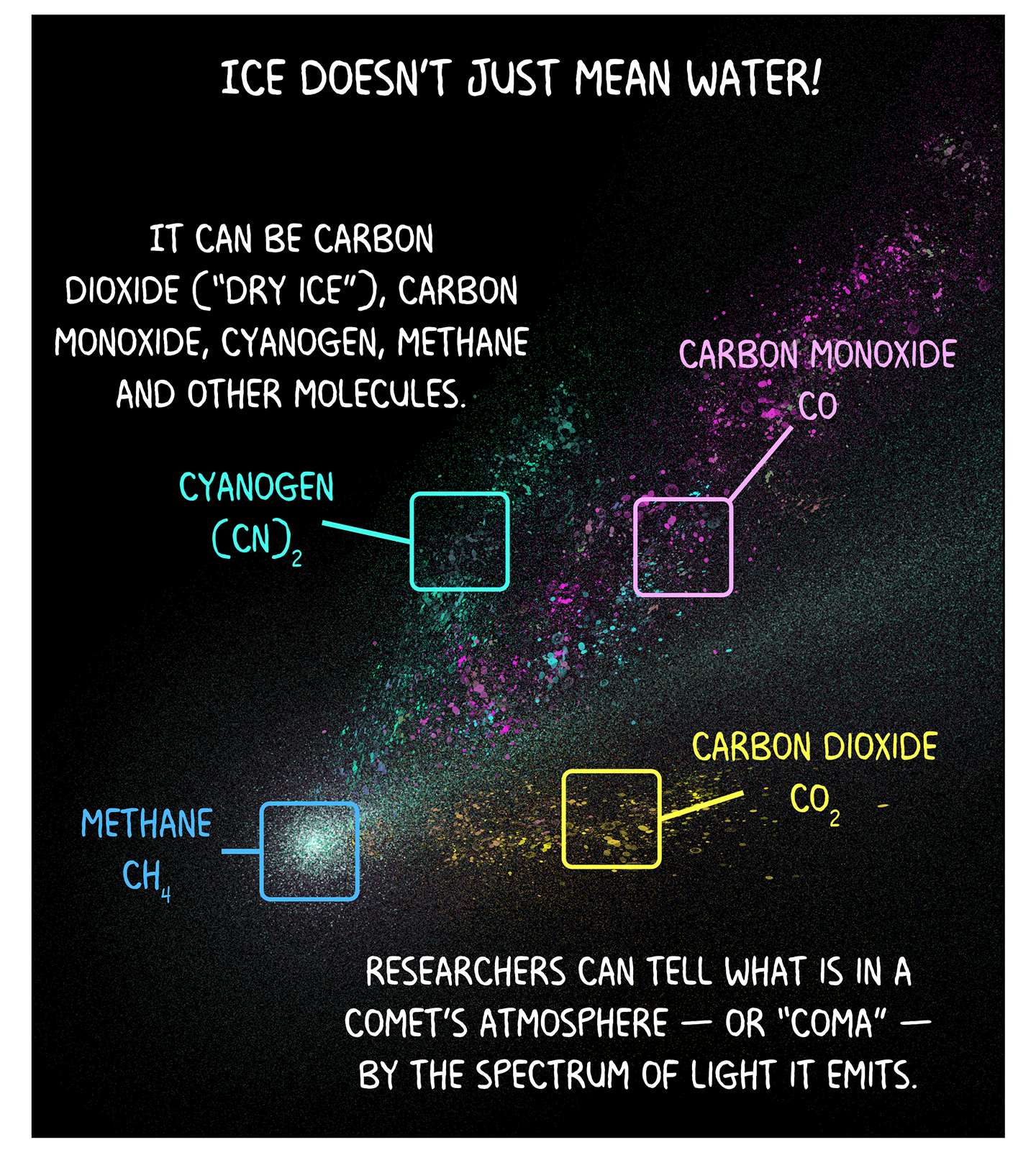
Text (above image): Ice doesn’t just mean water! It can be carbon dioxide (“dry ice”), carbon monoxide, cyanogen, methane and other molecules. Image: A hazy cloud of different colored bits drifts in space. Bluish-green bits are labeled as “cyanogen (CN)2.” Purple bits are labeled as “carbon monoxide (CO).” Whitish bits are labeled as “methane (CH4)." Yellow bits are labeled “carbon dioxide (CO2).” Text (below image: Researchers can tell what is in a comet’s atmosphere — or “coma” — by the spectrum of light it emits.
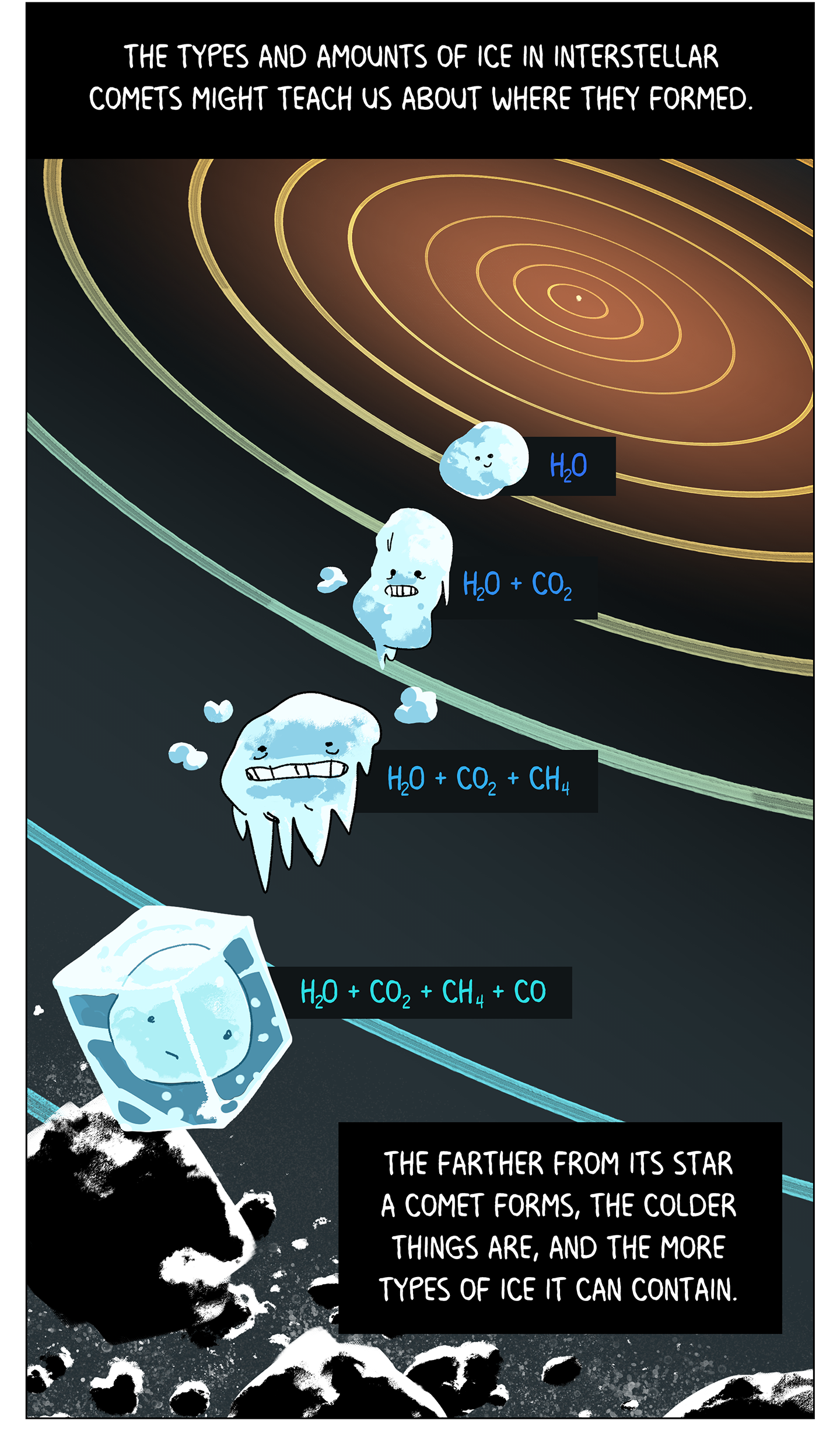
Text (above image): The types and amounts of ice in interstellar comets might teach us about where they formed. Image: Concentric circles show the paths of orbits increasingly distant from a central star. On one path, an icy comet is labeled “H2O.” On the next path farther from the star, a colder comet is labeled “H2O + CO2.” On the next path out, an even colder, icier comet is labeled as “H2O + CO2 + CH4.” And on the most distant path, a comet inside an ice cube is labeled “H2O + CO2 + CH4 + CO.” Text (below image): The farther from its star a comet forms, the colder things are, and the more types of ice it can contain.
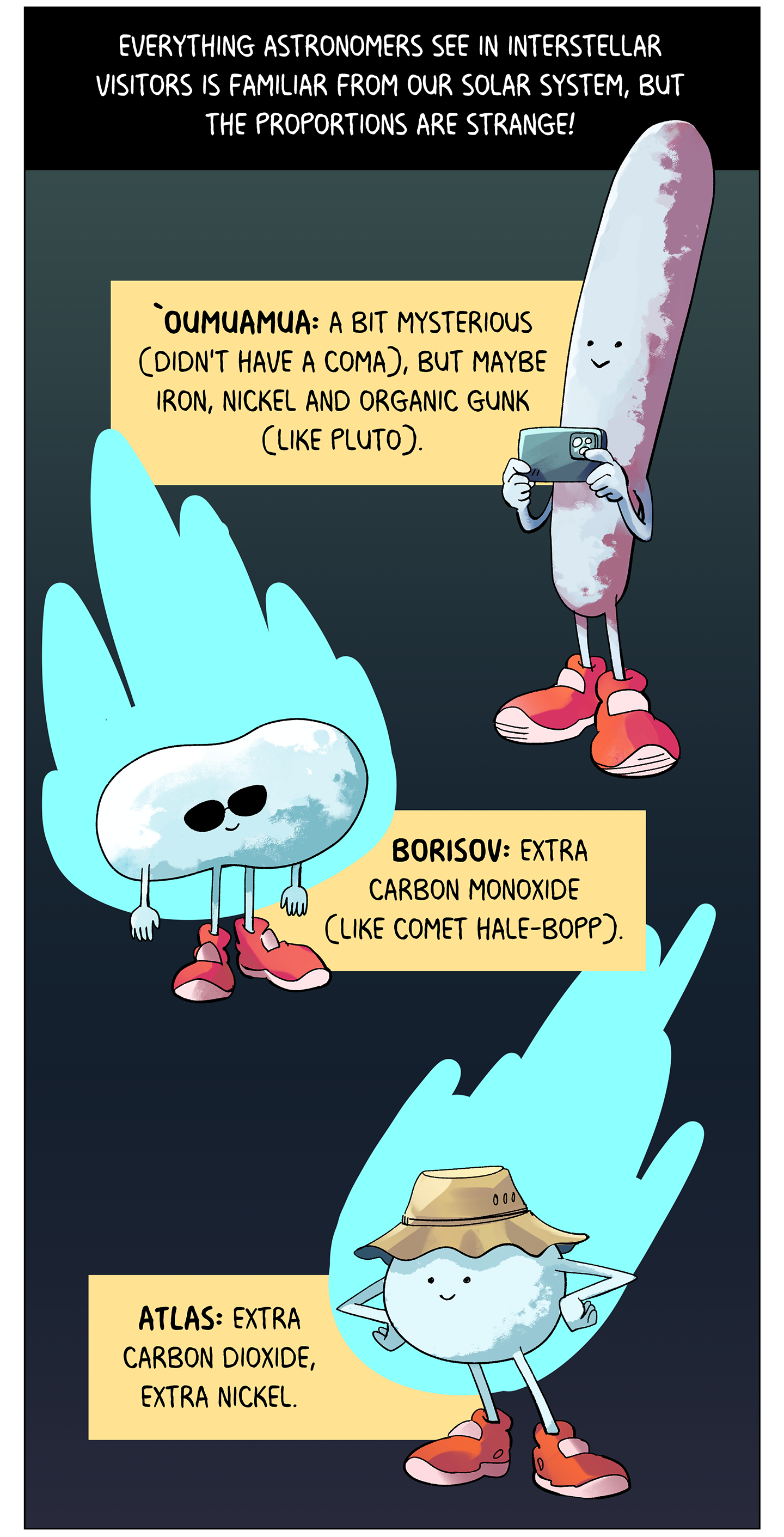
Text (above image): Everything astronomers see in interstellar visitors is familiar from our solar system, but the proportions are strange! First image: An oblong rock-like character smiles and holds a camera. It is labeled: `Oumuamua: A bit mysterious (didn’t have a coma), but maybe iron, nickel and organic gunk (like Pluto). Second image: A rounded rock-like character wearing sunglasses is smiling. It is labeled: Borisov: Extra carbon monoxide (like Comet Hale-Bopp). Third image: A circular rock-like character wearing a safari hat smiles. It is labeled: Atlas: extra carbon dioxide, extra nickel.
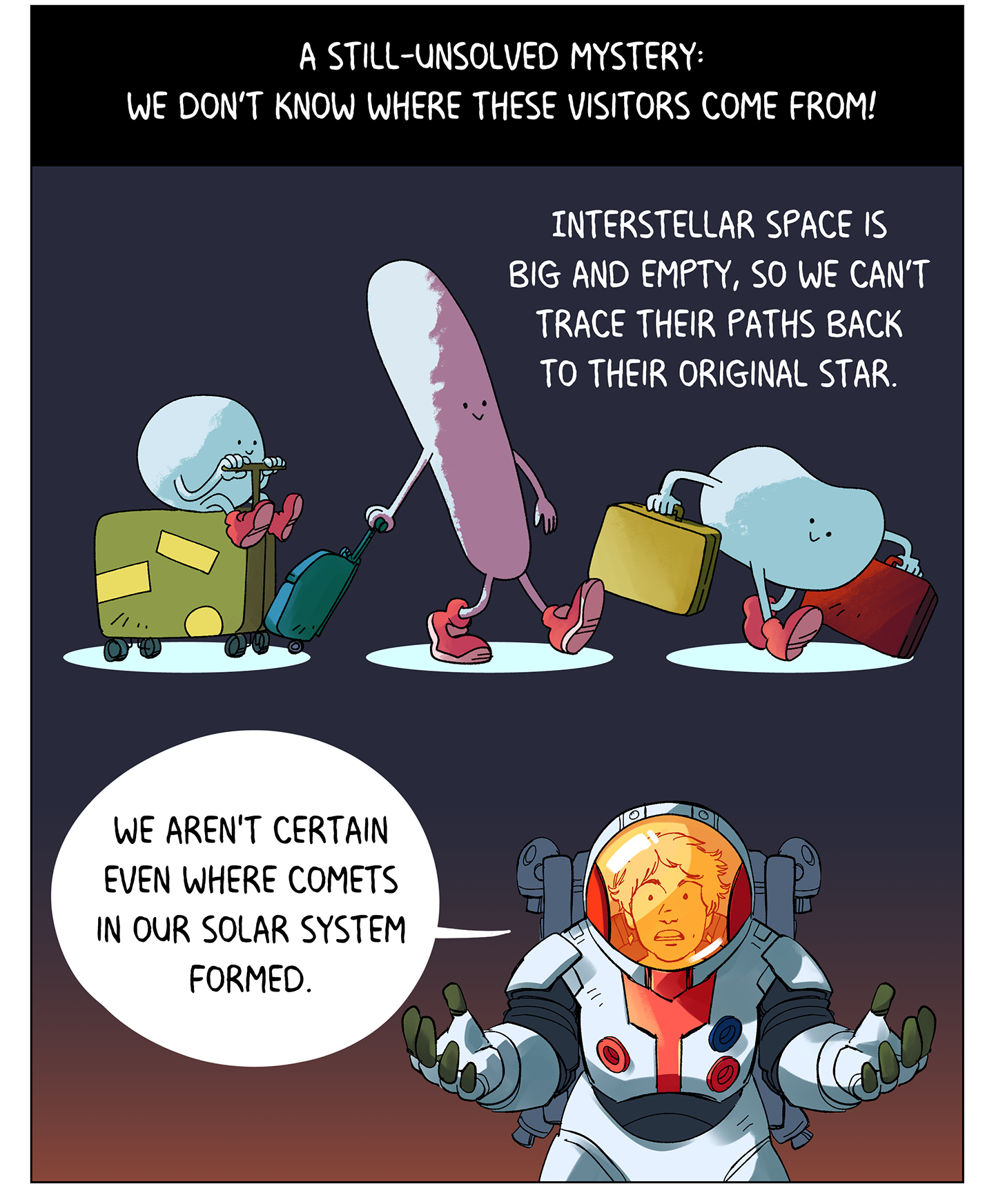
Text (above image): A still-unsolved mystery: We don’t know where these visitors come from! Interstellar space is big and empty, so we can’t trace their paths back to their original star. Image: The three rock-shaped interstellar object characters walk past in a line, toting their luggage and smiling. Below, Cyrielle Opitom floats in her space suit. She says, “We aren't certain even where comets in our solar system formed.”
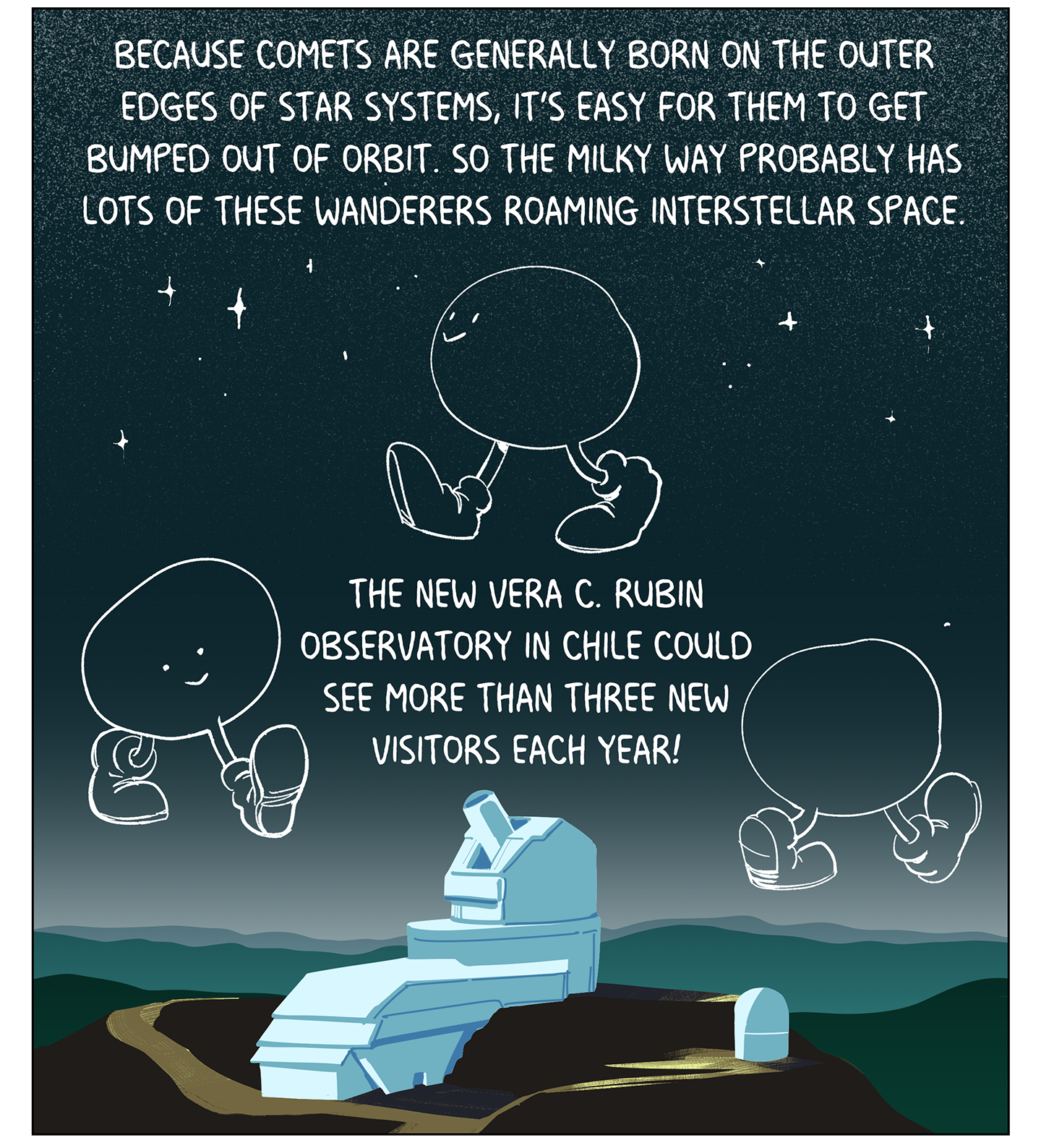
Text (above image): Because comets are generally born on the outer edges of star systems, it’s easy for them to get bumped out of orbit. So the Milky Way probably has lots of these wanderers roaming interstellar space. The new Vera C. Rubin Observatory in Chile could see more than three new visitors each year! Image: An observatory aims its telescope at the night sky. Overhead, the outlines of imagined interstellar objects stroll around, wandering space.
The planets of our solar system huddle around the three interstellar objects, smiling at them. Cyrielle Opitom looks upward at the celestial objects. She says, “What we learn from interstellar objects might help us understand our own solar system. And what we learn about our own solar system will help us understand these interstellar objects.”
All: Maki Naro

Read more science comics here.


📚 NCsolve - Your Global Education Partner 🌍

Empowering Students with AI-Driven Learning Solutions

Welcome to NCsolve — your trusted educational platform designed to support students worldwide. Whether you're preparing for Class 10, Class 11, or Class 12, NCsolve offers a wide range of learning resources powered by AI Education.

Our platform is committed to providing detailed solutions, effective study techniques, and reliable content to help you achieve academic success. With our AI-driven tools, you can now access personalized study guides, practice tests, and interactive learning experiences from anywhere in the world.

🔎 Why Choose NCsolve?

At NCsolve, we believe in smart learning. Our platform offers:

  • ✅ AI-powered solutions for faster and accurate learning.
  • ✅ Step-by-step NCERT Solutions for all subjects.
  • ✅ Access to Sample Papers and Previous Year Questions.
  • ✅ Detailed explanations to strengthen your concepts.
  • ✅ Regular updates on exams, syllabus changes, and study tips.
  • ✅ Support for students worldwide with multi-language content.

🌐 Explore Our Websites:

🔹 ncsolve.blogspot.com
🔹 ncsolve-global.blogspot.com
🔹 edu-ai.blogspot.com

📲 Connect With Us:

👍 Facebook: NCsolve
📧 Email: ncsolve@yopmail.com

#NCsolve #EducationForAll #AIeducation #WorldWideLearning #Class10 #Class11 #Class12 #BoardExams #StudySmart #CBSE #ICSE #SamplePapers #NCERTSolutions #ExamTips #SuccessWithNCsolve #GlobalEducation

Post a Comment

0Comments

😇 WHAT'S YOUR DOUBT DEAR ☕️

🌎 YOU'RE BEST 🏆

Post a Comment (0)