
The people of Sarekha Khurd have grown rice for longer than they can remember. A few hundred families live in this village in north-central India. Trees separate their little fields, which are slanty rectangles of land.
As those fields turn gold each fall with ripened rice, a sweet smell perfumes the air. Harvest time is nearing. But these fields aren’t just growing grain: They’re also capturing carbon.
Farmers here are part of a worldwide effort to combat climate change. Its goal is to pull billions of tons of planet-warming carbon dioxide (CO2) from the air.
In Sarekha Khurd, this effort starts in May. That’s when trucks rumble down dirt roads, dumping out huge piles of crushed, volcanic rock. Each load brings several hundred tons of gray basalt. Farmers sprinkle the dust-sized particles onto their fields. Weeks later, when the monsoon rains arrive, they plant rice.
The dust comes from rock usually used in road building. People mine this basalt from a nearby quarry. It doesn’t look like anything special.
“It’s the most abundant rock on the Earth’s surface,” says David Beerling. He’s a biogeochemist at the University of Sheffield in England.
But when the dust breaks down in soil, it “releases nutrients that are important for plant health,” he says. These include calcium, magnesium, potassium and silica.
Sprinkling crushed basalt on soil promotes the mineral dust’s natural breakdown. Known as enhanced rock “weathering,” or ERW, this process offers several big benefits. First, the minerals it releases can boost crop growth.
Rock weathering could also make crops more resistant to droughts, pests and heat waves. Some poor farmers in places like India and Africa “are already facing quite difficult situations,” says Shantanu Agarwal. They “are at the front end of vulnerability to climate extremes.” Agarwal is the founder of a company called Mati Carbon. It provides crushed basalt to Indian farmers in Sarekha Khurd and elsewhere.
But ERW also does another important thing: It traps CO2. As basalt dust breaks down, its minerals react with that gas from the air. They turn its carbon into a chemical form that can’t seep back into the air.
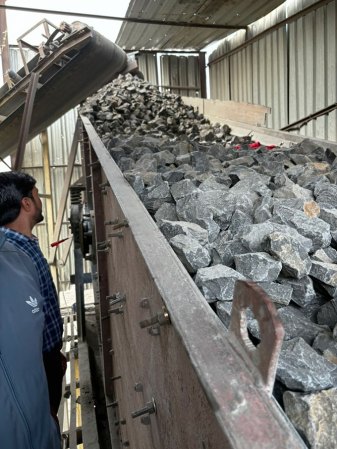
This rock crusher at a basalt quarry in India is moving rock that will be crushed into gravel to build roads. Powdered rock that’s too fine for road building can be used on nearby rice fields. Mining enough basalt and crushing it into dust is one challenge to enhanced rock weathering.
If ERW were done worldwide, Beerling’s team has calculated, it might capture up to 2 billion metric tons of CO2 per year. Combined with other CO2-trapping techniques — such as growing forests or using machines to filter the gas from industrial smokestacks — that could do a lot to combat climate change.
But big ERW would also bring big costs. People around the world would need to mine up to 13 billion metric tons of basalt each year. For perspective, that’s 400 million times the volume of a giant cement-mixing truck.
Some people recoil at that idea.
Bhoomika Chaudhury is one of them. “I do not think that very, very large-scale mining helps the Earth or people,” she says. Chaudhury is a business and human rights lawyer based in Dubai, in the Middle East. She previously worked with the international Business & Human Rights Resource Center. There, she studied how mining affects people’s lives in places like India.
Still, ERW has advantages over some other CO2-removal techniques. Growing trees to suck up the pollutant, for instance, might use land needed for growing food. With ERW, you “avoid this competition with land use,” say Beerling. And it doesn’t require anything more technical than dump trucks and tractors.
Crusty carbon corn
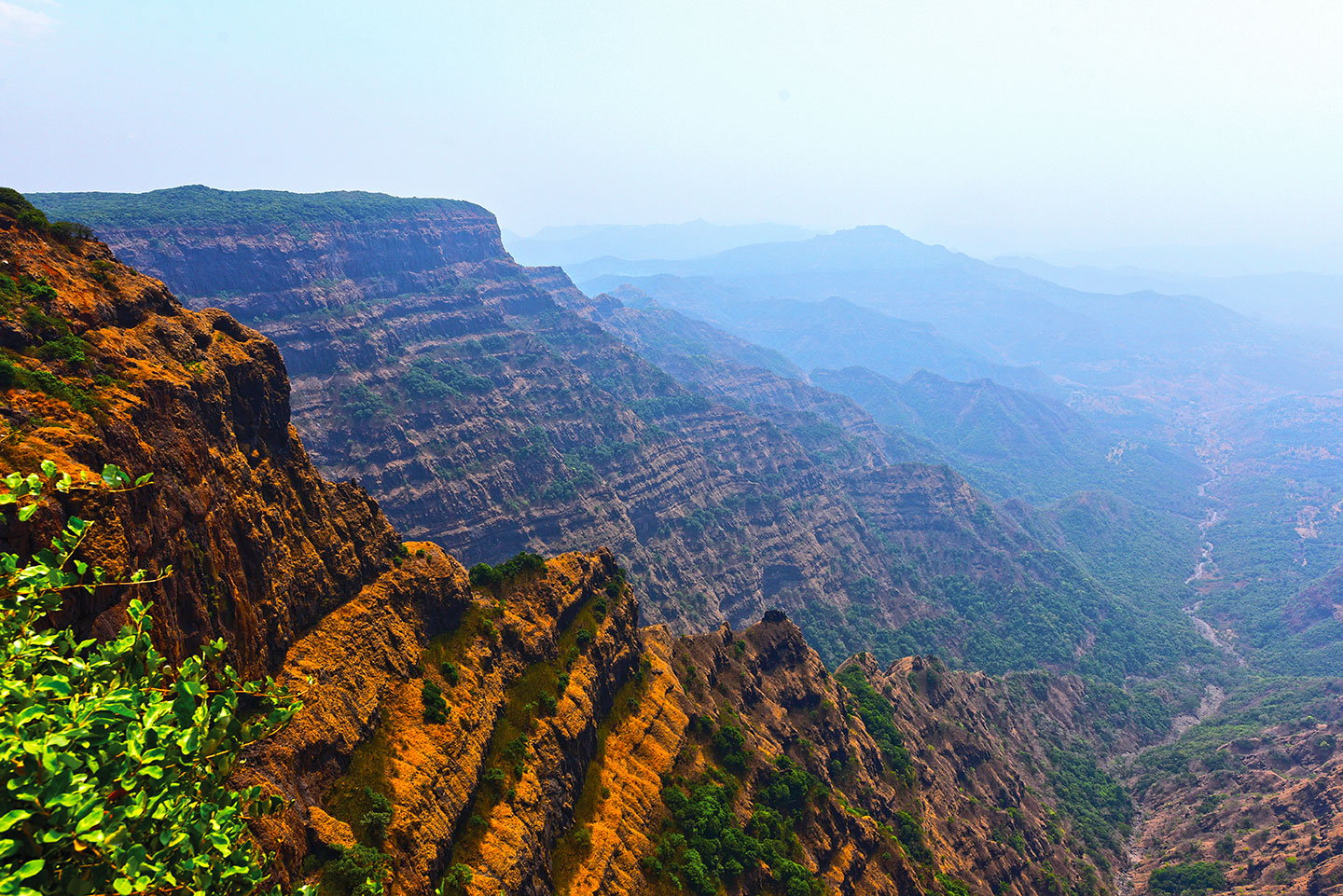
Rocks high in magnesium and calcium — such as basalt — have a knack for capturing CO2. Drive through western India, or Oman in the Middle East, or the Atlantic U.S. coast, and you can see cliffs of basalt or other rocks crisscrossed with white stripes.
Those stripes are carbonate minerals — essentially, petrified CO2. They form naturally. As rainwater percolates through cracks in rocks, CO2 that’s dissolved in the rainwater reacts with calcium or magnesium in the stone. Those reactions lock up CO2 in mineral form.
Something similar occurs at rundown steel mills in England. Refining iron creates gray, gravelly waste. Called slag, it holds lots of calcium and magnesium. So does crumbling concrete and the crushed-rock wastes — called tailings — left behind by mining many metals. Carbonate can even form in the wastes left behind from burning coal or from extracting aluminum from mined ore.
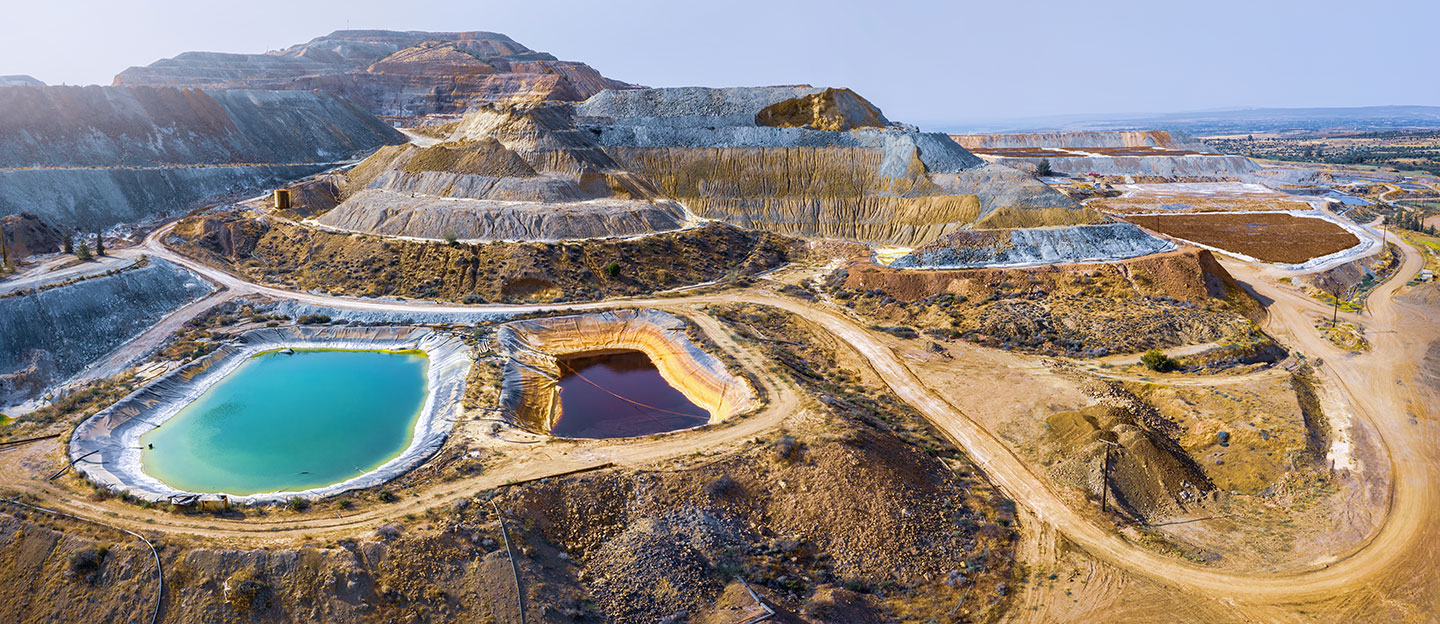
White carbonate crusts can form in the soil around these old deposits. Researchers are looking for ways to use vast mountains of such waste to capture CO2. (Arca, a CO2-removal company in Vancouver, Canada, for instance, is finding ways to stir mine tailings so they will more quickly bind up the carbon in CO2.)
One problem: Many of these wastes also host toxic metals or metal-like elements, such as chromium, lead and arsenic. So they must be used in a way that does not involve growing food.
Basalt ties up carbon but hosts few toxic metals. That makes it a better candidate for farm fields.
In 2016, Beerling and Evan DeLucia launched an experiment to see if basalt would boost soil’s ability to trap CO2.
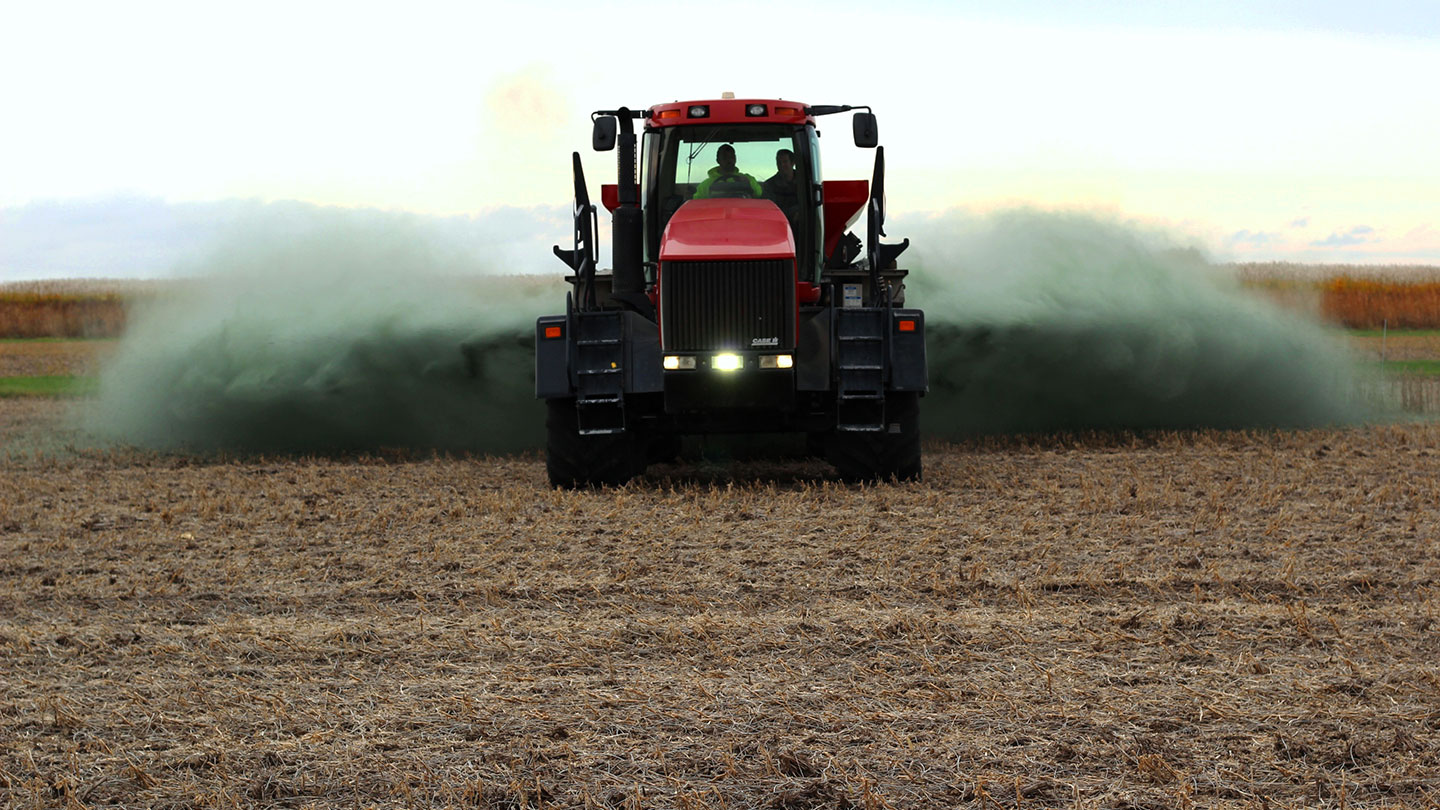
DeLucia is a plant scientist at the University of Illinois Urbana-Champaign. At a farm there, workers spread basalt dust on several fields. On some, they grew alternating crops of corn and soybeans. On the rest, they planted a tall grass — miscanthus. (It’s used to make biofuels for cars and trucks.)
They started out by adding 21 metric tons per acre (50 tons per hectare). Each year, the team added more basalt.
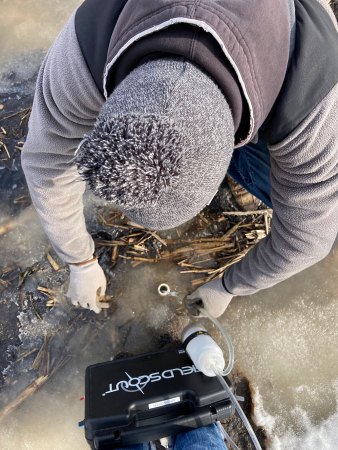
Beerling and DeLucia regularly sampled the fields’ soil and water. They measured how quickly the rock was breaking down. And they calculated how much CO2 had been trapped per hectare of land. (A hectare is 2.5 acres, or about 1.4 times the size of a soccer field.)
Each hectare of miscanthus captured an average of roughly 8.6 metric tons of CO2 per year. And each hectare of corn and soy captured about 2.6 metric tons of CO2 per year. His team shared its findings in papers published in 2023 and 2024.
“This was really a first for us,” says Beerling. And these greenhouse-gas data are “very exciting,” he adds.
In 2025, another report calculated how much CO2 could realistically be captured if the treatment were ramped up quickly across 20 U.S. states. That tally came to 160 million to 300 million metric tons of CO2 per year by 2050. By 2070, that could rise to 250 million to 490 million metric tons. That would be equal to the CO2 emitted by 1 billion miles traveled by gasoline-powered cars or the energy used to charge 32.3 billion smartphones.
Cow and plant farts
Not all CO2 comes from factories and vehicles. Farming releases a lot, too.
Plants suck up some as they grow. But plowing and fertilizing stimulates soil microbes. These exhale CO2 as they chow down on plant wastes. And where cattle graze, those beasts will burp and fart out even more greenhouse gases. They’re produced by microbes in the animals’ guts.
Overall, crops and livestock produce about one-tenth of all greenhouse gases emitted in the United States. These farm-emitted greenhouse gases add up to about 600 million metric tons of CO2 per year.
Crushed basalt reduces those farming emissions. In the Illinois study, fields growing corn and soy still emitted some CO2 even when basalt was added. But adding the basalt cut those emissions by 20 to 40 percent. In the fields growing miscanthus, adding basalt caused them to trap more CO2 than they released.
Beerling’s team has estimated that spreading basalt on farm soils across 12 large nations — including China, India and the United States — could trap some 2 billion metric tons of CO2 per year by 2050. Building up to mining, crushing and spreading that much rock dust could take years, though.
At the same time, scientists see another possible benefit from spreading basalt on fields: more crops.
In the Illinois study, basalt dust increased corn yields by 12 percent and soy yields by 16 percent. Multiplied across the entire U.S. Corn Belt, that could put an extra $17 billion per year into farmers’ pockets.
And in England, adding crushed basalt increased oat harvests by up to 20 percent. That extra growth came despite it being a dry year, notes Kirstine Skov. A geographer, she led that study. She works for a company in London, England, called UNDO Carbon.
Skov credits the crop boost to silica. Basalt’s breakdown releases it. “Plants use silica to strengthen their cell walls,” she says. Those sturdy barriers shield the plant from drying out. “That can make the crops more drought and pest resistant.”
Basalt’s potential anti-drought benefit could prove a huge boon to farmers in countries hard hit by climate change.
Global Basalt Distribution
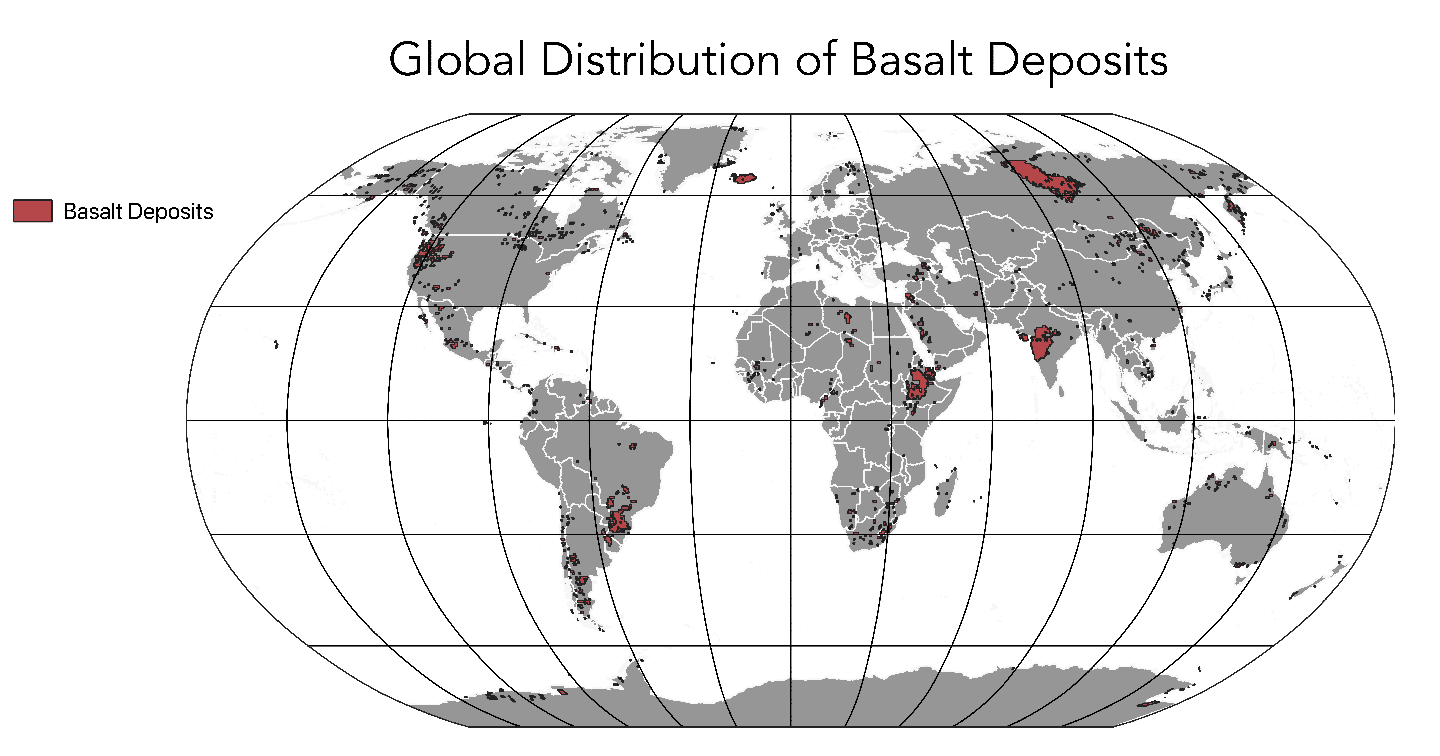
Basalt is one of the most common rocks on Earth’s surface (upper map). That means that many farms are located close to sources of it (lower map), potentially making them good sites for basalt treatment.
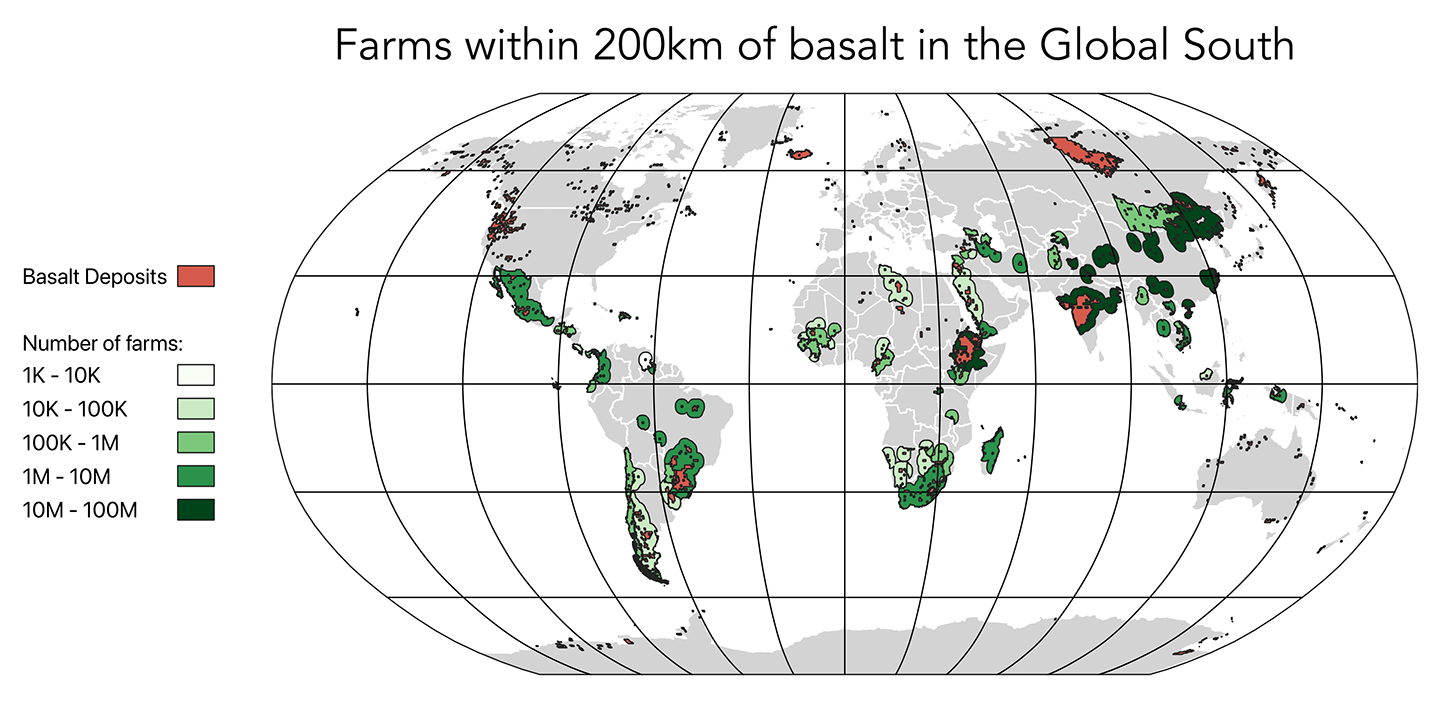
Vulnerable to climate
In central India, rice crops depend on heavy monsoon rains. But over the past 75 years, these summer rains have decreased by around 15 percent. Droughts there have been frequent since 2000, as have the number of extremely hot days.
Fortunately, basalt is plentiful in this part of India.
A few years ago, Agarwal heard about the successful basalt trials on Illinois farms. They prompted this business-starter in Houston, Texas, to launch Mati Carbon in 2022. It aims to bring basalt soil treatment to farmers in India, his home country. He hired Jake Jordan as his chief scientist. A geoscientist, Jordan is based in St. Louis, Mo.
“The goal is to provide climate relief” to poor farmers, who are “most vulnerable” to climate change, says Jordan. They’re also among those least responsible for producing CO2 emissions, he notes. They don’t fly on airplanes or drive big cars.
Mati Carbon arranged for farmers in Sarekha Khurd and other villages to spread basalt dust on their fields. By December 2025, the company was working with 16,000 farmers across India. They had spread 300,000 metric tons of the rock dust onto their fields. Mati Carbon is now working with farmers in two African nations, Zambia and Tanzania, too.
The company is monitoring some of the fields to verify if they’re capturing CO2. In February, Jordan reported some positive early results.
His team looked at the rice paddies of more than 600 farmers in the Indian state of Chhattisgarh. It’s near Sarekha Khurd. Farmers who used basalt dust captured around 4 metric tons of CO2 per hectare of land during the first year. Their rice yields also increased by 23 percent. For an average rice farmer, that could mean an extra $300 of income, according to their calculations.
Workers bury a device called a lysimeter at a rice-field test site in India. It will allow researchers to measure chemical changes in the soil and water as basalt dust breaks down. The breakdown of that basalt, which was mixed into the soil earlier in the year, releases nutrients and traps CO2.
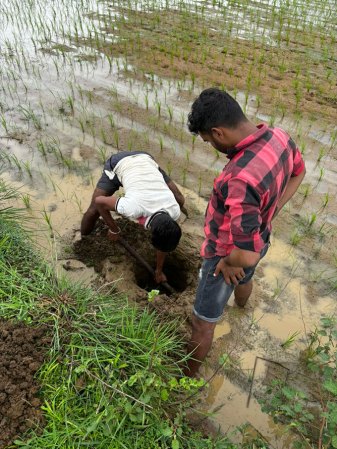
That CO2 capture number is an educated estimate, Jordan points out (since measuring it is very challenging). But as basalt is eventually spread over far bigger expanses, he and other scientists could also tally the trapped CO2 another way. Dissolved CO2 reacts with water and minerals to form a molecule called bicarbonate. Researchers could measure bicarbonate levels in rivers that drain the rainwater from treated fields.
This process will take a while, though. Based on one large study of U.S. rivers, it could take 20 to 40 years for those bicarbonate increases to show up in the runoff entering the Mississippi River.
Do you have a science question? We can help!
Submit your question here, and we might answer it an upcoming issue of Science News Explores
More mining
Obtaining enough rock may be the biggest challenge of all. Digging up and crushing 4.5 cubic kilometers of it each year is a daunting task. It would mean boosting worldwide gravel and stone mining by 30 percent. Crushing and trucking all of that to farms would take money and energy. And it would have environmental costs.
Beerling’s team has included those costs in its calculations. It would cost around $100 to $150 per metric ton of CO2 captured, they estimate. That would be similar to the costs of some other CO2-reduction methods, such as biofuels. And it would be lower than the cost of using machines to capture CO2 from the air.
If you add in basalt’s crop benefits, the picture might look even rosier.
Farmers already use lots of fertilizers. These often come from rock that is mined, crushed, cooked and treated with strong acids. Making them in factories takes lots of energy and spews out lots of CO2 pollution, explains Eunice Oppon. She’s an environmental economist at the University of Exeter Business School, in England.
She compared the environmental costs of farm fertilizers against those for crushed basalt. Basalt “is environmentally more sustainable,” she finds. Its greenhouse-gas emissions, she’s calculated, are “way less, compared to how we [currently] produce fertilizers.”
For farmers in Sarekha Khurd, replacing some of those fertilizers with crushed basalt could make a big difference. Currently, much of what they earn from their rice must go to buy costly fertilizers. A drought and a bad harvest might force them to give up farming.
Losing a farm often forces families to travel far away, to the outskirts of some large city. There, thousands of displaced farmers can end up crowded into rickety shanty towns of concrete blocks and plywood. For the world’s poorest farmers, that future is what climate change threatens.
Basalt soil treatment may avert such a future, some scientists hope.
Our goal is “keeping more of those folks on their farms, doing things they know how to do,” says Jordan. Picturing that, he says, is what “gets me out of bed” every morning.
📚 NCsolve - Your Global Education Partner 🌍
Empowering Students with AI-Driven Learning Solutions
Welcome to NCsolve — your trusted educational platform designed to support students worldwide. Whether you're preparing for Class 10, Class 11, or Class 12, NCsolve offers a wide range of learning resources powered by AI Education.
Our platform is committed to providing detailed solutions, effective study techniques, and reliable content to help you achieve academic success. With our AI-driven tools, you can now access personalized study guides, practice tests, and interactive learning experiences from anywhere in the world.
🔎 Why Choose NCsolve?
At NCsolve, we believe in smart learning. Our platform offers:
- ✅ AI-powered solutions for faster and accurate learning.
- ✅ Step-by-step NCERT Solutions for all subjects.
- ✅ Access to Sample Papers and Previous Year Questions.
- ✅ Detailed explanations to strengthen your concepts.
- ✅ Regular updates on exams, syllabus changes, and study tips.
- ✅ Support for students worldwide with multi-language content.
🌐 Explore Our Websites:
🔹 ncsolve.blogspot.com
🔹 ncsolve-global.blogspot.com
🔹 edu-ai.blogspot.com
📲 Connect With Us:
👍 Facebook: NCsolve
📧 Email: ncsolve@yopmail.com

😇 WHAT'S YOUR DOUBT DEAR ☕️
🌎 YOU'RE BEST 🏆