
Can animals experience joy?
Well, of course — just look at my tuxedo cat, Tango. Every night, he waits atop the bed for his brother Teddy, a fat orange tabby that resembles a loaf of bread. When Teddy strolls by, Tango reaches out to snatch his brother’s tail with apparent glee.
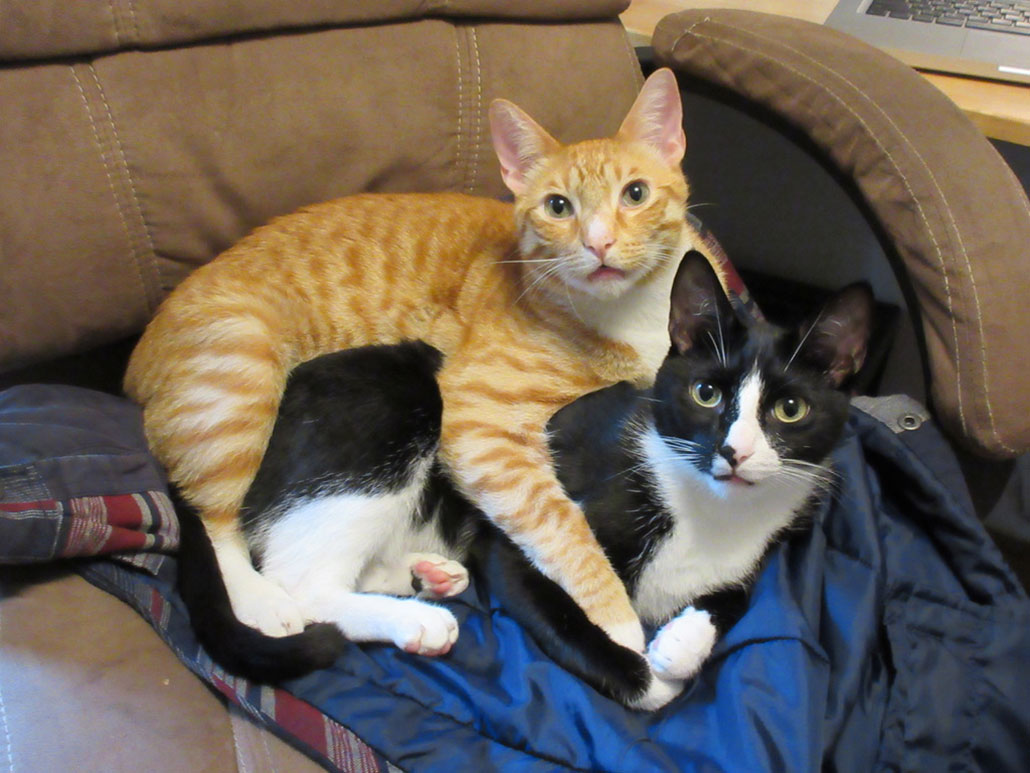
As animals ourselves, we think we see happiness in our fellow creatures all the time. Dogs romp in the park. Squirrels chase each other. Tango purrs his head off at night while attempting to sleep on my face. Yet I know that tail-snatch might not express glee. I can’t be certain what a creature that can’t speak to me is feeling. Sure, young squirrels could be playing. But adults are more likely to be chasing off a rival for their stored acorns or competing for a mate.
For decades, scientists haven’t paid much attention to good feelings in nonhuman animals. When they do study this, they call it “positive affect.” But they have struggled to identify or measure it. And they have been wary of anthropomorphism (giving human characteristics to nonhumans) and subjective topics like feelings.
Scientists were doubtful even after one study found that rats make a laughter-like sound when tickled. (Later studies found rats not just laughing, but also jumping for joy and playing hide-and-seek.)
Better tools to measure positive emotions could help. They’d let scientists more deeply investigate what causes happiness and how animals communicate it. And they could be used to support mental health among captive animals. The question has inspired a bold group effort to develop a “joy-o-meter.” This set of happiness tests, if it works, could help understand many critters, whether they walk, fly or swim.
Gordon M. Burghardt studied animal play for more than 40 years. He’s now retired from the University of Tennessee, Knoxville. He is not involved in the joy project, but he says it’s a good idea. He notes, “Positive affect is as much worthy of scientific study as studying pain and negative emotions.”
Defining joy
“The overall goal of the project is to establish this serious, scientific approach to positive emotion in animals,” says Erica Cartmill. She’s a cognitive scientist at Indiana University Bloomington. Cartmill studies great apes. But she knew that they wouldn’t be enough to build happiness tests for all creatures. So she joined up with scientists who study dolphins and parrots.
The project quickly ran into challenges. “Studying emotions is actually really hard,” says Colin Allen. This team member is a philosopher at the University of California, Santa Barbara.
Do you have a science question? We can help!
Submit your question here, and we might answer it an upcoming issue of Science News Explores
To keep it simple, Allen and the other scientists have focused on a strict definition of joy. For this project, they call “joy” an intense, brief, positive emotion triggered by an event. That event might be getting a favorite food or reuniting with a friend. Even with a strict definition, though, it’s tough. Animals vary a lot, even within the same species or group, they’re finding.
“You want to make sure that what you’re putting out there is based on reality, as opposed to just guessing what is happening in the animal’s mind,” says Heidi Lyn. She is a comparative psychologist at the University of South Alabama in Mobile. She is in charge of the project’s dolphin studies as well as some of the ape work.
Do our nearest relatives feel joy?
The team began the work in apes, humankind’s closest relatives. Bonobos are known for playful behavior. Chimpanzees are considered more violent.
Wild chimps don’t have easy lives, says Gal Badihi. She’s a primatologist on the team. She spent three months following a chimp troop around in Senegal, in western Africa. Chimps deal with power struggles, competition and a constant search for food. Nonetheless, Badihi recorded moments that might be joyful.
For example, chimps played with infants. A baby called Youssa proved to be quite the goofball. He would hang upside down all the time. Other young chimps liked to drink from each other’s mouths or roll around giggling. When reuniting with their friends, chimps would hug and kiss. “The joyous moments kind of stick out because they are quite rare,” says Badihi.
Chimps often made a panting sound like a whispered laugh during those apparently positive or social behaviors. They also panted during situations where they wanted to communicate positive intent or stop a conflict. “It’s really similar to how we use laughter and smiles across social context as people,” Badihi says. (She now works at the German Primate Center in Göttingen.)
Behavioral biologist Daan Laméris is another team member. He tried to trigger possible joyful moments with a bonobo troop at ZOO Planckendael in Mechelen, Belgium. He brought new toys to the bonobo enclosure. His attempts illustrate how hard it is to predict what makes animals happy. Their favorites included a basketball, burlap sacks and T-shirts. (The bonobos like to tear the fabric.) But they ignored other toys, like tennis balls. And not all apes responded the same way to the joy triggers. The goal is to assess whether apes that play together tend to interact more later in the day. But Laméris isn’t ready to finalize his conclusions.
Primatologist Sasha Winkler is yet another member of the research group. She has succeeded in both causing and measuring signs of joy in bonobos. She worked with animals at the Ape Initiative in Des Moines, Iowa. Her approach was based on something scientists know, that depression can make people feel pessimistic. She used this connection to design a test of bonobo feelings. First, Winkler trained four adult bonobos to approach a black box in expectation of a tasty grape. And they learned to ignore a white box that held no such treat. If the researchers then offered a gray box, Winkler expected, an optimistic bonobo would be more likely to check it out, hoping for a goody.
Then she brought in the happiness trigger: the sound of baby bonobo laughter. Winkler and co-workers primed the apes with a sound recording of seven and a half minutes of either laughter or a neutral, windlike sound. Then they set out the boxes. After hearing baby giggles, the bonobos were more likely to approach the gray boxes. Winkler reported this in 2025 in Scientific Reports. “That was evidence that they feel better after hearing laughter,” says Winkler. She is now a postdoctoral fellow at Duke University in Durham, N.C.
The researchers are also conducting “windfall” experiments in multiple species. This type of test offers a happy surprise as the joy trigger. Lyn tackled this test with bonobos at the Ape Initiative and Jacksonville Zoo and Gardens in Florida. She used an unexpected bounty of treats as the trigger.
First, the experimenter showed a bonobo a grape. Then they hid the fruit between two overturned bins. Finally, the researcher revealed the grape for the ape to eat. So far, the treat was entirely expected.
But after repeating this five times, the researcher performed a magic trick. Unnoticed by the bonobos, there was a third container underneath the other two. And sandwiched between the two lower boxes were 10 grapes — jackpot!
That reveal was the windfall. In response, the Jacksonville bonobos made hooting sounds that ape researchers call “food peeps.” The Des Moines bonobos nodded their heads instead, so that might also be a joyful sign, Lyn says.
The team also set up a social windfall. They arranged video calls between bonobos and their keepers on an iPad. The happy surprise was the appearance of a keeper the bonobo hadn’t seen in a while. Again, the apes peeped or nodded, suggesting those behaviors might be about more than food. “Maybe they’re just ‘happy peeps,’” Lyn speculates.
Parrots that make snowballs
The ape results were looking promising. So the researchers began parrot and dolphin studies in 2024.
The parrots under study are keas. These big, smart birds live in the mountains and forests of New Zealand’s South Island. Ximena Nelson is a behavioral biologist in Christchurch, New Zealand, at the University of Canterbury. She already had plenty of reasons to suspect keas experience joy. In particular, she noticed they seem to love sunny, snowy weather. Nelson has seen them make snowballs and sled down the roofs of ski huts. “That is anthropomorphizing, there’s no doubt about it,” she says. “But I’ve spent a lot of time up in the mountains with these kea[s], and it’s a thing, I’m sure of it.”
Nelson’s previous research had revealed that these parrots make playful “warble calls” that are contagious. It’s like human giggle fits. Playing a warble recording to a wild kea — young or adult — sets off a playful response. “It will start, like, tap-dancing,” Nelson says. “They start playing, and they start warble calling.”
Nelson worked with zoologist Alex Grabham. They figured those warble calls would make an easy joy trigger for experiments with a kea flock. (Kea flocks are sometimes called a “circus.”) This flock was at the Willowbank Wildlife Reserve in Christchurch. But the team immediately hit a snag. Born and raised in human care, these parrots had never heard a warble call. And they hated it. When the researchers played the tape, the birds flew around making distress calls.
After some time back at the drawing board, Grabham returned to the circus with new potential joy triggers.
One was a favorite food for the kea windfall experiment. It was a variation on what Lyn had done with the bonobos. First the keas got a carrot, which they consider “sort of a ‘meh’ food,” Nelson says. Then another carrot, and another carrot. Then, the windfall: peanut butter!
Grabham hopes to use changes in keas’ body temperature as a measure of joy. Body temperature changes with stress, so perhaps it does with happiness, too.
Measuring biological markers like temperature, and not just behaviors, is important, says Sergio Pellis. He’s an expert in animal behavior and play at the University of Lethbridge in Canada. He’s not involved in the joy-o-meter project. “Just looking at the behavior from the outside may not be sufficient to make a judgment about how much the animals are enjoying this,” he says.
For example, Pellis says, sometimes horses and dogs look like they’re playing. But their levels of the stress hormone cortisol indicate they’re not having a good time.
As with Laméris’ apes, individual parrots had varying interest in joy triggers. They also differed in whether they wanted to take part in the experiments at all. One young kea called Megatron eagerly bounded along behind Grabham as he headed for a testing platform. But another, Mystique, tended to ignore the scientist’s calls. She’d rather push a leaf back and forth in the water.
That doesn’t mean it’s not possible to trigger and measure joyful behaviors, Grabham says. But “one experiment might not fit all.”
He’s still analyzing data from the circus at the wildlife reserve. Meanwhile, data from wild keas has shored up Nelson’s beliefs about their happiness in sunny, snowy weather. She sent a student with a video camera to tramp up and down New Zealand’s mountains and film the birds. In the resulting videos, the keas were four times more likely to warble if the sun shone.
“It is intriguing that keas make a warble song during play. And that it is four times more frequent when the sun is shining emphasizes the potential joyful aspect of the display,” says Nicky Clayton. She’s an expert in bird behavior and cognition at the University of Cambridge in England who was not involved in the study.
“Given the difficulties,” says Nelson, “I think we’ve actually made quite a lot of progress.”
Behind the dolphin’s smile
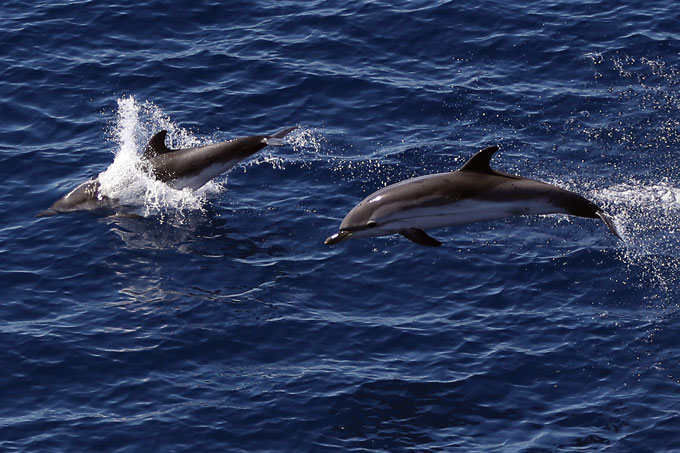
Like keas in the sun, dolphins sure look like they’re having fun. They leap through the bow waves of boats and play catch with bits of seaweed. But their characteristic “smile” is frozen in place. And it says nothing about how they feel.
Dolphins have a few things in common with great apes. For one, they’re intelligent. They also can sometimes be violent. They may kidnap females, kill baby dolphins or smack around harbor porpoises. And sometimes their play objects are unlucky sea turtles or seals.
Captive dolphins, too, are typically offered objects to play with. The Association of Zoos and Aquariums requires the facilities it certifies to provide animals with enrichment, such as toys. And here, a joy-o-meter could offer useful insight into the animals’ well-being. Not every toy offered provokes positive behaviors.
In a 2020 study, Lyn’s team provided new items like bubble generators or barrels coated in fake grass. The dolphins’ biggest response was to a meter-long (3-foot-long) block of ice. And it wasn’t a positive one — at least not at first. The two dolphins, Bo and Buster, initially fled, then returned to scope it out. Overall, dolphins tended to avoid the new objects — hardly a strong endorsement of their joy potential.
As with apes and parrots, vocal calls may be the key to understanding dolphin joy. Other dolphin researchers have defined a “victory squeal.” This is a sound the animals make when they catch a fish or receive a fish prize from their trainers.
The scientists suggest it reflects release of the reward chemical dopamine in the brain. Once trained, dolphins make the same sound after they complete a task, but before they get the fish reward. It’s as if they’re saying, “Yay, I did it!”
Lyn’s team has observed similar squeals in other situations. For instance, it’s happened when dolphins are surprised with a treat, like a toy or bucket of ice. She hopes to perform windfall experiments to measure if the dolphins squeal more in the moments after they get an joyful surprise, like a favorite toy.
Early data indicate that squeals may have a social function, too. If their trainers are also screaming with joy, the dolphins seem to make bigger or more frequent squeals. And they do it when socializing with other dolphins, such as swimming together. “It seems to very much be this sort of communicative pattern,” Lyn says.
While there’s still plenty more work to do, the project researchers are excited about the progress they’ve made and what’s to come. After scientists spent many decades focusing on unhappy feelings, kea researcher Nelson notes, “It’s just nice to turn the tables and think about the positive.” Her own reason for studying animal happiness is even simpler than that: “Because it gives me joy.”
📚 NCsolve - Your Global Education Partner 🌍
Empowering Students with AI-Driven Learning Solutions
Welcome to NCsolve — your trusted educational platform designed to support students worldwide. Whether you're preparing for Class 10, Class 11, or Class 12, NCsolve offers a wide range of learning resources powered by AI Education.
Our platform is committed to providing detailed solutions, effective study techniques, and reliable content to help you achieve academic success. With our AI-driven tools, you can now access personalized study guides, practice tests, and interactive learning experiences from anywhere in the world.
🔎 Why Choose NCsolve?
At NCsolve, we believe in smart learning. Our platform offers:
- ✅ AI-powered solutions for faster and accurate learning.
- ✅ Step-by-step NCERT Solutions for all subjects.
- ✅ Access to Sample Papers and Previous Year Questions.
- ✅ Detailed explanations to strengthen your concepts.
- ✅ Regular updates on exams, syllabus changes, and study tips.
- ✅ Support for students worldwide with multi-language content.
🌐 Explore Our Websites:
🔹 ncsolve.blogspot.com
🔹 ncsolve-global.blogspot.com
🔹 edu-ai.blogspot.com
📲 Connect With Us:
👍 Facebook: NCsolve
📧 Email: ncsolve@yopmail.com

😇 WHAT'S YOUR DOUBT DEAR ☕️
🌎 YOU'RE BEST 🏆