
Being from New Orleans, La., Elliott White Jr. has a clear understanding of the importance of healthy wetland ecosystems. He was 12 when Hurricane Katrina struck the Louisiana coast, which is home to vast wetlands. After the destructive storm, his family had to relocate to Galveston, Texas. “That was actually the driving force for me studying wetlands,” he says. “Since then, I have a more scientific reason. … Scientifically, wetlands are the ultimate ecosystem.” They let scientists like White investigate many scientific interests at once.
White now studies how climate change, sea level rise and human impacts affect coastal ecosystems and local communities. He has to think about how plants, soil, water and animals interact with each other. And he considers how humans help or hurt in these environments. “It’s [focusing] on environmental science in one hand and social sciences in the other hand — and doing so in a way that actually brings them together,” he says.
While working on his Ph.D. at the University of Florida, White studied the part of the Okefenokee swamp that drains into the Suwannee River. That led him to becoming an advisor on the Okefenokee’s application to be named a UNESCO World Heritage Site. This designation would grant the land extra protections for future generations to enjoy. Now, he’s at Stanford University in California leading a group that’s studying wetlands around the world. In this interview, he shares his experience and advice with Science News Explores. (This interview has been edited for content and readability.)
What made you want to study wetlands?
In my junior year of undergrad, I decided I wanted to go to graduate school. But when my undergraduate academic advisor asked me what I wanted to study, I hadn’t thought that far yet. I went back to my dorm room and remembered this ad would play on the radio when I was growing up in New Orleans. It said, “Louisiana is losing a football field of wetlands every 45 minutes.”
In my college coursework, I learned that wetlands can actually reduce the impacts of hurricanes and reduce storm surges. And so I wondered, if Louisiana hadn’t been losing wetlands for at least 100 years, would Hurricane Katrina have been so bad? Would my family and I have had to evacuate and relocate? That’s where that really strong desire to study wetlands and restore them came from. If wetlands can be a part of our natural defense systems against hurricanes, then we need to do what we can to save them.
What are you researching right now?
I’m in The Gambia in West Africa studying a wetland ecosystem called mangrove forests. Most plants cannot tolerate being in salt water, but mangrove trees can. What’s happening in Gambia right now is primarily driven by climate change. There’s not as much fresh water coming down the River Gambia. The soil is becoming too salty even for mangroves to live. Huge patches of the mangrove forest are dying off.
Companies from other countries are replanting mangroves as part of restoration efforts. But they’re not always replanting mangroves in the best places or planting the right species. This could cause problems in the mangrove ecosystem. Some of the animals that used to live in a more diverse mangrove ecosystem are now living in a mangrove ecosystem that only has one type of tree, for instance.
And the human population can be affected, too. Culturally, the people of Gambia use the mangrove ecosystem for a lot of different things. They use the wood for building. Oysters grow on the roots of the trees. People are losing access to their livelihood and food. It’s important to make sure that we’re doing this restoration correctly. So that not only the ecosystem benefits properly, but the humans living in those landscapes are interacting with the right mix of species.
How do you get your best ideas?
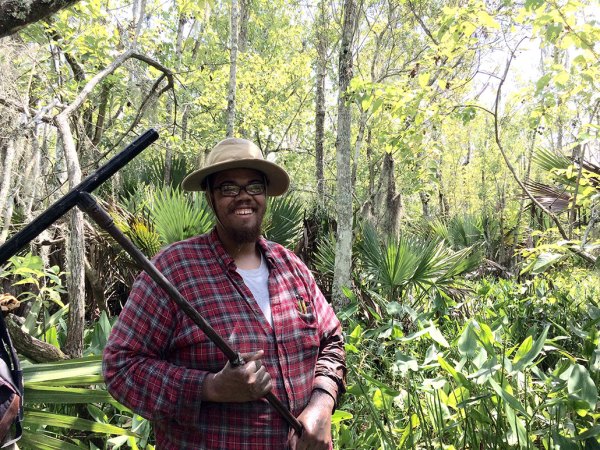
I get my best ideas doing field work. Going out and being in the environment, you get a chance to see things in a way that you can never really experience in the classroom. When you’re out there, you get a chance to see how these things actually interact in person, and you get to see variation.
What is one of your biggest successes?
Graduating with a Ph.D. is a big success for me. I’m the first person in my family to do anything like that. Many people in my family have college degrees, but none of them did science. I’m also the only one in my family, as far as I know, that pursued science as a professional career.
Have you ever made a mistake in your career? How did you overcome it?
I was placed on academic probation, and I had to meet with my advisor. It was the most beneficial meeting I probably had in my career. He was trying to build me back up, and he diagnosed the problem as imposter syndrome, which is people feeling like they don’t belong in a certain environment for many different reasons. Sometimes it’s made worse by the fear that if you ask for help, other people might also think that you don’t belong. And that was what was really holding me back.
The major lesson that came out of that experience is just learning how to ask for help. And not being afraid that people will think less of me or think I’m not smart enough because I have to ask for help. Even at this point in my career, I still ask people for help.
What piece of advice do you wish you had been given when you were younger?
Some people may find themselves in places and spaces where they’re the only one that looks like them, and sometimes that can be challenging to deal with. But just because you’re the only one that looks like you in a certain place or space doesn’t mean that you don’t belong. You very much do belong there.
What would you say to kids who experience natural disasters like you did growing up?
There’s always tomorrow. The place you live at may be experiencing climate change in a really drastic way, but that’s not the end all, be all for your life and what you can be. And sometimes when you are in those types of places where it seems like there’s no hope, you just have to look for those silver linings to keep you motivated and to keep you moving forward. Because sometimes when you get stuck, it’s hard to get out. And that’s true in wetlands, too. Sometimes you get stuck in the mud and it’s very hard to climb out.
📚 NCsolve - Your Global Education Partner 🌍
Empowering Students with AI-Driven Learning Solutions
Welcome to NCsolve — your trusted educational platform designed to support students worldwide. Whether you're preparing for Class 10, Class 11, or Class 12, NCsolve offers a wide range of learning resources powered by AI Education.
Our platform is committed to providing detailed solutions, effective study techniques, and reliable content to help you achieve academic success. With our AI-driven tools, you can now access personalized study guides, practice tests, and interactive learning experiences from anywhere in the world.
🔎 Why Choose NCsolve?
At NCsolve, we believe in smart learning. Our platform offers:
- ✅ AI-powered solutions for faster and accurate learning.
- ✅ Step-by-step NCERT Solutions for all subjects.
- ✅ Access to Sample Papers and Previous Year Questions.
- ✅ Detailed explanations to strengthen your concepts.
- ✅ Regular updates on exams, syllabus changes, and study tips.
- ✅ Support for students worldwide with multi-language content.
🌐 Explore Our Websites:
🔹 ncsolve.blogspot.com
🔹 ncsolve-global.blogspot.com
🔹 edu-ai.blogspot.com
📲 Connect With Us:
👍 Facebook: NCsolve
📧 Email: ncsolve@yopmail.com

😇 WHAT'S YOUR DOUBT DEAR ☕️
🌎 YOU'RE BEST 🏆