
During revision, students quickly go through Class 7 Maths Extra Questions Chapter 5 Parallel and Intersecting Lines Class 7 Extra Questions with Answers for clarity.
Class 7 Parallel and Intersecting Lines Extra Questions
Class 7 Maths Chapter 5 Parallel and Intersecting Lines Extra Questions
Class 7 Maths Chapter 5 Extra Questions – Parallel and Intersecting Lines Extra Questions Class 7
Question 1.
Identify the given pair of lines as either parallel, perpendicular, or intersecting.

(a) Lines FQ and HT are ___________ lines.
(b) Lines FQ and MW are ___________ lines.
(c) Lines CN and FQ are ___________ lines.
(d) Lines DZ and YG are ___________ lines.
(e) Lines CN and YG are ___________ lines.
(f) Lines HT and MW are ___________lines.
Solution:
(a) Lines FQ and HT are intersecting lines.
(b) Lines FQ and MW are parallel lines.
(c) Lines CN and FQ are perpendicular lines.
(d) Lines DZ and YG are perpendicular lines,
(e) Lines CN and YG are perpendicular lines.
(f) Lines HT and MW are intersecting lines.

Question 2.
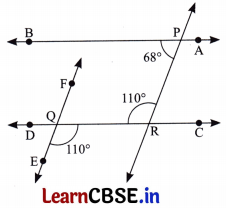
State which lines are parallel and why.
Solution:
If a transversal intersects two lines such that a pair of alternate interior angles is equal, then the two lines are parallel.
Since ∠EQR = ∠PRQ =110° and lines FE and PR are intersected by a transversal DC such that the pair of alternate angles is equal.
So, FE || PR.
Question 3.
In the given figure, l || m and t is a transversal. If ∠1 = 55°, find ∠2, ∠3, ∠4, ∠5, ∠6, ∠7 and ∠8.

Solution:
Since l || m and ∠1 = 55°
So, ∠3 = ∠1 = 55° (Vertically opposite angles)
and ∠1 + ∠2 = 180° (Linear pair)
or, ∠2 = 180° – ∠1 = 180° – 55° = 125°
Also, ∠5 = ∠3 = 55° (Alternate interior angles)
Now, ∠4 + ∠5 = 180°
(Interior angles on the same side of the transversal)
or ∠4 = 180° – ∠5 = 180° – 55° = 125°
Also, ∠6 = ∠2 = 125° (Corresponding angles)
Now ∠5 = ∠7 = 55° (Vertically opposite angles)
Also, ∠6 = ∠8 = 125° (Vertically opposite angles)
Hence, ∠2 = 125°, ∠3 = 55°, ∠4 = 125°, ∠5 = 55°, ∠6 = 125°, ∠7 = 55° and ∠8 = 125°.
Question 4.
In the given question, a statement of Assertion (A) is followed by a statement of Reason (R).
Assertion (A): Two vertically opposite angles can be obtuse.
Reason (R): Two vertically opposite angles are always equal to each other.
Choose the correct option as:
(a) Both assertion and reason are true and the reason is the correct explanation of assertion.
(b) Both assertion and reason are true but the reason is not the correct explanation of the assertion.
(c) Assertion is true and the reason is false.
(d) Assertion is false, and the reason is true.
Solution:
(b) The assertion is true—vertically opposite angles can be obtuse.
The reason is also true, as it is a fundamental property of vertically opposite angles.
Thus, both the assertion and the reason are true, but the reason does not directly explain why vertically opposite angles can be obtuse.
Question 5.
Find whether the lines AB and CD are parallel or not.

Solution:
∠CIF + ∠FIJ = 180° “[Linear pair]
∠CIF = 180°- ∠FIJ
= 180° -50°= 130°
So, ∠ALI = ∠CIF = 130° .
If two parallel lines are intersected by a transversal, then each pair of corresponding angles are equal.
Here, ∠ALI = ∠CIF = 130° are two corresponding angles.
Hence, AB || CD.
Question 6.
In the figure given below, if AB is parallel to CD and CD is parallel to EF, find ∠ACE.
Solution:
Given that AB is parallel to CD and CD is parallel to EF.
∠CEF + ∠ECD = 180°
[Sum of the interior angles of same side of transversal]
130° + ∠ECD = 180°
∠ECD = 180°-130° = 50°
Also, ∠BAC = ∠ACD = 70° [Alternate angles]
Now, ∠ACD = ∠ECD + ∠ACE
∠ACE = ∠ACD – ∠ECD
= 70° – 50°
= 20°
Therefore, ∠ACE = 20°.
Very Short Answer Type Questions
Question 1.
Draw any rectangle and find the measures of angles at the four vertices made by the intersecting lines.
Answer:
Let A B C D be the rectangle.
A B C D is a parallelogram with ∠A = 90°.
We have, ∠C = ∠A = 90°
[opposite angles of a parallelogram are equal]

Again, ∠A+∠B = 180°
[ ∵ ∠A and ∠B are adjacent angles of a parallelogram]
→ 90°+∠B = 180°
→ ∠B = 180°-90° = 90°
∴ ∠D = ∠B = 90°
[ ∵ opposite angles of a parallelogram are equal]
Hence, ∠A = ∠B = ∠C = ∠D = 90°
Question 2.
Name the pair of angles in figure.

Answer:
∠11 and ∠12 are pair of linear pair of angles.
Question 3.
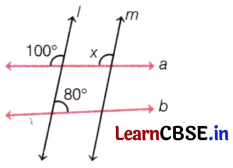
Find the value of x in the following figure if I and m are parallel lines.
Answer:
Since, l and m are parallel lines and a is a transversal.

∴ ∠x = 100° [corresponding angles]
Hence, the required value of x is 100°.
Question 4.
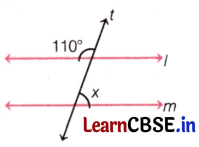
Find the value of x in the following figure if I and m are parallel lines.
Answer:
We have, l and m are parallel lines and t is a transversal.
∴ ∠x = ∠1 [alternate interior angles]
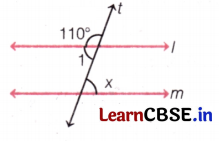
Now, ∠1 + 110° = 180°
[by linear pair]
∴ ∠1 = 180°-110° = 70° → ∠x = 70°
Hence, the required value of x is 70°.
Question 5.
In the given figure, state whether l is parallel to m or not?

Answer:
Since, 44°+126° = 170°
But 170° ≠ 180°
i.e.The sum of the interior angles on the same side of the transversal is not 180°.
So, l and m are not parallel.
Short Answer Type Questions
Question 1.
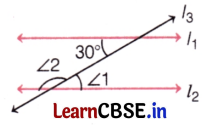
In the following figure, I1 is parallel to I2. Find the value of ∠1 and ∠2.
Answer:
Since, line l1 is parallel to the line l2, where line l3 is transversal and ∠30° and ∠1 are alternate interior angles.
So, ∠1 = 30°
Also, ∠1 and ∠2 form a linear pair angles.
So, ∠1+∠2 = 180° → 30°+∠2 = 180°
→ ∠2 = 180°-30° → ∠2 = 150°.
Question 2.
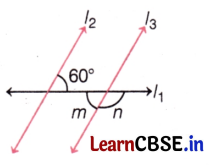
In the following figure, I2 is parallel to I3. Find the value of ∠m and ∠n.
Answer:
Since, lines l2 and l3 are parallel to each other, where l1 is transversal.
∴ ∠60° and m are alternate interior angles.
So, m = 60°
Also, angles m and n form a linear pair angles.
So, m + n = 180°
→ 60° + n = 180°
→ n = 180° – 60°
→ n = 120°
Question 3.
In the following figure, I1 is parallel to I2. Find the value of ∠P and ∠Q.

Answer:
Since, lines l1 and l2 are parallel to each other, where l3 is transversal.
∴ ∠130° and ∠P are corresponding angles.
So, ∠P = 130°
Also, ∠P and ∠Q are vertically opposite angles.
So, ∠Q = ∠P = 130°
→ ∠Q = 130°
Question 4.
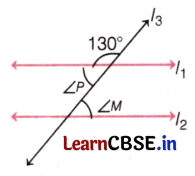
In the following figure, I1 is parallel to I2. Find the value of ∠M.
Answer:
Since, lines l1 and l2 are parallel to each other, where l3 is transversal.
∴ ∠P and ∠130° form a linear pair angles.
So, ∠P+130° = 180°
→ ∠P = 180° – 130°
→ ∠P = 50°
Also, ∠P and ∠M are alternate interior angles.
∴ ∠M = ∠P = 50°
Question 5.
In the following figure, l1 is parallel to l2. Find the value of ∠P and ∠Q.

Answer:
Since, lines l1 and l2 are parallel to each other, where l3 is transversal.
∴ ∠Q and ∠52° are vertically opposite angles.
So, ∠Q = 52°
Also, angles 128° and ∠P form a linear pair angles.
So, 128° + ∠P = 180°
→ ∠P = 180 °- 128°
→ ∠P = 52°
Question 6.
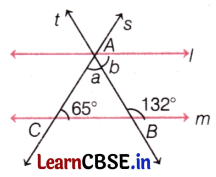
In the following figure, if l is parallel to m, find the value of ∠a and ∠b.
Answer:
Since, ∠b and ∠132° are pair of interior angles on the same side of transversal.
∴ ∠b + 132° = 180° [∵ cointerior angles ]
→ ∠b = 180°-132°
→ ∠b = 48°
Also, ∠a+∠b and ∠65° are pair of interior angles on the same side of transversal.
∴ ∠a+∠b+65° = 180°
→ ∠a+48°+65° = 180°
→ ∠a = 180° – 113°
→ ∠a = 67°
Hence, ∠a = 67° and ∠b = 48°
Question 7.
In the following figure, QP is parallel to RS, then find the value of ∠a and ∠b.

Answer:
Since, QP and RS are parallel lines, PR is a transversal.
∴ ∠QPR = ∠PRS = 65° [alternate interior angles]
∠a = 65° [∵ ∠PR S = ∠a]
∠PQR = ∠b = 70° [corresponding angles]
Hence, ∠a and ∠b are 65° and 70°, respectively.
Question 8.
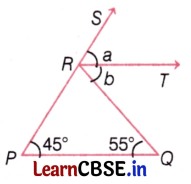
In the following figure, PQ is parallel to RT. Find the value of a + b.
Answer:
Since, PQ and RT are parallel lines and RQ is a transversal.
∠RPQ and ∠a are corresponding angles.
∴ ∠RPQ = ∠a
→ ∠a = 45°
Also, ∠b and ∠RQP are alternate interior angles.
∴ ∠b = 55°
Hence, ∠a+∠b = 45°+55° = 100°
Question 9.
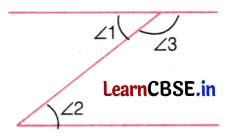
In the following figure, ∠2 = 58°. Find ∠1 and ∠3.
Answer:
Given, ∠2 = 58°
→ ∠1 = ∠2 = 58°
[alternate interior angles]
Also, ∠1 + ∠3 = 180°
[linear pair]
∴ 58°+∠3 = 180°
→ ∠3 = 180° – 58°
So, ∠1 = 58° and ∠3 = 122°
Question 10.
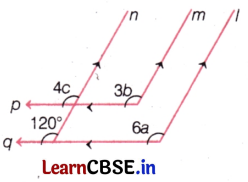
In the adjoining figure, I, m and n are parallel lines and the lines p and q are also parallel. Find the values of a, b and c.
Answer:
Given, l || m || n and p || q
∴ 6a = 120°
⇒ a = \(\frac{120°}{6}\) = 20°
Similarly, 4c = 120°
⇒ c = \(\frac{120°}{4}\) = 30° and 3b = 4c[correspondingangles]
⇒ b = \(\frac{4\times30°}{3}\)
⇒ b =40°
Question 11.
In the given figure, AB is parallel to CD. Find the reflex of ∠EFG.

Answer:
Given, ∠1 = 34°
∠AEF = 34° [alternate interior angles]
∵ ∠FGD = 135°
∴ ∠2 + 135° = 180° [sum of pair of cointerior angles is 180°]
∠2 = 180°-135°
→ ∠2 = 45°
→ ∠1 + ∠2 = 34° + 45° = 79°
Reflex of ∠EFG = 360° – 79° = 281°
[∵ reflex angle is less than 360° and more than 180°]
Question 12.
In the given figure, two parallel lines / and m are cut by two transversals n and p. Find the values of x and y.

Answer:
Given, l and m are parallel lines, n and p are transversals, ∠TBO = 66°.
∴ ∠TBO + ∠x = 180°
[∵ l and m are parallel lines and cointerior angles has a sum of 180°]
→ ∠x = 180°-66° = 114°
∵ ∠OCA = ∠BDO
[alternate angles formed by transversal m are equal]
So, ∠BDO = 48° [alternate interior angles]
∵ ∠BDO+∠QDO = 180° [linear pair]
→ 48°+∠y = 180°
→ ∠y = 180°-48° = 132°
Long Answer Type Questions
Question 1.
In the following figure, AB is parallel to CD, AF is parallel to ED, ∠AFC = 70° and ∠FED = 40°, then find ∠EFD.

Answer:
Since, AF || ED and E F is a transversal.
Also, AB || CD
So, ∠AFE = ∠FED = 40° [alternate interior angles] 70° and (∠AFE + ∠EFD) form a linear pair angles.
70° + ∠AFE + ∠EFD = 180°
→ 70°+40° + ∠EFD = 180°
→ ∠EFD = 180° – 110°
→ ∠EFD = 70°
Question 2.
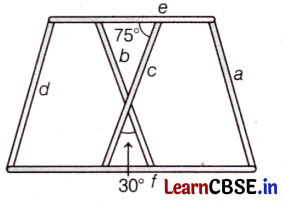
Iron rods a, b, c, d, e and f are making a design of a bridge as shown in figure, in which a is parallel to b, c is parallel to d, e is parallel to f. Find the marked angles between
(i) band c
(ii) d and e
(iii) d and f
(iv) c and f
Answer:
(i) Angle between b and c = 30° [vertically opposite angles]
(ii) Angle between d and e + Angle between
e and c = 180° [cointerior angles]
∴ Angle between d and e = 180°-75° = 105°
[∵ angle between c and e = 75°]
(iii) Angle between d and f+ Angle between d and e = 180°
[ ∵ pair of cointerior angles]
∴ Angle between d and f = 180°-105° = 75°
(iv) Angle between c and f = Angle between d and f [corresponding angles]
∴ Angle between c and f = 75°
Question 3.
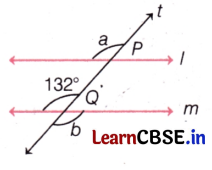
In the following figure, land m are parallel lines and a line t, intersects these lines at P and Q, respectively. Find the value of 2a + b.
Answer:
Since, lines l and m are parallel to each other and line t is a transversal.
∴ ∠132° and ∠b are vertically opposite angles.
So, ∠b = 132°
Also, ∠132° and ∠a are corresponding angles.
So, ∠a = 132°
Now, the value of 2a + b = 2 × 132° + 132° = 264° + 132°
∴ 2a + b = 396°
Hence, the value of 2a + b is 396°.
Question 4.
In the given figure, AE is parallel to GF and GF is parallel to BD, again AB is parallel to CG and CG is parallel to DF then find ∠ABC and ∠CDE

Answer:
Given, AE is parallel to GF and GF is parallel to BD, AB is parallel to C G and CG is parallel to DF.
∠CHE = 120°
∵ AE and BD are parallel lines.
∴ ∠CHE+∠HCD = 180° [cointerior angles]
→ 120°+∠HCD = 180°
→ ∠HCD = 180°-120° = 60°
→ ∠HCD = ∠ABC = 60° [corresponding angles]
Also, ∠HCD + ∠CDE = 180° [cointerior angles]
→ 60°+∠CDE = 180°
→ ∠CDE = 180° – 60°
∴ ∠CDE = 120°
Question 5.
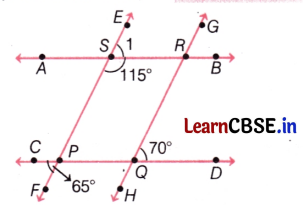
In the given figure, examine whether the following pairs of lines are parallel or not.
(i) E F and GH
(ii) A B and CD
Answer:
Given, ∠PSR = 115° ; ∠RQD = 70° and ∠CPF = 65°
(i) ∠PQR+∠RQD = 180°
[linear pair]
→ ∠PQR = 180°-70°
→ ∠PQR = 110°
∠CPF = ∠SPQ = 65° [vertically opposite angles]
If E F and G H are parallel lines then according to the definition of cointerior angles, the sum of ∠SPQ + ∠RQP should be 180°.
∴ 65° + 110° = 175° ≠ 180°
So, EF is not parallel to GH.
(ii) ∠CPF + ∠CPS = 180°
→ 65° + ∠CPS = 180°
→ ∠CP S = 180°-65° = 115° [linear pair]
If AB and CD are parallel lines then according to the definition of alternate angles,
∠RSP = ∠CPS
It is satisfying the condition. [∵ ∠RSP = ∠CPS = 115°] So, AB is parallel to CD.
Question 6.
In the following figure, E F is parallel to GH, ∠EAB = 70° and ∠ACH=120°. Then, find ∠CAF and ∠BAC.

Answer:
Since, lines EF and G H are parallel to each other.
Where, ∠EAB = 70° and ∠ACH = 120°
∠EAB and ∠CBA are alternate interior angles.
So, ∠CBA = 70°
∵(∠EAB + ∠BAC) and ∠ACH are alternate interior angles.
so, ∠EAB + ∠BAC = 120°
→ 70° + ∠BAC = 120°
→ ∠B A C = 120°-70° = 50°
∠CAE = ∠EAB + ∠BAC
∴ ∠CAE = 70°+50° = 120°
Also, ∠FAC + ∠CAE = 180° [linear pair]
→ ∠FAC = 180°-120°
∴ ∠FAC = 60°
Question 7.
Amisha makes a star with the help of line segments a, b, c, d, e and f in which a is parallel to d, b is parallel to e and c is parallel to f. Chhaya marks an angle as 120°, as shown in figure and asks Amisha to find ∠x, ∠y and ∠z. Help Amisha in finding the angles.

Answer:
Given, a is parallel to d, b is parallel to e, c is parallel to f and a, b, c, d, e and f are line segments.
Give them points A, B, C, D, E, F, G, H, I, J and K.
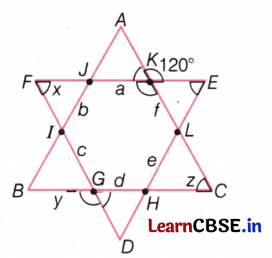
∵ ∠AKE = 120°
∴ ∠IKL = ∠AKE = 120° [vertically opposite angles]
Now, a and d are parallel lines.
∴ ∠JKL+∠KCH = 180°
→ 120°+∠z = 180°
→ ∠z = 180°-120° = 60° [cointerior angles]
Also, ∠FGH+∠KCH = 180° [cointerior angles]
→ ∠FGH = 180°-60° = 120°
∠FGH = ∠BGD [vertically opposite angles]
→ ∠BGD = 120° → ∠y = 120°
and ∠x+∠FGH = 180° [cointerior angles]
∴ ∠x = 180°-120° = 60°
Hence, ∠x = 60°, ∠y = 120° and ∠z = 60°.
Question 8.
A road crosses a railway line at an angle of 30° as shown in figure. Find the values of a, b and c.

Answer:
Firstly, make a rough diagram of given figure.
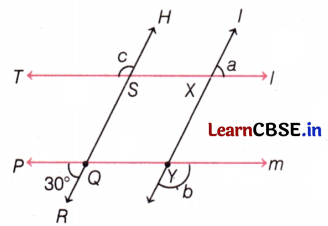
Given, ∠PQR = 30°
∠HST = ∠PQS [corresponding angles]
or ∠PQS = ∠c
∵ ∠RQS = 180° [by linear pair]
∴ ∠PQR+∠PQS = 180°
30°+∠c = 180°
→ ∠c = 180° – 30°
→ ∠c = 150°
∵ ∠XYQ = ∠PQS [corresponding angles]
and ∠XYQ = ∠b [vertically opposite angles]
∴ ∠b = ∠c or ∠b = 150°
Now, ∠IXS = ∠XYQ [corresponding angles]
∴ ∠IXS = 150°
Here, ∠IXS+∠a = 180° [linear pair]
→ 150°+∠a = 180°
→ ∠a = 180° – 150° = 30°
Skill Based Questions
Question 1.
Crossword Puzzle
Fill the crossword puzzle with the help of following clues.
Across
1. Two lines in a plane which do not intersect each other.
2. A pair of adjacent angles having their non common arms opposite rays.
3. The two lines are intersected by a line at distinct points.
4. Surn of two interior angles is equal to 180°.
Down
5. The two lines in a plane intersect each other at one and only one point are called ….. .
6. When two parallel lines intersected by a transversal at two distinct points then the ….. angles are equal.
7. A pair of angles having a common vertex, a common arm and their interiors do not overlap.
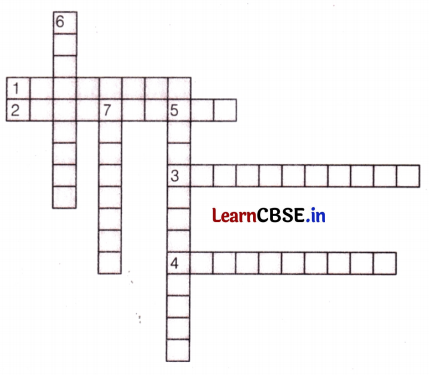
Answers:
1. Parallel
2. Linear pair
3. Transversal
4. Cointerior
5. Intersecting
6. Alternate
7. Adjacent
Class 7 Maths Chapter 5 Extra Questions in Hindi समांतर और प्रतिच्छेदी रेखाएँ
Parallel and Intersecting Lines Class 7 Extra Questions in Hindi
A. दक्षता आधारित प्रश्न (MCQs)
प्रश्न 1.
निम्नलिखित चित्र में, कोणों का कौन-सा युग्म संगत कोण नहीं है?

(a) ∠2 और ∠6
(b) ∠4 और ∠8
(c) ∠3 और ∠7
(d) ∠1 और ∠6
उत्तर:
(d) ∠1 और ∠6
प्रश्न 2.
निम्नलिखित चित्र में, रेखाएँ p और q समांतर हैं। y का क्या मान है?

(a) 32°
(b) 64°
(c) 116 °
(d) 148°
उत्तर:
(b) 64°
प्रश्न 3.
निम्नलिखित चित्र में RT पर OP लम्ब है, जहाँ 0 दो रेखाओं QS और RT का प्रतिच्छेद बिंदु है।
∠ROS का मान क्या है?

(a) 43°
(b) 133°
(c) 137°
(d) 143°
उत्तर:
(b) 133°
प्रश्न 4.
यदि एक रैखिक युग्म का एक कोण 105° है, तो उसका दूसरा कोण है:
(a) 75°
(b) 45°
(c) 65°
(d) 55°
उत्तर:
(a) 75°
प्रश्न 5.
यदि दो शीर्षाभिमुख कोणों का योग 130° है, तो इन कोणों में प्रत्येक कोण है:
(a) 55°
(b) 60°
(c) 65°
(d) 70°
उत्तर:
(c) 65°
B. स्थिति अध्ययन
प्रश्न 1.
अध्यापक ब्लैकबोर्ड पर पाँच रेखाएँ l, m, n, p और q इस प्रकार खींचता है कि q के समांतर p है तथा l, m और n परस्पर समांतर हैं।

(a) ∠6 का मान क्या है?
(b) ∠1 का मान क्या है?
(c) ∠4 का मान क्या है?
(d) ∠5 का मान क्या है?
(e) ∠2 का मान क्या है?
(f) ∠3 का मान क्या है?
उत्तर:
(a) ∠6 = 180° – 55° = 125°
(b) ∠1 = ∠6 = 125°
(c) ∠4 = 55° (शीर्षाभिमुख कोण)
(d) ∠5 = ∠4 = 55°
(e) ∠2 = 55° (संगत कोण)
(f) ∠x = ∠5 = 55°
अतः, ∠3 = 180° – 55° = 125°
प्रश्न 2.
अध्यापक ब्लैकबोर्ड पर एक आकृति खींचता है, जिसमें बिंदु A, O और B संरेखी हैं तथा OD पर OC लम्ब है।

बताइए सत्य या असत्य :
(a) कोणों AOC और BOD का योग 90° है।
(b) कोण BOD और AOC आसन्न हैं।
(c) कोण AOC और DOC आसन्न हैं।
(d) कोण COD और BOD आसन्न हैं।
(e) कोण COD और BOD का योग 180° है।
(f) ∠BOD की माप है :
(i) 22\(\frac{1}{2}\)°
(ii) 45°
(iii) 60°
(iv) 67\(\frac{1}{2}\)°
उत्तर :
(a) सत्य;
(b) असत्य;
(c) सत्य;
(d) सत्य;
(e) असत्य;
(f) (iv).
C. मिलान कीजिए
प्रश्न 1.
स्तंभ I का स्तंभ II से मिलान कीजिए, यदि दी हुई आकृति में CD के समांतर AB है।

| स्तंभ I | स्तंभ II |
| (i) ∠x का मान | (a) 80° |
| (ii) ∠y का मान | (b) 100° |
| (iii) ∠2 का मान | (c) 20° |
| (iv) ∠x + ∠y – ∠z का मान | (d) 40° |
| (v) ∠y + ∠z – ∠x का मान | (e) 60° |
उत्तर:
(i) – (d), (ii) – (e), (iii) – (a), (iv) – (c), (v) – (b).
| स्तंभ I | स्तंभ II |
| (i) ∠x का मान | (d) 40° |
| (ii) ∠y का मान | (e) 60° |
| (iii) ∠2 का मान | (a) 80° |
| (iv) ∠x + ∠y – ∠z का मान | (c) 20° |
| (v) ∠y + ∠z – ∠x का मान | (b) 100° |
D. अभिकथन- कारण प्रश्न
निम्नलिखित में से प्रत्येक प्रश्न में, दो कथन दिए गए एक को अभिकथन (A) और दूसरे को कारण (R) कहा गया है। आपको दिए गए चार विकल्पों में से सही विकल्प का चुनाव करना है।
(a) दोनों कथन (A) और (R) सही हैं, तथा (A) का (R) सही स्पष्टीकरण है।
(b) दोनों कथन (A) और (R) सही हैं, परंतु (A) का (R) सही स्पष्टीकरण नहीं है।
(c) (A) सही है, परंतु (R) सही नहीं है।
(d) (R) सही है, परंतु (A) सही नहीं है।
प्रश्न 1.
(A) : दी हुई आकृति में,
∠x = 48° है।
(R) : शीर्षाभिमुख कोण बराबर होते हैं।

उत्तर:
(d) (R) सही है, परंतु (A) सही नहीं है।
प्रश्न 2.
(A) : दी हुई आकृति में,
∠1 और ∠6 संगत कोण नहीं हैं।
(R) : रेखाएँ l और m समांतर नहीं हैं।

उत्तर:
(d) (R) सही है, परंतु (A) सही नहीं है।
प्रश्न 3.
(A) : आकृति में, रेखाएँ l और m समांतर हैं, इसलिए, ∠1 = ∠2 है।
(R) : यदि दो समांतर रेखाओं को एक तिर्यक रेखा प्रतिच्छेद करती है, तो एकांतर कोण बराबर होते हैं।

उत्तर:
(a) दोनों कथन (A) और (R) सही हैं, तथा (A) का (R) सही स्पष्टीकरण है।
प्रश्न 4.
(A) : शीर्षाभिमुख कोणों के एक युग्म के दोनों कोण अधिक कोण हो सकते हैं।
(R) : एक रैखिक युग्म के दोनों कोणों का योग 180° होता है।
उत्तर:
(b) दोनों कथन (A) और (R) सही हैं, परंतु (A) का (R) सही स्पष्टीकरण नहीं है।
प्रश्न 5.
(A) : आकृति में, क्योंकि रेखाएँ l और m समांतर हैं, इसलिए ∠1 = ∠6 है।
(R) : यदि दो समांतर रेखाओं को एक तिर्यक रेखा प्रतिच्छेद करती है, तो तिर्यक रेखा के एक ही ओर के अंत: कोण बराबर होते हैं।

उत्तर:
(c) (A) सही है, परंतु (R) सही नहीं है।
E. सत्य / असत्य
1. दी हुई आकृति में, ∠1 और ∠2 आसन्न कोण हैं।

उत्तर:
असत्य
2. एक रैखिक युग्म के दोनों कोण न्यून कोण नहीं हो सकते हैं।
उत्तर:
सत्य
3. शीर्षाभिमुख कोणों के एक युग्म के दोनों कोण अधिक कोण नहीं हो सकते हैं।
उत्तर:
असत्य
4. एक रैखिक युग्म के दोनों कोण समकोण हो सकते हैं।
उत्तर:
सत्य
5. एक रैखिक युग्म के दोनों कोण अधिक कोण हो सकते हैं।
उत्तर:
असत्य
F. रिक्त स्थानों को भरिए
1. यदि दो समांतर रेखाओं को एक तिर्यक रेखा प्रतिच्छेद करती है, तो तिर्यक रेखा के एक ही ओर के अंतः कोणों का योग ………………………….. होता है।
उत्तर:
180°
2. लम्ब रेखाओं के बीच का कोण ………………………….. होता है।
उत्तर:
90°
3. यदि दो समांतर रेखाओं को एक ………………………….. प्रतिच्छेद करती है, तो एकांतर कोण बराबर होते हैं।
उत्तर:
तिर्यक रेखा
4. यदि दो रेखाएँ एक बिंदु पर प्रतिच्छेद करती हैं तथा शीर्षाभिमुख कोणों के एक युग्म के कोण न्यून कोण हैं, तो शीर्षाभिमुख कोणों के दूसरे युग्म के कोण ………………………….. होते हैं।
उत्तर:
अधिक कोण
5. संगत कोण तिर्यक रेखा के ………………………….. स्थित होते हैं।
उत्तर:
एक ही ओर
G. अति संक्षिप्त उत्तरीय प्रश्न
प्रश्न 1.
दो शीर्षाभिमुख कोणों का योग 166° है। प्रत्येक कोण ज्ञात कीजिए।
हल:
प्रत्येक कोण = \(\frac{166^{\circ}}{2}\) = 83° है।
प्रश्न 2.
यदि एक रैखिक युग्म का एक कोण 70° है, तो उसका दूसरा कोण ज्ञात कीजिए।
हल:
दूसरा कोण = 180° – 70° = 110° है।
प्रश्न 3.
आकृति में, यदि रेखा l रेखा m के समांतर है, तो x का मान ज्ञात कीजिए।

हल:
∠1 = 180° – 105°
= 75° है।
अत:, ∠x = ∠1 = 75° (संगत कोण)
प्रश्न 4.
यदि एक रैखिक युग्म का एक कोण 90° का है, तो उस युग्म का दूसरा कोण ज्ञात कीजिए।
हल :
दूसरा कोण = 180° – 90° = 90° है।
प्रश्न 5.
दी हुई आकृति में, बताइए कि रेखा l रेखा m के समांतर है या नहीं। क्यों और क्यों नहीं?

हल:
तिर्यक रेखा के एक ही ओर के अंतः कोणों का योग = 110° + 68° = 178° ≠ 180° है।
अतः, रेखा l रेखा m के समांतर नहीं है।
H. संक्षिप्त उत्तरीय प्रश्न
प्रश्न 1.
दो कोण एक रैखिक युग्म बना रहे हैं। यदि इनमें से एक कोण दूसरे कोण का एक-तिहाई है, तो दोनों कोण ज्ञात कीजिए।
हल:
मान लीजिए कि एक कोण 3x है। तब, दूसरा कोण = x है।
अत:, 3x + x = 180° है।
या 4x = 180° या x = \(\frac{180^{\circ}}{4}\) = 45° है।
इसलिए एक कोण 45° है और दूसरा कोण 3 × 45° = 135° है।
प्रश्न 2.
दी हुई आकृति में, कोणों x y और 2 के मान ज्ञात कीजिए।

हल:
x + 40° + 25° = 180° है।
अत:, x + 65° = 180° है।
इसलिए x = 180° – 65° = 115° है।
साथ ही, y + 40° = 180° है।
अतः, y = 180° – 40° = 140° है।
पुन:, y + z = 180° है।
अत:, 140° + z = 180° है।
अर्थात्, z = 180° – 140° = 40° है।
प्रश्न 3.
दी हुई आकृति में, DE के समांतर AB है तथा EF के समांतर BC है। ज्ञात कीजिए:
(i) ∠DGC
(ii) ∠DEF

हल:
(i) क्योंकि ED के समांतर AB है और BC एक तिर्यक रेखा है, इसलिए ∠DGC = ∠ABC है। (संगत कोण)
अत:, ∠DGC = 70° है।
(ii) क्योंकि EF के समांतर BC है तथा DE एक तिर्यक रेखा है, इसलिए ∠DEF = ∠DGC है। (संगत कोण)
अत:, ∠DEF = 70° है।
प्रश्न 4.
दी हुई आकृति में, यदि रेखाएँ l और m समांतर हैं, तो ∠BAC ज्ञात कीजिए।

हल:
∠EAC + ∠ACF = 180°
(तिर्यक रेखा के एक ही ओर के दो अंत: कोण)
अत:, ∠EAC + 120° = 180° है।
या ∠EAC = 180° – 120° = 60° ……….. (i)
अब, ∠DAB + ∠BAC + ∠EAC = 180°
अत:, 40° + ∠BAC + 60° = 180°
या ∠BAC = 180° – 40° – 60° = 80°.
प्रश्न 5.
दी हुई आकृति में, यदि l रेखा m के समांतर है, तो p + q + r का मान ज्ञात कीजिए।

हल:
p = 130° (शीर्षाभिमुख कोण)
q = p = 130° (एकांतर कोण)
r = q = 130° (शीर्षाभिमुख कोण)
अत:, p+ 9 + r = 130° + 130° + 130° = 390°.
I. दीर्घ उत्तरीय प्रश्न
प्रश्न 1.
दी हुई आकृति में, यदि l रेखा m के समांतर है, तो 2a + b + c का मान ज्ञात कीजिए।

हल:
a = 132° (संगत कोण)
b = 180° – 132° = 48° (रैखिक युग्म)
c = 132° (शीर्षाभिमुख कोण)
अत:, 2a + b + c = 2 × 132° + 48° + 132°
= 264° + 180°
= 444° है।
प्रश्न 2.
दी हुई आकृति में यदि l और m दो समांतर रेखाएँ हैं, जिनको तिर्यक रेखाएँ p और q प्रतिच्छेद करती हैं, तो x + y का मान ज्ञात कीजिए।

हल:
p रेखाओं l और m की एक तिर्यक रेखा है।
अत:, x + 48° = 180° है।
अर्थात्, x = 180° – 48° = 132° है। (तिर्यक रेखा के एक ही ओर के अंत: कोण)
साथ ही, q रेखाओं l और m की एक तिर्यक रेखा है।
अतः, y = 66° (एकांतर कोण)
अत:, x + y = 132° + 66° = 198° है।
The post Parallel and Intersecting Lines Class 7 Extra Questions Maths Chapter 5 appeared first on Learn CBSE.
📚 NCsolve - Your Global Education Partner 🌍
Empowering Students with AI-Driven Learning Solutions
Welcome to NCsolve — your trusted educational platform designed to support students worldwide. Whether you're preparing for Class 10, Class 11, or Class 12, NCsolve offers a wide range of learning resources powered by AI Education.
Our platform is committed to providing detailed solutions, effective study techniques, and reliable content to help you achieve academic success. With our AI-driven tools, you can now access personalized study guides, practice tests, and interactive learning experiences from anywhere in the world.
🔎 Why Choose NCsolve?
At NCsolve, we believe in smart learning. Our platform offers:
- ✅ AI-powered solutions for faster and accurate learning.
- ✅ Step-by-step NCERT Solutions for all subjects.
- ✅ Access to Sample Papers and Previous Year Questions.
- ✅ Detailed explanations to strengthen your concepts.
- ✅ Regular updates on exams, syllabus changes, and study tips.
- ✅ Support for students worldwide with multi-language content.
🌐 Explore Our Websites:
🔹 ncsolve.blogspot.com
🔹 ncsolve-global.blogspot.com
🔹 edu-ai.blogspot.com
📲 Connect With Us:
👍 Facebook: NCsolve
📧 Email: ncsolve@yopmail.com

😇 WHAT'S YOUR DOUBT DEAR ☕️
🌎 YOU'RE BEST 🏆