
The latest Understanding Society India and Beyond Class 9 Solutions and Class 9 Social Science SST Part 2 Chapter 6 From Ideas to Startups Question Answer NCERT Solutions are prepared according to the updated syllabus.
From Ideas to Startups Class 9 Questions and Answers
Class 9 From Ideas to Startups Question Answer
The Big Questions (Page No. 125)
Question 1.
How does entrepreneurship impact society and the economy?
Answer:
Entrepreneurship creates jobs, generates income, introduces innovations, and improves people’s quality of life. It encourages investment, increases economic activity, supports communities and contributes to government revenue through taxes.
Question 2.
What are some functional areas of a business?
Answer:
There are four main functional areas of a business:
- Management and Operations: Planning and managing daily business activities.
- Finance and Accounting: Managing money, expenses and financial records.
- Human Resources: Recruiting, training and managing employees.
- Marketing and Sales: Promoting products, attracting customers and generating revenue.
Question 3.
How to develop a business plan?
Answer:
A business plan can be developed by considering eight elements: identifying customer needs and the business idea, determining potential customers, estimating money and costs, selecting a location, arranging human resources, deciding prices and profits, planning marketing strategies and identifying challenges and risks. These steps help entrepreneurs organise their resources, make informed decisions and achieve business goals.
From Ideas to Startups Question Answer Class 9
Intext Questions
Let’s Explore
Question 1.
Interview two people in your vicinity who run a business (tailor, shopkeeper, factory owner, etc.) and find out about their journey of starting the business by asking them the following questions: (Page No. 136)
- Why did they start the business?
- What were the challenges they faced?
- What were the risks taken?
- What did they learn from the process?
Answer:
Interview with Two Local Entrepreneurs.
| Questions | Person 1 – Tailor | Person 2 – Shopkeeper |
| Why did they start the business? | To earn a stable income and use their tailoring skills. | To become self-employed and earn a livelihood. |
| What challenges did they face? | Finding customers and arranging money for a sewing machine and materials. | Competition from other shops and changing customer preferences. |
| What risks did they take? | Invested savings in equipment and rented a small workspace. | Invested savings in shop rent and stock without knowing how much would sell. |
| What did they learn? | Quality work, patience, and customer satisfaction are important. | Good customer relationships, careful money management and understanding demand are essential. |
Question 2.
Prepare a short report on the tasks an entrepreneur performs at each stage, with reference to Fig. (below). (Page No. 136)
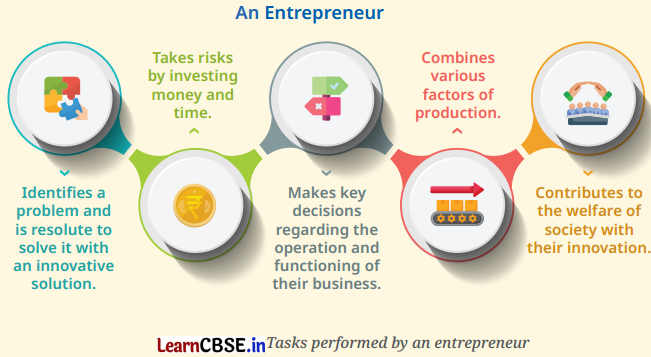
Answer:
An entrepreneur first identifies a problem or opportunity and develops an idea to solve it. Next, they take risks and arrange resources such as money, materials and people. They then plan, organise and manage the business, make important decisions and monitor its performance. Finally, they work towards earning profit, satisfying customers and contributing to society through their product or service.

Question 3.
Based on the case study of Mohan Singh Oberoi on Page 128 (Textbook), which functional area helped improve the quality of the company’s products? How did different functional areas work together to make the business successful? (Page No. 136)
Answer:
Based on the case study of Mohan Singh Oberoi the Management and Operations areas helped improve the quality of the hotels by ensuring efficient operations, maintaining facilities and improving services.
However, the success of the Oberoi Group depended on the combined efforts of all functional areas:
- Management and Operations: Ensured efficient hotel functioning and maintained high standards.
- Finance and Accounting: Managed money carefully and supported expansion.
- Human Resources: Hired and trained skilled employees.
- Marketing and Sales: Built a strong brand associated with luxury and quality.
- Customer Service: Focused on guest satisfaction and improved their experience.
Thus, coordination among different functional areas helped Oberoi transform hotels into successful and respected businesses.
Question 4.
Now that you know about the functional areas of a business, create a business plan for your business idea using the template given on Page No. 142 (Textbook). (Page No. 136)
Answer:
(Suggestive Answer)
Here is a business plan for my business idea using the template given on Page No. 142.
(a) Business Idea
Name of company/shop: SpeakSmart Academy
Product/Service: English-speaking and communication classes
Tagline: Speak with Confidence
(b) Entrepreneur Profile
Founder: XYZ
Why did you choose this business idea?
I chose this idea because many people need better English-speaking and communication skills for everyday life.
What problem does your business solve?
It helps to overcome hesitation and improve their vocabulary, pronunciation, confidence and speaking ability.
(c) Target Customers
- Students
- Parents
- Local residents
- Tourists
- Farmers
- Businesses
Description: School-going children and adults who want to improve their English communication skills.
(d) Market Research
| Question | Findings |
| What do customers need? | Affordable and practical English speaking classes. |
| What products/services centres already exist? | English coaching and online courses. |
| How is your idea different? | Small interactive batches with greater focus on speaking, activities and individual participation. |
(e) Product/Service Description
The academy provides interactive English-speaking classes. Key features include vocabulary building, conversations, pronunciation practice, role plays, discussions and confidence-building activities.
Benefits: Better communication, greater confidence and improved everyday English.
(f) Resources Required
| Resource | What is needed |
| Human Resources | English teachers and support staff |
| Finance | Money for rent, furniture, teaching materials, advertising and other expenses |
| Materials | Worksheets, notebooks and stationery |
| Technology | Smartphone/laptop, internet and presentation tools |
| Infrastructure | Classroom with chairs, board and suitable learning space |
(g) Operations Plan
- Identify students’ learning needs.
- Enroll students into suitable batches.
- Conduct interactive speaking classes.
- Give practice activities and homework.
- Monitor students’ progress.
- Take feedback and improve the classes.
(h) Marketing Plan
- Posters
- Social media
- Word of mouth
- School/community events
Other: Free trial classes and referral offers.
(i) Financial Plan
Sources of finance: Personal savings Estimated monthly costs:
| Item | Cost |
| Salaries | 30,000 |
| Rent | 8,000 |
| Teaching materials | ₹ 2,000 |
| Advertising | ₹ 2,000 |
| Intemet/electricity | ₹ 1,500 |
| Miscellaneous | ₹ 1,500 |
| Total Cost | ₹ 45,000 |
Expected monthly revenue:
| Source of Income | Amount |
| Student fees | ₹ 50,000 |
| Total Revenue | ₹ 50,000 |
Expected Profit = Revenue – Cost
₹ 50,000 – ₹ 45,000 = ₹ 5,000
(j) Risks and Challenges:
The business may face competition, difficulty in attracting students initially, irregular attendance and changing customer preferences. These challenges can be managed through quality teaching, reasonable fees, good communication and regular feedback.
(k) Social and Environmental Impact:
The business will improve students’ communication skills and confidence and create opportunities for learning. Digital worksheets and online resources can also reduce paper consumption.
(l) Conclusion:
The business can succeed because English communication is an important skill for education, employment and everyday life. Interactive classes, affordable fees and individual attention can attract students and encourage them to continue learning.
Question 5.
Find out more about other regional communities who have excelled as entrepreneurs. (Page No. 137)
Answer:
Several Indian communities have a long history of entrepreneurship and trade. For example:
- Marwaris (Rajasthan): Traditionally involved in trading, banking and finance. Many later expanded into large industries and family businesses.
- Gujaratis (Gujarat): Historically active in trade and commerce and later became prominent in industries such as textiles and manufacturing.
- Parsis (western India): Played an important role in the development of industries, particularly cotton textiles and later large-scale industrial enterprises.
- Sindhis: Traditionally known for trading and commercial activities, with strong business networks that supported entrepreneurship across different regions.
- Jains: Have a long history of involvement in trade, finance and business. Community networks have also supported entrepreneurial activities.
These communities show that business knowledge, community networks, trust, risk-taking, financial discipline and long-term planning have played an important role in India’s entrepreneurial history.
Think About It
Question 1.
What problem was Lijjat solving beyond just selling papads? (Page No. 128)
Answer:
Lijjat was helping women become financially independent and economically empowered. It provided them with employment, equal ownership and a way to contribute to their families while working from home.
Question 2.
What challenges do you think the founders could have faced at the start? How might they have overcome them? (Page No. 128)
Answer:
They may have faced lack of money, equipment, business experience, customers and social support. They overcame these challenges through teamwork, self-reliance, consistent quality, determination and by sharing responsibilities equally.
Question 3.
Can you think of a similar cooperative idea you could start in your community? (Page No. 128)
Answer:
Yes. A group of women in the community could start a homemade food and snacks cooperative, preparing pickles, snacks, cakes or other food items together. They could share the work and profits equally and sell their products locally or online.
Class 9 SST Part 2 Chapter 6 Question Answer
Questions and Activities (Page No. 140 – 146)
Question 1.
Explain why a business can fail even with a great idea if one functional area [finance, human resources (HR), operations, or marketing] is weak. If you were running a bakery, which functional area would you prioritise first and why?
Answer:
A great business idea alone cannot guarantee success. All functional areas of a business need to work properly.
- Finance: Without proper financial management, a business may run out of money or fail to control its costs.
- Human Resources: Unskilled or unmotivated employees can affect the quality of products and services.
- Operations: Poor production, wastage or delayed delivery can lead to customer dissatisfaction.
- Marketing: Even a good product may fail if customers do not know about it.
If I were running a bakery, I would prioritise operations first because the quality, freshness, hygiene and timely production of food are essential. Once these are managed well, finance, HR and marketing can help the bakery grow.
Question 2.
Do you think innovation alone is enough to make a business successful? Why or why not?
Answer:
No, innovation alone is not enough. A business also needs proper planning, finance, skilled employees, efficient operations, marketing and good customers’ service. An innovative product may fail if it is too expensive, poorly marketed or does not meet customers’ needs. Therefore, innovation must be supported by effective business management.
Question 3.
“A business plan is a dynamic roadmap for a startup.” Explain this statement with suitable examples. When should one change the business plan?
Answer:
A business plan is called a dynamic roadmap because it guides a business but can be changed according to new situations and experiences.
For example, a bakery may initially plan to sell only cakes in a local market. After observing customers’ demand, it may add cookies, healthy snacks or online delivery. Similarly, if costs increase, the business may change its prices or suppliers.
A business plan should be changed when:
- customers’ needs or market trends change,
- costs or available resources change,
- competition increases,
- the business introduces a new product,
- the original strategy is not giving expected results, or
- new opportunities or risks appear.
Question 4.
Do you think every entrepreneur should think about the impact of their goods or services on society and the environment? Explain using relevant examples.
Answer:
Yes, entrepreneurs should consider the social and environmental impact of their businesses. Businesses use natural resources and affect people and communities.
For example, a company can use eco-friendly packaging instead of single-use plastic. A clothing business can reduce water wastage and use sustainable materials. A food business can donate excess food instead of wasting it.
Such practices help protect the environment, benefit society, and also build trust among customers. Therefore, responsible entrepreneurship is important for long-term success.
Question 5.
In 1931, two brothers, Digambar and Govind Dandekar, started a small business in South Mumbai selling ink powder. They began with limited resources, using recycled glass bottles to sell liquid ink. At first, they faced financial problems and struggled to convince customers to trust their products. Instead of giving up, they focused on providing good-quality stationery at affordable prices. As the business grew, they noticed that artists in India did not have access to good art materials. Seeing this as an opportunity, they travelled to Glasgow to study colour chemistry and improve their products. After returning to India, they set up a laboratory to develop colours and art supplies suited to Indian needs. Over time, the company expanded into pencils, crayons, geometry boxes, and paints, eventually becoming a well-known brand.
(a) What entrepreneurial qualities did the Dandekar brothers display?
(b) What opportunity did they identify in the market?
(c) Was travelling to Glasgow a risky decision?
(d) Which functional area helped the company improve its products?
(e) How did they serve society apart from earning profits?
Answers:
(a) The Dandekar brothers showed several entrepreneurial qualities such as:
- Perseverance – they continued despite financial difficulties.
- Innovation – they developed better colours and art materials.
- Risk-taking – they invested their limited resources and travelled abroad to learn.
- Opportunity recognition – they noticed the lack of good art materials in India.
- Problem-solving – they developed products according to Indian needs.
- Hard work and determination – they gradually expanded their business.
(b) They identified that artists in India did not have easy access to good-quality art materials. They saw this gap as an opportunity to develop and sell suitable colours and art supplies in India.
(c) Yes, travelling to Glasgow was a risky decision because the brothers had limited resources and were investing time and money in learning colour chemistry without knowing whether it would lead to business success. However, the decision helped them gain knowledge and improve their products.
(d) The operations and product-development/ technical function helped the company improve its products. The brothers studied colour chemistry, established a laboratory and developed colours and art supplies according to Indian requirements.
(e) They served society by making good-quality and affordable stationery and art materials available in India. Their products helped students, artists and other users. They also contributed to employment and the growth of the Indian stationery and art-material industry.
Question 6.
How do you think entrepreneurship is important for India’s goal of becoming a developed nation by 2047 ?
Answer:
Entrepreneurship can play an important role in making India a developed nation by 2047.
Entrepreneurs:
- create employment opportunities,
- introduce new products and technologies,
- solve social and economic problems,
- increase production and income,
- encourage self-reliance,
- contribute to government revenue through taxes, and
- improve people’s quality of life.
A strong startup and business ecosystem can therefore contribute to India’s economic growth and the goal of Viksit Bharat 2047.
Question 7.
Choose a product or service and develop a business plan for it using the following template:
- Business name
- Business idea
- Target customers
- Product/service and price
- Marketing idea
- Basic cost and expected profit
Answer:
(Suggestive Answer) A Business Plan
Business Name: EcoNest
Business Idea: To make and sell eco-friendly, reusable products such as cloth bags, bamboo stationery and reusable lunch bags.
Target Customers: Students, parents, households and environmentally conscious customers.
Product/Service and Price:
- Cloth shopping bag – ₹ 80
- Reusable lunch bag – ₹ 250
- Bamboo stationery set – ₹ 150
Marketing Idea:
The products will be promoted through social media, school exhibitions, local markets and word-of-mouth recommendations. Attractive packaging and introductory discounts can also be used.
Basic cost and Expected Profit:
| Particular | Amount |
| Expected monthly revenue | ₹ 30,000 |
| Raw materials | ₹ 12,000 |
| Packaging and transportation | ₹ 4,000 |
| Marketing and other expenses | ₹ 4,000 |
| Total Cost | ₹ 20,000 |
| Expected Profit | ₹ 10,000 |
The business can grow by introducing more eco-friendly products and selling them through online platforms.
Question 8.
Find out about various government schemes to promote entrepreneurs in India. Learn about the eligibility requirements of these schemes. Prepare a write-up and discuss in the class.
Answer:
The Government of India has introduced several schemes to encourage entrepreneurship and provide financial and other support to businesses.
| Scheme | Main Purpose | General Eligibility |
| Startup India | Supports recognised startups through various benefits and a supportive ecosystem. | Eligible entities meeting the startup recognition requirements. |
| Pradhan Mantri MUDRA Yojana (PMMY) | Provides loans to micro and small businesses. | Small entrepreneurs and eligible micro enterprises. |
| StandUp India | Encourages entrepreneurship among women and SC/ST entrepreneurs. | Eligible women or SC/ST entrepreneurs starting a new enterprise, subject to scheme conditions. |
| PMEGP | Provides financial assistance for setting up eligible microenterprises. | Eligible individuals and organisations meeting the scheme requirements. |
| PM Vishwakarma | Supports traditional artisans and craftspeople through training, credit and other assistance. | Eligible artisans/craftspeople working in recognised traditional trades. |
These schemes can help entrepreneurs obtain finance, training, skills and other support.
Question 9.
Take any popular brand and identify:
- The problem it tackles
- Its initial target customers
- How it differentiated itself from other competitors or brands
- The resources it may have started with
Answer:
(Suggestive Answer) Example: Amul
Problem it tackles:
Amul helped connect milk producers with consumers and created a reliable market for dairy farmers while making milk and dairy products widely available.
Initial target customers:
Indian households and consumers who needed affordable and reliable dairy products.
How did it differentiate itself ?
It developed a strong cooperative model, focused on quality and built a trusted brand with a wide range of dairy products.
Resources it may have started with:
Milk supplied by farmers, collection centres, processing facilities, workers, basic technology and cooperative support.
Question 10.
Over the next week, observe your daily routine at school and home. Identify 2-3 problems or inconveniences you or others face. For each problem, answer the following questions in a tabular format:
- Who faces this problem?
- How often does it occur?
- Why hasn’t it been solved yet?
- What business idea could solve it?
- Would people pay for your solution?
Answer:
| Problem | Who faces it? | Why hasn’t it been solved? | Possible | Business Idea | Would people pay? |
| Students forget important school supplies. | Students | Frequently | Students may not plan in advance. | Emergency school supplies delivery service near schools. | Yes |
| Students struggle to find healthy snacks after school. | Students and parents | Daily | Healthy options may not be easily available nearby. | Affordable healthy snack boxes. | Yes |
| Parents find it difficult to arrange safe transport for children after activities. | Parents and students | Several times a week | Transport timings may not match school schedules. | Verified school activity transport service. | Yes |
These ideas can be developed further after studying customer needs, costs, competition and safety requirements.
Question 11.
Think of your startup idea and fill in the business plan template given below:
a. Business idea
Name of the company or shop: ____________________
Product/service: ____________________
Tagline (optional): ____________________
b. Entrepreneur profile
Founder(s): ____________________
Why did you choose this business idea?
____________________
____________________
What problem does your business solve?
____________________
____________________
c. Target customers
Who will buy your product or service?
 Students
Parents
Local residents
Tourists
Farmers
Businesses
Others: ____________________
Describe your target customers:
____________________
____________________
d. Market research
Find answers to the following questions about potential customers.
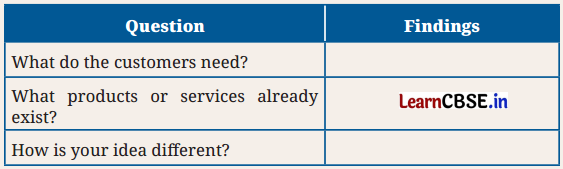
e. Product or service description: Describe your product or service. List its key features and benefits:
____________________
____________________
f. Resources required
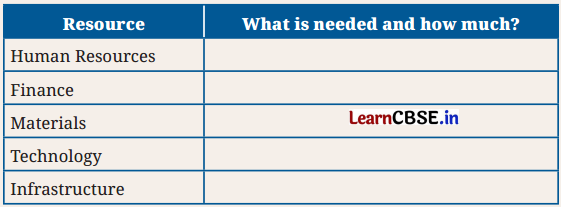
g. Operations plan
How will the business work? Write the steps. You may depict this using a flow chart.
h. Marketing plan
How will customers learn about your business?
Posters
School events
Social media
Local market
Word of mouth
Newspapers
Other: ____________________
i. Financial plan
Source(s) of finance:
Estimated monthly cost on various items:
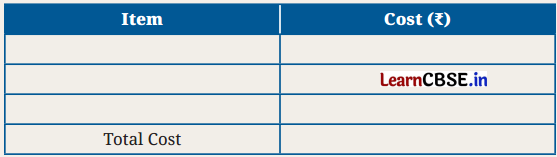
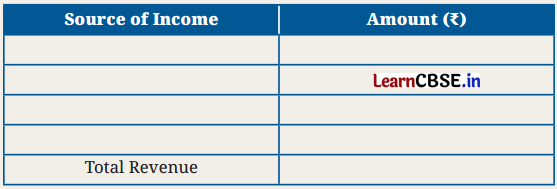
Details of expected monthly revenue sources:
Expected Profit:
Revenue – Cost ₹ ____________________
j. Risks and challenges
What challenges might your business face?
____________________
____________________
k. Social and environmental impact
How will your business help people or the environment?
____________________
____________________
I. Conclusion
Why do you believe your business will succeed?
____________________
____________________
Answer:
(Suggestive Answer)
a. Business Idea
Name of the company or shop: FreshBite
Product/service: Healthy and affordable snack boxes for students.
Tagline: Healthy Bites, Happy Lives!
b. Entrepreneur Profile
Founder(s): ABC
Why did you choose this business idea?
Answer:
Many students prefer packaged junk food because healthy snacks are not easily available. I chose this idea to provide tasty, fresh and nutritious snacks at affordable prices.
What problem does your business solve?
Answer:
It provides students with convenient and healthier alternatives to unhealthy packaged snacks.
c. Target Customers
Who will buy your product or service?
- Students
- Parents
- Local residents
- Tourists
- Farmers
- Business
Others: School Canteens
Describe your target customers:
Answer:
School students and parents looking for fresh, hygenic and reasonably priced snacks for school and everyday use.
d. Market Research
| Question | Findings |
| What do the customers need? | Fresh, tasty, hygienic and affordable snacks. |
| What products or services already exist? | Packaged chips, biscuits, sweets, fast food and school-canteen snacks. |
| How is your idea different? | Fresh snack boxes with healthier options, attractive packaging and different choices each day. |
e. Product or Service Description
FreshBite will provide ready-to-eat snack boxes containing items such as sandwiches, fruit, roasted snacks and homemade treats.
Key features and benefits:
- Freshly prepared food
- Hygienic packaging
- Affordable prices
- Variety of snacks
- Healthier alternatives to junk food
- Convenient for school-going children
f. Resources Required
| Resource | What is needed and how much? |
| Human Resources | 1 cook and 1 helper |
| Finance | ₹ 20,000 initial investment |
| Materials | Food ingredients, boxes, labels and packaging |
| Technology | Refrigerator, weighing machine and online payment facility |
| Infrastructure | Small kitchen and storage space |
g. Operations Plan
The business will work through the following steps:
Purchase fresh ingredients
↓
Prepare snacks
↓
Quality and hygiene check
↓
Pack the snack boxes
↓
Receive orders
↓
Deliver to customers/schools
↓
Collect feedback and improve products
h. Marketing Plan
Customers will learn about the business through:
- Posters
- Social media
- Word of mouth
- School events
- Local market
- Newspapers
Other: Free samples and introductory discounts.
i. Financial Plan
Source(s) of Finance: Personal savings and a small family contribution.
Estimated Monthly Cost
| Item | Cost |
| Food ingredients | ₹ 12,000 |
| Packaging | ₹ 3,000 |
| Transportation | ₹ 2,000 |
| Marketing | ₹ 1,000 |
| Electricity and other expenses | ₹ 2,000 |
| Total Cost | ₹ 20,000 |
Details of Expected Monthly Revenue
| Source of Income | Amount |
| Snack box sales | ₹ 30,000 |
| Total Revenue | ₹ 30,000 |
Expected Profit:
Revenue – Cost = ₹ 30,000 – ₹ 20,000 = ₹ 10,000
j. Risks and Challenges
The business may face challenges such as:
- Competition from existing snack shops and canteens.
- Increase in the price of ingredients.
- Food wastage if orders are not received on time.
- Maintaining hygiene and consistent quality.
- Difficulty in attracting customers in the beginning.
k. Social and Environmental Impact
FreshBite will provide healthier food choices to students and create employment opportunities. The business will try to reduce plastic use by using recyclable or reusable packaging and will avoid unnecessary food wastage.
I. Conclusion
FreshBite can become a successful business because students and parents need convenient, hygienic and affordable snacks. Good quality, reasonable prices and effective marketing can help the business attract customers and grow.
Question 12.
Visit a factory or a production unit.
Explore how a business operates by visiting a factory or production unit that manufactures a product. Prepare questions for the owner or manager, such as:
- What product does the factory produce?
- Who are its customers?
- How did the business start?
- What challenges did the business face in its early years?
- How does the business manage its finances?
- How are employees recruited and trained?
- How are products supplied to wholesalers, retailers, or consumers?
During the visit, observe the production process carefully. Note the resources used, such as raw materials, machinery and technology, workers, and managers. Interact with the owner or manager and record key information. Take notes and photographs (if permitted).
After the visit:
- Understand the manufacturing process and create a process map showing the journey of the product from raw materials to the final customer.
- Identify barriers to growth, such as:
→ Financial Barriers: Lack of capital, difficulty obtaining loans or credit, etc.
→ Technical Barriers: Outdated machinery, limited access to technology, etc.
→ Human Resource Barriers: Skill shortages, difficulty hiring or retaining workers, etc.
→ Market Barriers: Competition, limited access to suppliers or customers, etc.
→ Regulatory Barriers: Complex procedures, licences, approvals, or paperwork, etc.
Recommend some practical solutions through which the business could overcome these challenges. Share your findings by preparing a presentation and a report highlighting your observations, analysis, and recommendations. The format of the report may be as follows:
- Introduction
- Production or service delivery process (with diagrams or flowcharts)
- Resources required
- Barriers identified (supported by observations or evidence)
- Suggested solutions
- Reflection: key lessons learned from the visit
Answer:
(Suggestive Answer) Introduction
I visited a small packaged-food production unit to understand how a business operates. The visit helped me understand the role of raw materials, workers, machinery, finance, management, and marketing.
Production Process:
Raw materials received
↓
Quality checking
↓
Processing/preparation
↓
Cooking/manufacturing
↓
Quality testing
↓
Packaging
↓
Storage
↓
Distribution to retailers/customers
Resources Required:
- Raw materials
- Machinery
- Electricity and water
- Skilled and unskilled workers
- Packaging material
- Technology
- Managers and supervisors
- Finance
- Storage and transportation facilities
Barriers Identified:
1. Financial Barriers
The business may need additional money to purchase modern machinery or expand production.
2. Technical Barriers
Old machinery may reduce production speed and efficiency.
3. Human Resource Barriers
Finding skilled workers and providing them with proper training may be difficult.
4. Market Barriers
Competition from larger brands may make it difficult to attract customers.
5. Regulatory Barriers
Licences, safety standards, and other official procedures may require time and documentation.
Suggested Solutions:
- Apply for suitable government schemes or business loans.
- Invest gradually in better machinery and technology.
- Provide regular training to employees.
- Improve product quality and packaging.
- Use social media and online platforms for promotion.
- Maintain proper records and follow all legal and safety requirements.
Reflection: Key Lessons Learned
The visit showed me that running a business involves much more than producing a product. Finance, operations, human resources, marketing, and management must work together. I also learned that businesses need to continuously improve their products and adapt to changing customer needs.
The post From Ideas to Startups Class 9 Question Answer SST Part 2 Chapter 6 appeared first on Learn CBSE.
📚 NCsolve - Your Global Education Partner 🌍
Empowering Students with AI-Driven Learning Solutions
Welcome to NCsolve — your trusted educational platform designed to support students worldwide. Whether you're preparing for Class 10, Class 11, or Class 12, NCsolve offers a wide range of learning resources powered by AI Education.
Our platform is committed to providing detailed solutions, effective study techniques, and reliable content to help you achieve academic success. With our AI-driven tools, you can now access personalized study guides, practice tests, and interactive learning experiences from anywhere in the world.
🔎 Why Choose NCsolve?
At NCsolve, we believe in smart learning. Our platform offers:
- ✅ AI-powered solutions for faster and accurate learning.
- ✅ Step-by-step NCERT Solutions for all subjects.
- ✅ Access to Sample Papers and Previous Year Questions.
- ✅ Detailed explanations to strengthen your concepts.
- ✅ Regular updates on exams, syllabus changes, and study tips.
- ✅ Support for students worldwide with multi-language content.
🌐 Explore Our Websites:
🔹 ncsolve.blogspot.com
🔹 ncsolve-global.blogspot.com
🔹 edu-ai.blogspot.com
📲 Connect With Us:
👍 Facebook: NCsolve
📧 Email: ncsolve@yopmail.com

😇 WHAT'S YOUR DOUBT DEAR ☕️
🌎 YOU'RE BEST 🏆