
The latest Understanding Society India and Beyond Class 9 Solutions and Class 9 Social Science SST Part 2 Chapter 5 Managing Your Personal Finances Question Answer NCERT Solutions are prepared according to the updated syllabus.
Managing Your Personal Finances Class 9 Questions and Answers
Class 9 Managing Your Personal Finances Question Answer
The Big Questions (Page No. 107)
Question 1.
What is personal finance and why is it important for individuals ?
Answer:
Personal finance refers to the planning and management of an individual’s money to meet their needs and wants. It is important because it helps individuals make informed decisions about spending, saving, investing, and preparing for future financial needs.
Question 2.
What are the pillars of personal finance?
Answer:
The five pillars of personal finance are:
- Income
- Budgeting
- Saving
- Investing
- Protection and risk management
Question 3.
What are some common savings and investment options?
Answer:
Common savings and investment options include fixed deposits (FDs), bonds, stocks (equity or shares) and mutual funds.
Question 4.
How can you protect your savings and assets?
Answer:
Savings and assets can be protected through banks, financial institutions, insurance and proper risk management. Insurance provides financial support against specified losses caused by events such as illness, accidents or property damage. Banks and other financial institutions such as Mutual Fund keep savings safe and give timely returns.
Question 5.
What is income tax?
Answer:
Income tax is a tax paid on the income a person earns in a year. It is a direct tax and helps the government fund essential public services and infrastructure.

Managing Your Personal Finances Question Answer Class 9
Intext Questions
Let’s Explore
Question 1.
Think of all your expenses and prepare your monthly/weekly budget using the template on NCERT Page No. 122. (Page No. 109)
Answer:
A sample weekly budget can be prepared by listing expenses such as stationery, transport, food and other needs, followed by the amount spent on each. A portion should also be kept aside as savings.
Here is my Monthly Budget
| Expenses | Amount |
| Books/Copies | ₹ 300 |
| Pens | ₹ 200 |
| Pencils/Colours etc. | ₹ 100 |
| Snacks | ₹ 600 |
| Conveyance | ₹ 900 |
| Misc. | ₹ 400 |
| Total Expenses | ₹ 2500 |
| Savings | ₹ 500 |
| Total Amount | ₹ 3000 |
Question 2.
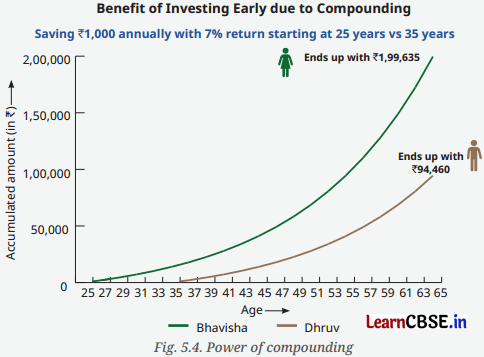
In Fig. (below), the curves are flatter in the beginning and tend to become steeper in the later years. Why do you think that happens? (Page No. 112)
Answer:
The curves become steeper because of compound interest. The interest earned is added to the original amount, and future interest is calculated on this increased amount. Thus, the money grows faster as time passes.
Question 3.
Talk to your parents and find out the fixed deposit rates of their bank. You can also refer to the bank’s website. (Page No. 112)
Answer:
This is a research/activity-based question. The answer will depend on the bank selected and the current FD rate. Banks offer different rates depending on factors such as the tenure and type of deposit.
Think About It
Question 1.
Have you ever thought about earning your own money? What kind of skill would you require and which work would you choose? (Page No. 108)
Answer:
Yes. Skills such as communication, computer skills, creativity or teaching can help earn money. One could choose suitable part-time work, an internship or another activity based on one’s skills.
Question 2.
Suppose you and your friends need to buy new badminton rackets for an upcoming tournament because the old ones have worn out. How would you manage your budget to cover the cost? Would you cut back on other expenses, use your savings, or borrow the amount from your parents or friends? (Page No. 109)
Answer:
I would first check my available money and savings. I would reduce unnecessary expenses and use some savings if required. Borrowing should be considered only if necessary and if repayment is possible.
Question 3.
What would you do if you received 3:100 today? Would you save some or all of it, or spend it right away? (Page No. 111)
Answer:
I would save a part of it and spend the remaining amount only if needed.
Question 4.
In the Grade 9 Part 1 Chapter ‘Building Blocks in Economics: The Problem of Choice’, you learnt about wants and needs. Would you prefer spending the money on a want or a need? (Page No. 111)
Answer:
A need should generally be given priority over a want and I would prefer spending on need rather than want.
Question 5.
Financial experts often suggest saving first and spending what is left. Do you agree? (Page No. 111)
Answer:
Yes, I agree. Saving first ensures that some money is set aside for future needs and emergencies.
Question 6.
Do you think individuals with low income can also save? Why or why not? (Page No. 111)
Answer:
Yes, I think individuals with low income can also save. Even a small amount can be saved regularly by controlling unnecessary expenditure and prioritising needs.
Question 7.
Have you heard this disclaimer in mutual fund advertisements on the television?
“Mutual fund investments are subject to market risks. Please read all scheme-related documents carefully before investing.” (Page No. 115)
Answer:
Mutual fund investments are linked to market conditions, so their value and returns can rise or fall. The disclaimer reminds investors that returns are not guaranteed and that they should read the scheme-related documents carefully before investing.
Question 8.
Why do you think this is included? (Page No. 115)
Answer:
This is included because the company does not guarantee any fixed return, so to avoid any confusion or misunderstanding, such disclaimer is issued.
Question 9.
Why might a family choose to buy something on EMI even if it costs more in the long run? (Page No. 117)
Answer:
An EMI allows the family to pay for an expensive item in smaller instalments instead of paying the entire amount at once. This way they are able to buy an item immediately otherwise they would have to save for a long period and then buy the item.
Question 10.
Can having too many EM Is affect savings and emergency funds? (Page No. 117)
Answer:
Yes, too many EMIs affect savings and emergency funds. A large number of EMIs can reduce the amount of money available for savings and emergencies and may create financial pressure.
Let’s Analyse
Question 1.
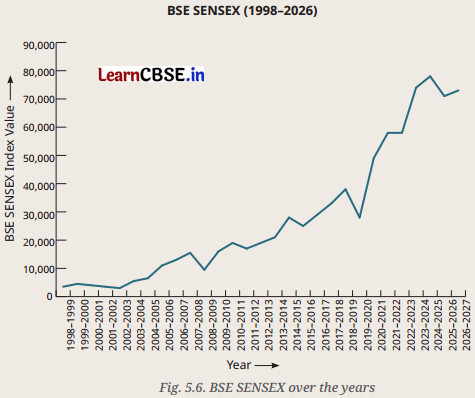
Look at the graph below that displays the performance of BSE SENSEX over the years. It fluctuates over short time periods; however, it can go up significantly in the long run. Why do you think these fluctuations happen? Discuss possible reasons with your classmates and find out more from newspapers, the internet, or by speaking to your family members. (Page No. 114)
Answer:
Stock-market fluctuations can occur because of changes in company’s performance, economic conditions, investor expectations, market sentiment, government policies, and other developments affecting businesses and the economy. Besides these, shares prices also depend on demand and supply.
Question 2.
Sai’s taxable income is ₹ 3,80,000 in a financial year. How much income tax does he have to pay according to the above tax slabs? (Page No. 120)
Answer:
According to the tax slab given in the chapter, income up to ₹ 4,00,000 is taxed at a nil rate, so he will have to pay nothing as income tax.
Question 3.
Ask your parents, relative or a person in your neighbourhood if they file personal income tax returns. Make a small report on the procedure to file an income tax return. You may refer to the following
website: https://ift.tt/rBVlyda. in/Pages/ tax- services/file-income-tax-return.aspx (Page No. 120)
Answer:
A brief report can include:
- Collect the required income and tax-related documents.
- Calculate taxable income.
- Log in to the Income Tax Department’s e-filing portal.
- Select the appropriate Income Tax Return (ITR) form.
- Enter the required details.
- Verify the return.
- Submit the return electronically.
Class 9 SST Part 2 Chapter 5 Question Answer
Questions And Activities (Page No. 121 – 124)
Question 1.
Why is managing money wisely important for all individuals irrespective of their income?
Answer:
Managing money wisely helps people control expenses, meet their needs, save for the future, deal with emergencies and achieve financial goals, regardless of their income level.
Question 2.
How can budgeting help people balance their present needs with their future financial goals? Give examples.
Answer:
Budgeting helps allocate income between present expenses and savings for future goals. For example, a family can budget for food, transport and education while setting aside money for higher education, emergencies or a future purchase.
Question 3.
School Reopening Budget Activity
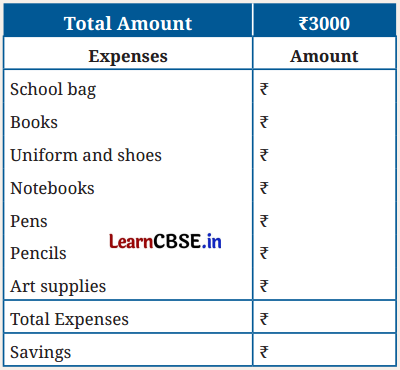
Your parents have given you ₹ 3,000 to prepare for the new school year. Make a list of the items you need, find out their prices (by visiting local stores, or asking a parent or teacher), and prepare a budget. Calculate the total cost and check whether it stays within ₹ 3, 000.
- If your total is less than ₹ 3,000, you may add one additional item of your choice.
- If your total exceeds ₹ 3,000, decide which item(s) you can postpone or avoid buying to stay within your budget.
Use the budget template provided and ensure that all expenses are accurately calculated.
School Reopening Budget
Answer:
Prepare a budget using ₹ 3000 for the new school year.
A sample:
School Reopening Budget
| Total Amount | ₹ 3000 |
| School bag | ₹ 700 |
| Books | ₹ 600 |
| Uniform and shoes | ₹ 900 |
| Notebooks | ₹ 300 |
| Pens | ₹ 150 |
| Pencils | ₹ 150 |
| Art supplies | ₹ 150 |
| Total Expenses | ₹ 2,950 |
| Savings | ₹ 50 |
The total expenditure is ₹ 2,950, which is within the ₹ 3,000 budget. Therefore, ₹ 50 can be kept as savings.
Question 4.
Why is saving alone often not enough to build wealth in the long run? How do investments help increase the value of money over time?
Answer:
Simply keeping money as savings may not provide sufficient returns to overcome inflation. Investments can generate returns and, through compounding, can help money grow over time.
Question 5.
Investment Planning Activity
Suppose you received cash gifts worth ₹ 3000 on your last birthday and decided to save ₹ 1500. With the help of your teacher, calculate the returns you might have earned if you had invested this amount in different combinations of investments. For example, what returns would you have received if you had invested ₹ 500 in a fixed deposit, X800 in the stock market, and ₹ 200 in gold? Try other combinations and find information on the returns from different investment options using reliable sources, such as newspapers, magazines, or official websites. Based on your findings, prepare an investment plan explaining why you think each investment option is suitable or unsuitable.
Answer:
The exact return depends on the investment rates/prices for the period being studied. The activity requires students to research current/relevant returns from reliable sources and then prepare an investment plan explaining why each selected option is suitable or unsuitable.
Question 6.
How does inflation affect the value of money over time? Why should people consider inflation while making financial decisions?
Answer:
Inflation causes the prices of goods and services to rise, reducing the purchasing power of money. Therefore, people should consider inflation while saving and investing so that their money retains or increases its purchasing power.
Question 7.
Different investment options involve different levels of risk and return. Do you think taking higher risks is always the best way to earn higher returns? How should a person decide which investment option is most suitable for them?
Answer:
Higher risk does not automatically guarantee higher returns. A person should consider their financial goals, risk tolerance, time horizon and liquidity requirements before selecting an investment.
Question 8.
Why do people buy insurance policies even though they may never face a major loss? How does insurance provide financial security?
Answer:
Insurance protects people against unexpected financial losses. By paying a premium, a person gets financial protection against specified risks such as illness, accidents or property damage.
Question 9.
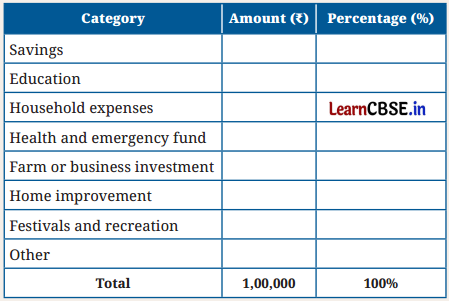
Imagine your family receives ₹ 1,00,000 from farming, a small business, livestock sales, and savings. Help your family decide how to use the money wisely.
Step 1: Prepare a Budget
Allocate the ₹ 1,00,000 among the following categories:
Step 2: Needs vs Wants
Classify each expense as a need or a want and give a reason. Examples:
- School fees
- New mobile phone
- Better seeds or livestock feed
- Festival celebrations
- Water storage tank
Step 3: Save for the Future
Suppose your family saves ₹ 30,000 at 8% compound interest per year.
Using the formula A = P (1 + r)<sup>n</sup>,
where A: Amount,
P: Principal,
r: Rate of compound interest,
n: number of years, calculate:
1. The amount after 5 years.
2. The interest earned.
Step 4: Save First, Spend Later
Many financial experts recommend:
Expenses = Income – Savings
If your family receives ₹ 1,00,000 and saves ₹ 20,000 first, only ₹ 80,000 is available for spending.
This helps ensure that future needs and emergencies can be met.
Step 5: Reflect
1. What percentage of the money did you save?
2. Which expenses were needs and which were wants?
3. How can savings improve a family’s financial security?
4. How does compound interest help money grow?
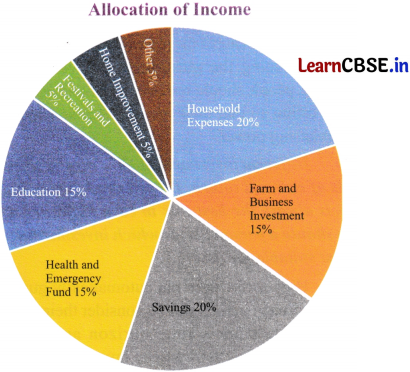
Challenge: Create a pie chart showing how the ₹ 1,00,000 was allocated across different categories.
Answer:
One possible allocation is:
| Category | Amount (₹) | Percentage (%) |
| Savings | ₹ 20,000 | 20% |
| Education | ₹ 15,000 | 15% |
| Household expenses | ₹ 20,000 | 20% |
| Health and emergency fund | ₹ 15,000 | 15% |
| Farm or business investment | ₹ 15,000 | 15% |
| Home improvement | ₹ 5,000 | 5% |
| Festivals and recreation | ₹ 5,000 | 5% |
| Other | ₹ 5,000 | 5% |
| Total | 1,00,000 | 100% |
Step 2: Needs vs Wants
| Expense | Classification |
| School fees | Need |
| New mobile phone | Want |
| Better seeds/livestock feed | Need |
| Festival celebrations | Want |
| Water storage tank | Need |
Reason: Needs are essential for living, education, health or productive activities, while wants are desirable but can generally be postponed.
Step 3: Save for the Future
Question 10.
Suppose your family saves ₹ 30,000 at 8 % compound interest per year. Calculate:
Answer:
Formula:
A = P(1 + r)n
Where:
P = ₹ 30,000
r = 8 % = 0.08
n = 5 years
1. Amount after 5 years
A = 30,000 × (1.08)5
A = ₹ 44,080
2. Interest earned
Interest = Amount – Principal
= ₹ 44,080 – ₹ 30,000
Interest Earned = ₹ 14,080
Save First, Spend Later Expenses = Income – Savings
If income = ₹ 1,00,000 and
savings = ₹ 20,000
Expenses = ₹ 1,00,000 – ₹ 20,000 = ₹ 80,000
Step 5: Reflect
1. What percentage of the money did you save?
Answer:
₹ 20,000 out of ₹ 1,00,000 = 20 %.
2. Which expenses were needs and which were wants?
Answer:
School fees, essential household expenses, health expenses, and productive investments are generally needs. Festival celebrations and some discretionary purchases are wants.
3. How can savings improve a family’s financial security?
Answer:
Savings provide money for future goals and emergencies and reduce dependence on borrowing.
4. How does compound interest help money grow?
Answer:
Compound interest allows interest earned to become part of the investment and itself earn further interest over time.
Challenge:
Create a pie chart showing how the ₹ 1,00,000 was allocated across different categories.
Answer:
Here is the pie chart prepared using the allocation selected in Step 1.
The post Managing Your Personal Finances Class 9 Question Answer SST Part 2 Chapter 5 appeared first on Learn CBSE.
📚 NCsolve - Your Global Education Partner 🌍
Empowering Students with AI-Driven Learning Solutions
Welcome to NCsolve — your trusted educational platform designed to support students worldwide. Whether you're preparing for Class 10, Class 11, or Class 12, NCsolve offers a wide range of learning resources powered by AI Education.
Our platform is committed to providing detailed solutions, effective study techniques, and reliable content to help you achieve academic success. With our AI-driven tools, you can now access personalized study guides, practice tests, and interactive learning experiences from anywhere in the world.
🔎 Why Choose NCsolve?
At NCsolve, we believe in smart learning. Our platform offers:
- ✅ AI-powered solutions for faster and accurate learning.
- ✅ Step-by-step NCERT Solutions for all subjects.
- ✅ Access to Sample Papers and Previous Year Questions.
- ✅ Detailed explanations to strengthen your concepts.
- ✅ Regular updates on exams, syllabus changes, and study tips.
- ✅ Support for students worldwide with multi-language content.
🌐 Explore Our Websites:
🔹 ncsolve.blogspot.com
🔹 ncsolve-global.blogspot.com
🔹 edu-ai.blogspot.com
📲 Connect With Us:
👍 Facebook: NCsolve
📧 Email: ncsolve@yopmail.com

😇 WHAT'S YOUR DOUBT DEAR ☕️
🌎 YOU'RE BEST 🏆