
The latest Understanding Society India and Beyond Class 9 Solutions and Class 9 Social Science SST Part 2 Chapter 4 Governance and Public Policy Question Answer NCERT Solutions are prepared according to the updated syllabus.
Governance and Public Policy Class 9 Questions and Answers
Class 9 Governance and Public Policy Question Answer
The Big Questions (Page No. 81)
Question 1.
What is governance, and how have its meaning and practice evolved over time?
Answer:
Governance is the process that helps make decisions, implement them, and supervise them in the interest of the public. Governance is not only the work of the government but also includes citizens, media, civil society, and even private organisations. For centuries in India, governance has been considered a responsibility towards society. Since ancient times in the Vedic era, institutions such as Sabha and Samiti discussed public welfare issues. The concept of Rajadharma made it imperative upon the ruler to safeguard the people by protecting the Dharma, and Kautilya’s Arthashastra emphasised the happiness of the king was tied to the happiness of the people. The era of colonialism brought with it its own concepts of governance and colonial institutions persisted in post-independence India too. However, India framed its constitution in accordance with its own ethos in its mottos of ‘Satyamev Jayate’ and ‘Yato Dharmastato Jayah’.
Question 2.
What is public policy? How does it affect our day-to-day lives, and what makes it ‘public’ ?
Answer:
Public policy refers to the policy action taken by the government that helps resolve issues related to the community and meets the needs of the citizens. Public policies help make life easier, better, and safe for us by helping to develop roads, traffic lights, clean drinking water, electric power to schools, recreational parks, and garbage disposal. The policy can be termed as a public policy when it is undertaken for the benefit of the public, formulated by the government, implemented through public organisations, financed by public funds generated through taxes, and where the participation of citizens is allowed. The policies followed by schools, firms, and housing societies are restricted to the members within them, and therefore, cannot be public policies.
Question 3.
What are the various stages of policy-making and policy implementation?
Answer:
The process of policy starts from the stage of policy desirability, at which needs and problems are determined. After that comes the stage of prioritisation, in which the government identifies which issues should be given priority. In the process of policy formulation, opinions are collected from all stakeholders and the policy is formulated and evaluated from the viewpoint of economic feasibility. In policy adoption stage, laws and regulations (rules and guidelines) are established. Further on, implementation stage involves putting the policy into effect through government officials, local authorities, civil society, private organisations and individuals. This is followed by the stage of monitoring, in which the progress made is monitored and weaknesses are identified. The last stage is that of evaluation, at which the outcome of the policy is evaluated and feedback provided for further improvement.
Question 4.
Who are the major contributors to policy-making and implementation?
Answer:
Various stakeholders get involved. Citizens detect the problem, vote, and make suggestions. Members of elected bodies like MPs, MLAs, and other representatives voice their concerns, participate in the law-making process, and sanction budgets. Government officials, departments, and ministries formulate and implement policies, coordinate between various departments, provide services, and follow up on them. NGOs and civil society groups along with experts, researchers, and the media analyse the problems, propose solutions, and help evaluate the programmes. The private sector provides technical expertise and innovative ideas as well as resources in collaboration with the government. The international organisations provide technical support, knowledge and financial assistance, for instance, the WHO adds the international perspective.
Question 5.
What role do citizens play in shaping public policy and strengthening good governance?
Answer:
Citizens play an active role at every stage. They identify issues, express their concerns, take part in consultations, offer suggestions, and share feedback once a policy is implemented, which governments use to improve policies over time. By voting, following laws, participating in public affairs, and giving feedback on government services, they help public institutions function better. They also hold public authorities accountable, which strengthens democracy and promotes good governance. The making of the National Education Policy 2020, which drew about two lakh suggestions from citizens and institutions, is a good example of how public participation shapes policy.
Governance and Public Policy Question Answer Class 9
Intext Questions
Let’s Explore
Question 1.
Let us see how a government and citizens come together to address various challenges. (Page No. 81 – 82)
Imagine that your town experiences several days of unusually heavy rainfall. Roads become flooded, schools remain closed, electricity is disrupted in some areas, public health concerns rise, and many people find it difficult to reach schools, workplaces, or even hospitals. During such situations, organisations and individuals come together to help all in need.
The municipal corporation clears drains and removes garbage. The Public Works Department repairs damaged roads. The police manage traffic. School authorities inform parents that schools will remain closed. Health workers prevent the spread of diseases. Local representatives raise people’s concerns, while residents volunteer to help vulnerable neighbours and report on flooded areas. The situation improves with collective efforts of all.
Form groups and discuss the following.
(i) Who are the different people and organisations involved in dealing with this situation?
(ii) Why cannot a single department solve the problem on its own?
(iii) What would happen if these departments did not communicate or coordinate with one another?
(iv) What role can citizens play before, during, and after the heavy rainfall?
(v) What makes the collective response effective?
Answer:
(i) Different people and organisations involved in dealing with this situation are the municipal corporation, Public Works Department, police, school authorities, health workers, local representatives, and residents.
(ii) A single department cannot solve the problem on its own because the problem has many parts (drains, roads, traffic, health, schools), and each needs different skills and resources.
(iii) If these departments do not communicate or coordinate with one another then the work would be duplicated or missed, help would reach people late, and confusion would grow.
(iv) Citizens can also play a major role before, during and after the heavy rainfall. They can avoid dumping garbage in drains, report flooded areas, help vulnerable neighbours, help clean and clear drains, volunteer during emergencies, and provide feedback to the authorities.
(v) Coordination, quick action clear responsibility, cooperation, communication, and public participation make the collective response effective.
Share your ideas with the class. Make a list of the qualities that help the town respond effectively. These qualities are essential whenever governments and society work together to solve public problems.
Answer:
(Suggestive Answer)
A town responds effectively to a crisis like heavy rainfall when its departments coordinate and communicate well, so that work is not duplicated and people are informed quickly. Quick response and clear responsibility ensure that every department does its duty without delay and is answerable for it. Cooperation between government, organisations, and individuals, along with active public participation such as volunteering and reporting flooded areas, makes the effort stronger.
Compassion for the elderly, the sick, and other vulnerable people, transparency about what is being done, and the wise use of workers, funds, and supplies complete the response. These qualities are essential whenever governments and society work together to solve public problems.
Question 2.
Government refers to the institution that has the authority to provide public services. For example, the municipal corporation or panchayat is responsible for installing street lights. Governance is the process by which this street lighting is planned, implemented, and maintained, involving people in identifying dark spots, reporting non-functional lights, and providing feedback.
It ensures the continuous delivery of public services-in this case, well-lit streets and greater public safety.
Can you identify more such examples from your day-to-day life to understand the difference between government and governance? (Page No. 83 – 84)
Answer:
(Suggestive Answer)
In our daily lives, the government provides services such as public transport, clean drinking water, street lights and waste collection. Governance involves planning and implementing these services, maintaining them properly, and allowing people to report problems and provide feedback.
Question 3.
The Sengol – a cultural marker of rulership and good governance— was placed in India’s newly inaugurated Parliament building in the year 2023 by Prime Minister Narendra Modi. The tradition of using the Sengol as a mark of righteous governance began more than a thousand years ago during the reign of Chola dynasty. To mark the occasion of India’s Independence, at the stroke of midnight on 15th August 1947, the first Prime Minister, Jawaharlal Nehru, received the Sengol from the Adheenam Saints (an old Shaivite tradition) of Tamil Nadu. Try to find out more about the journey of the Sengol through its historic pictures. (Page 85)
Answer:
The Sengol is a cultural marker of rulership and good governance. The tradition of using the Sengol began over a thousand years ago during the Chola dynasty, where it symbolised righteous and just rule.
1947: At the stroke of midnight on 15 August 1947, marking India’s Independence, Jawaharlal Nehru, the first Prime Minister, received the Sengol from the Adheenam saints (an old Shaivite tradition) of Tamil Nadu.
After 1947: It was kept in a museum in Prayagraj (Allahabad) for decades, and it received little public attention. In 2023, it was brought back into focus and placed in India’s newly inaugurated Parliament building by Prime Minister Narendra Modi.
Question 4.
Select two cities (one should be from a region other than yours) in India that have received awards for being the cleanest city. Make a visual presentation (chart paper or slideshow) to explain the ‘good governance model’ used in those cities by looking into the role played by government agencies (local, state, and national), residents, market associations, civil society organisations, etc. Also look into the steps they are taking to continue being clean cities. (Page No. 87)
Answer:
(Suggestive Answer)
Two cities that have received awards for being the cleanest cities in India are Indore and Surat in Madhya Pradesh and Gujarat respectively. Presented below is an example of good governance model used by these cities. All the agencies like the local state, and central governments, residents, market associations, civil society organisations etc. have played a major role in keeping these cities clean.
| Indore (Madhya Pradesh) | Surat (Gujarat) |
| Government agencies: Scientific waste management and technology-based monitoring. | Government agencies: Door-to-door waste collection, waste segregation, regular monitoring. |
| Residents: Segregate waste, keep surroundings clean, join awareness drives. | Residents: Follow cleanliness rules and support waste segregation. |
| Market associations: Maintain clean markets and reduce plastic waste. | Market associations: Manage commercial waste and support cleanliness drives. |
| Civil society organisations: Conduct awareness campaigns and community programmes. | Civil society organisations: Promote environmental awareness and public participation |
| Private sector: Supports recycling and waste management projects. | Private sector: Invests in sanitation and waste processing through partnerships |
Steps that these cities have followed to Remain Clean are:’
- 100% door-to-door waste collection.
- Waste segregation at source.
- Scientific waste processing and recycling.
- Regular cleanliness inspections.
- Public awareness campaigns.
- Technology-based monitoring.
- Active citizen participation and public-private partnerships.
Question 5.
Form pairs or groups and assign one State or Union Territory to each group. Prepare a short classroom discussion paper on:
(i) Good governance initiatives being implemented.
(ii) Suggestions for further improving governance. (Page No. 88)
Answer:
(Suggestive Answer)
(i) Delhi has been assigned as the Union Territory for this discussion paper. Delhi is both the national capital and a Union Territory with its own legislature, so its governance is shared among the Delhi government, municipal bodies like the MCD, NDMC, and Delhi Cantonment Board and the Union Government.
Several good governance initiatives are being implemented here. Online services and the e-District system let people apply for certificates, licences, and registrations without repeated office visits, while doorstep delivery brings selected services to people’s homes, which promotes transparency and accessibility. Ayushman Arogya Mandirs (formerly known as Mohalla Clinics), offer free basic healthcare in neighbourhoods, and reforms in government schools aim at better buildings, teacher training, and new curricula, showing responsiveness and effectiveness. Subsidised electricity and water, free bus travel for women and public grievance helplines and portals, along with CPGRAMS at the national level, help citizens lodge and track complaints, which strengthens accountability. Resident Welfare Associations and the Bhagidari approach involve residents in local planning, promoting participation.
(ii) Delhi’s governance can be improved further in several ways. Better coordination between the Delhi government, MCD, NDMC, DDA, and central agencies would help, since overlapping responsibilities slow down work on drainage, roads, and waste management. Air pollution and waterlogging need stronger planning and waste management, with planning rather than emergency measures. Digital services should be made easy for the elderly, migrants, and people with limited digital skills so that no one is left behind. Public transport, last-mile connectivity, and pedestrian safety also need improvement. RWAs, students, market associations and local committees can be involved through feedback drives. Finally, clear and verified official updates can help counter misinformation.
Question 6.
Did you know that 25th December is celebrated as National Good Governance Day? Can you find out why this date was chosen? How is National Good Governance Day celebrated in your district? Discuss in your class. (Page No. 88)
Answer:
(Suggestive Answer)
Yes, I knew that 25th December is celebrated in India as ‘Good Governance Day’. This date was chosen because 25 December is the birth anniversary of former Prime Minister Atal Bihari Vajpayee, who is remembered for his emphasis on accountable, people-friendly governance. The government began observing it in 2014. To spread awareness about accountability in administration and to encourage effective, citizen-centred governance. Seminars and workshops, public grievance camps, awareness drives on government services and schemes, and school and college competitions such as essays and debates. At the central government level, ministries and departments of the Government of India conduct seminars, workshops, and pledge-taking ceremonies in the week around 25 December. The theme varies from year to year.
Vajpayee’s vision of governance was characterised by transparency and accountability, with frequent launches of technology platforms that are citizen-centric in nature, as well as e-governance services such as the iGOT Karmayogi portal and the CPGRAMS portal. Celebration events are often extended into an entire week’s affair, culminating on 25 December. In my district, Central Delhi, Good Governance Day was observed with a focus on improving public service delivery, addressing citizens’ grievances, promoting transparency and accountability, and encouraging citizen participation.
Question 7.
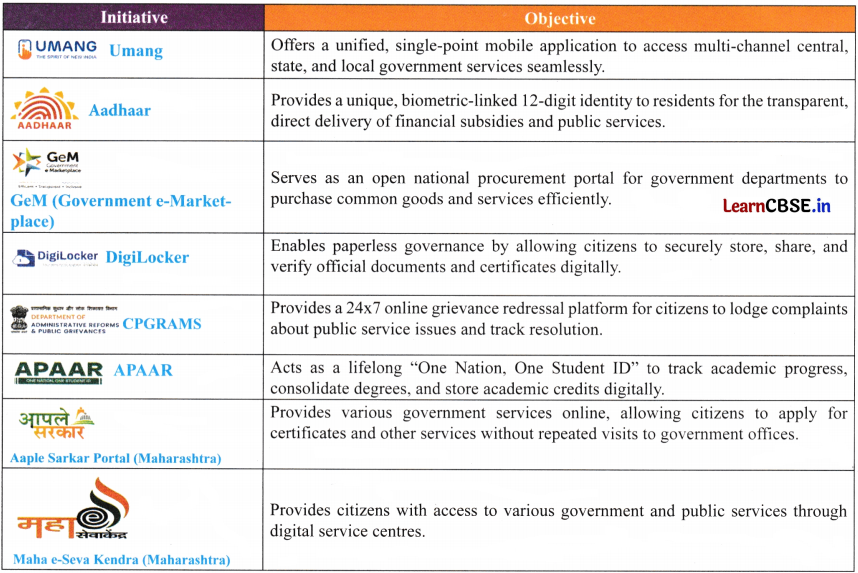
Below is a chart of a few e-governance initiatives. Complete the chart and also add two such initiatives undertaken by your state government. (Page No. 89)
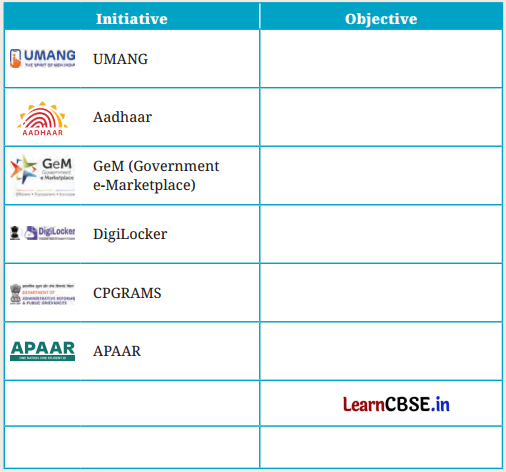
Answer:
(Suggestive Answer)
I have selected Maharashtra as the state for the additional e-governance initiatives. The completed chart is given below:
Question 8.
Let us try to understand the quality of life of citizens before and after e-governance. Form five groups and interview your seniors, teachers, security guards, administrative staff, and parents regarding the issues listed below. Did they have access to the internet and a smartphone or computer to make use of these e-governance facilities? Find out what problems they had faced before e-governance and whether they felt the same issues were easily handled after e-governance. (Page No. 90)
(i) Obtaining a birth certificate
(ii) Obtaining an admit card
(iii) Collecting and storing marksheets
(iv) Receiving salary
(v) Booking rail/flight tickets
(vi) Registering a vehicle
Answer:
(Suggestive Answer)
I spoke to security guards, administrative staff, and parents to understand their experiences with e-governance and the challenges they faced before and after these facilities became available. The findings are presented below.
| Issue | Before E-Governance (Challenges Faced) | After E-Governance (How it is Handled Now) |
| (i) Obtaining a birth certificate | Citizens had to visit several times the offices of the municipalities/panchayats. This included manually filling up forms, waiting for a long period of time, and delays in follow-up. | Applications are filled out using state websites. One can download the digital certificate safely through a QR code verification process. |
| (ii) Obtaining an admit card | Students or parents had to collect physical cards from school/college counters or rely on postal mail, which often caused anxiety due to delays or losses. | Admit cards are instantly downloaded via official student portals or exam websites, ensuring no one misses an exam due to lost mail. |
| (iii) Collecting and storing marksheets | Marksheets were distributed only as physical paper. If lost or damaged by water/fire, getting a duplicate copy from the board took months of paperwork. | Documents are securely saved and instantly verified using platforms like DigiLocker, eliminating the need to carry physical papers. |
| (iv) Receiving salary | Employees had to rely on manual salary payment processes, which could involve delays and more paperwork. | Funds are automatically transferred directly into bank accounts via electronic systems (like NEFT/IMPS), ensuring timely payments. |
| (v) Booking rail/flight tickets | People had to travel to railway stations or booking counters, fill out forms, and wait in crowded lines for hours, with no guarantee of getting a ticket. | Tickets are booked instantly via mobile apps (like IRCTC) or booking websites, allowing passengers to check live availability and seat layouts in real-time. |
| (vi) Registering a vehicle | Owners had to visit the Regional Transport Office (RTO) repeatedly, deal with middlemen, fill out complex paper forms, and wait weeks for a RC card. | Vehicle registration is largely handled online by dealerships via portals like VAHAN. Digital RC books are easily stored on mobile devices. |
Question 9.
Read each of the following examples carefully. Identify whether they are a policy or a public policy. Give a reason for your answer. (Page No. 92 – 93)
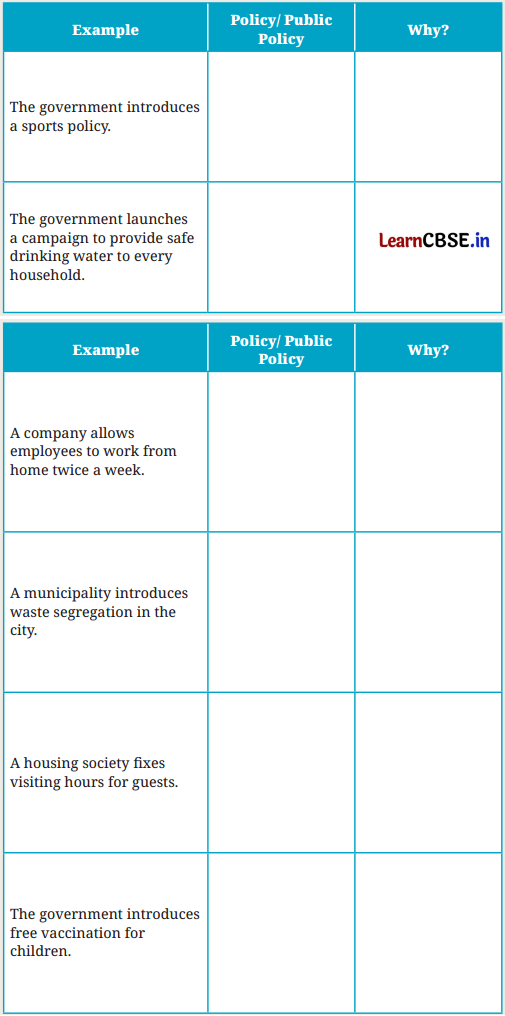
Answer:
| Example | Policy/ Public Policy | Why |
| The government introduces a sports policy. | Public Policy | Formulated by the government for the public benefit to regulate, fund, and encourage sports activities across the entire nation or state. |
| The government launches a campaign to provide safe drinking water to every household. | Public Policy | Solves a broad societal health problem, targets every citizen, uses public funds, and is implemented by public authorities. |
| A company allows employees to work from home twice a week. | Policy | It is an internal rule created by a private organisation that applies exclusively to their limited group of employees, not society at large |
| A municipality introduces waste segregation in the city. | Public Policy | Introduced by public local government body to address sanitation and environmental protection for all residents living in that city. |
| A housing society fixes visiting hours for guests. | Policy | It is a private rule meant strictly to manage a specific housing complex and affects only its residents and visitors, rather than the wider public. |
| The government introduces free vaccination for children. | Public Policy | Promotes public health and welfare, exists for all children across the nation, and is financed using public funds. |
Question 10.
Your school’s main gate faces a road that connects residential areas and a major market area. There is heavy traffic congestion on the road, especially during morning and afternoon hours. Pedal rickshaws, electric rickshaws, school buses, private vehicles, and pedestrians—all struggle to get their way. (Page No. 95 – 96)
Answer:
Form groups in your class and choose a course of action from the options given below.
- Form a group of volunteers to regulate traffic in rush hours.
- Write an application to the principal about the issue.
- Meet the principal, along with all the class representatives of the school, to discuss the gravity of the situation and then impress upon the principal the need to take up the issue with the local people’s representative so that a traffic signal can be installed.
- Request the school management to construct and open another gate on the other side of the school.
- Suggest that the school shift its pick-up and drop-off point to a location slightly away from the main gate.
- Change school timings so that the school’s opening and closing hours do not coincide with the busiest traffic hours in the market.
Answer the following based on the information given above.
→ Which option did you choose and why?
Answer:
(Suggestive Answer)
I will choose Option 3. It addresses the problem at its root. A traffic signal is a permanent solution that benefits students, parents, and commuters, not just the school. It also follows the proper route of public policy: students raise the issue, the principal supports it, and the local representatives and authorities act on it. Options 1 and 2 are only temporary or weak. Option 4 is costly and may not fix the market road congestion. Options 5 and 6 help but do not solve the traffic on the road itself.
→ Can you suggest a better solution to address the given problem? Compare your suggestion with other options.
Answer:
(Suggestive Answer)
A better solution would be to create a designated pick-up and drop-off area away from the main gate, along with proper traffic management during rush hours. This would reduce congestion at the school gate, improve pedestrian safety, and allow vehicles to move more smoothly.
Compared with the other options, this solution is more practical because forming a group of volunteers may not be enough to manage heavy traffic for a long time. Writing an application to the principal only reports the problem and does not solve it directly. Constructing another gate may be expensive and may not reduce congestion on the main road. Changing school timings may reduce traffic at certain times but could affect the routine of students and staff. Installing a traffic signal, as suggested in Option 3, can help control traffic, but a designated pick-up and drop-off area would also prevent vehicles from gathering near the school gate.
Therefore, a designated pick-up and drop-off area with proper traffic management would be a practical and effective solution to the problem.
→ Which stakeholders would be involved in solving this problem in your suggested solution? Explain their role in solving the problem.
Answer:
The following stakeholders would be involved in solving the suggested solutions:
- School authorities: Decide and arrange the designated pick-up and drop-off area and inform students and parents about the new arrangement.
- Parents and students: Use the designated area and follow the new pick-up and drop-off arrangements.
- Traffic police: Manage traffic during rush hours and ensure the smooth movement of vehicles and pedestrians.
- Local authorities: Help arrange the designated area and necessary traffic-management measures.
- Drivers: Follow the designated pick-up and drop-off area and avoid stopping near the school gate.
→ Suggest a feedback loop to ensure that the problem does not recur.
Answer:
The following is the feedback loop to ensure that the problem does not recur.
- Monitor: Teachers and student volunteers observe traffic at the gate every day for the first weeks, then weekly.
- Collect feedback: Parents, students, shopkeepers, and drivers share complaints and suggestions through a feedback box, a class representative, or the parent-teacher meeting.
- Review: A small committee consisting of the principal, teachers, students parents meets monthly to check whether congestion has reduced.
- Improve: Adjust the timings, pick-up point, or volunteer duty as needed, and report any new problems to the traffic police or municipal authorities.
- Repeat: Keep this cycle going, so that the solution continues to work as the traffic changes.
Question 11.
Read the case study and follow the journey of the issue from identifying the problem to implementing a solution. As you read, identify the problem, the people and institutions involved, the actions taken, and the steps through which the solution was developed and implemented. Then, answer the questions below: (Page No. 97)
(i) Arrange the various stages of the policy process in sequence for upgrading the hospital to be more patient-friendly.
Answer:
The sequence of the various stages of the policy process for upgrading the hospital to be more patient-friendly should be:
1. Problem identification: Patients and families notice that the hospital has no ramps, handrails, tactile paths, or Braille signs, so it is not accessible to the elderly, wheelchair users, and visually impaired people.
2. Raising the issue: Patients and families raise it with the hospital authorities and local representatives.
3. Creating public awareness: A local disability rights organisation highlights the problem through newspapers and social media.
4. Government Action: The district administration takes note of the issue and asks the PWD and the Health Department to inspect the hospital.
5. Consultation: Doctors, hospital staff, architectural experts, organisations working with persons with disabilities, senior citizens, and residents are consulted.
6. Policy formulation (plan): A plan is prepared to make the hospital accessible.
7. Approval and funding (adoption): The government approves the funds for ramps, lifts, handrails, tactile pathways, accessible toilets, and clear signboards.
8. Implementation: The construction and installation work is carried out.
9. Outcome and monitoring: The hospital becomes easier to use for older persons, persons with disabilities, pregnant women, patients, and children. Feedback can be collected to check and improve it.
(ii) Which stakeholders were involved in solving this problem? Identify at least three.
Answer:
(Suggestive Answer) The following stakeholders were involved in solving this problem:
- Patients and their families: Identified the problem and raised it with the authorities.
- Local disability rights organisation and the media: Highlighted the issue through newspapers and social media.
- District administration: Took note of the issue and ordered an inspection.
- Public Works Department (PWD) and Health Department: Inspected the hospital and helped prepare a plan.
- Doctors, hospital staff, architectural experts, and organisations working with PWD: Gave advice during consultation.
Government: Approved the funds.
(iii) Can you think of any public building in your locality that could be made more accessible? What improvements would you suggest?
Answer:
(Suggestive Answer)
Yes, the local government school in our neighbourhood could be made more accessible to persons with disabilities, older persons and pregnant women. The following improvements could be made:
- Build ramps with handrails at the entrance for wheelchair users and the elderly.
- Install tactile paths and Braille signs for visually impaired people.
- Provide accessible toilets and lifts or ground-floor facilities.
- Put up clear, large signboards and ensure good lighting.
- Keep a feedback box or helpline so that users can report problems.
Question 12.
As a student, what role can you play in the successful implementation of Khelo Bharat Niti 2025? (Page No. 102)
Answer:
(Suggestive Answer)
As a student, I can be of great importance to promote the participation of myself and other fellow students in sports and physical activities at school and in the community. I can motivate my schoolmates, families, and friends to engage in physical activities, particularly the female sex, as well as disabled students, so that all get equal opportunities. In addition, I can organise and participate in school sport days and tournaments, and discover those with athletic talents and inform the relevant teachers and coaches of such talents. I can clean sports grounds and parks and use them effectively and give feedback to the school administration and community officials on sporting programmes.
Question 13.
Your school is designated as the ‘state’s sports ambassador ’. What actions should it take to fulfil its role as sports ambassador? (Page No. 102)
Answer:
As an ambassador for sports in the state, the institution should conduct regular interschool sports competitions, camps, and tournaments and ensure that there is proper ground and facilities for all the students including those who are specially abled. It should spot talents among the students and link them up with coaching institutes and sport promotion organisations and invite sports professionals and coaches for conducting coaching classes and seminars. Other important things that should be done include conducting programs to create awareness about fitness and the importance of sports, motivating girls to play sports, and challenging the notion that sports is not a career option.
Question 14.
Which ministries of the government can contribute towards the success of Khelo Bharat Niti 2025? How? (Page No. 102)
Answer:
Many ministries can contribute towards the success of Khelo Bharat Niti 2025. The Ministry of Youth Affairs and Sports leads the policy, runs sports programmes, and builds infrastructure, while the Ministry of Education includes sports in school curricula and supports school sports facilities. The Ministry of Health and Family Welfare promotes fitness, nutrition, and medical care for sportspersons, and the Ministry of Women and Child Development encourages girls’ and women’s participation. The Ministry of External Affairs uses, sports for international diplomacy and helps with participation in global events, and the Ministry of Social Justice and Empowerment supports sports opportunities for persons with disabilities and disadvantaged groups.
Think About It
Question 1.
If any step in policy-making and implementation is skipped, what would be the implications? Discuss with a suitable example. (Page No. 99)
Answer:
(Suggestive Answer)
Skipping any step in the policy process weakens the policy and may cause it to fail. Without proper problem identification, the wrong need is addressed. Without consultation, people’s views are ignored. Without monitoring and evaluation, shortcomings go unnoticed and the policy cannot improve.
For example, a city launches a programme to plant one lakh trees and allocates funds, but nobody monitors whether the saplings are watered and protected. Only a few survive, public money is wasted, and the goal is not achieved.
Don’t Miss Out
Question 1.
Divide the class into groups. Each group represents one of these stakeholders:
- The Union Government, a state government, a school principal, a teacher, a parent, a student, an NGO, and a journalist.
- Discuss how the stakeholder group you belong to can contribute to the successful implementation of the NEP. Present your ideas to the class. You can access the policy document at https://static. pib.gov. in/WriteReadData/userfiles/NEP_ Final_English_0.pdf (Page No. 99)
Answer:
Role of Different Stakeholders in the Successful Implementation of NEP 2020 are:
- Union Government: Provide policies, funds and guidelines for implementing NEP 2020.
- State Government: Implement the policy according to local needs and provide resources to schools.
- School Principal: Ensure proper planning, facilities and teacher training.
- Teacher: Use activity-based, practical and student- centred teaching methods.
- Parent: Support children’s learning and encourage their participation in school activities.
- Student: Participate actively in learning, develop skills and follow good values.
- NGO: Support education by providing resources, training and learning opportunities to underprivileged children.
- Journalist: Spread awareness about NEP 2020 and report its progress and challenges.
Conclusion: All stakeholders must work together to make education accessible, inclusive, skill-based and effective for every child.
Class 9 SST Part 2 Chapter 4 Question Answer
Questions And Activities (Page No. 104-106)
Question 1.
“Good governance is the responsibility of the government alone.” Do you agree with this statement? Give reasons to support your answer.
Answer:
I strongly disagree. It is true that the government formulates laws, policies, and offers services, but good governance requires contributions from all parties. The citizens get involved by voting, obeying laws, giving suggestions, and participating in civic affairs. The media educates the people and brings out the problems. The civil society raises awareness and monitors programmes. The private sector also participates through innovations and finances. The example of heavy rain demonstrates that a particular department cannot handle any problem in the public sector alone.
Question 2.
Do you think students can contribute to good governance? Write a short note describing any five ways in which students can become more responsible and active citizens.
Answer:
Students can contribute to good governance in many ways. They can follow rules and laws, such as traffic and school rules, and take part in school elections and student bodies, learning to vote responsibly when they become eligible. They can keep the school and public places clean and avoid wasting water and electricity. They can also check news before sharing it, which helps stop fake news and misinformation. Finally, they can give feedback, raise local problems with the proper authorities, and volunteer in community work. In this way, students become responsible and active citizens who help make governance more transparent, accountable, and participatory.
Question 3.
Choose any one public policy [for example, Right to Education (RTE), Swachh Bharat Mission, PM POSHAN, Ayushman Bharat, Digital India, or Jal Jeevan Mission/ and prepare a chart showing the following aspects:
- The problem it addresses
- The major stakeholders involved
- How different actors coordinate
- The role of citizens in its success
Present your findings to the class.
Answer:
(Suggestive Answer)
One Public policy I have chosen is the Swachh Bharat Mission. The aspects given are discussed below:
| Aspect | Details & Description |
| The Problem it addresses |
|
| The major stakeholders involved |
|
| How different actors coordinate |
|
| The role of citizens in its success |
|
Question 4.
Answer the following in one or two sentences.
(a) What is governance?
(b) How is governance different from government?
(c) What is meant by public policy?
(d) Name any four principles of good governance.
Answer:
(a) Governance is the process through which decisions are made, implemented, and monitored in the public interest for the welfare of people.
(b) Government is the set of institutions that exercise political authority, while governance is the process of how decisions are made and carried out, involving citizens and others as well.
(c) Public policy is a course of action adopted by the government to solve public problems, meet people’s needs, and promote welfare.
(d) Four principles of good governance are: Participation, transparency, accountability, and the rule of law.
Question 5.
Compare the following and present your answer in a tabular form.
(a) Government and governance
(b) Policy and public policy
Answer:
(a)
| Basis | Government | Governance |
| Meaning | Institutions that exercise political authority | Process of decision making and implementation |
| Includes | Legislature, Executive, Judiciary | Government, citizens, media, civil society, private organisations |
| Focus | Who governs | How governing is carried out |
| Nature | An institution | A process |
(b)
| Basis | Policy | Public policy |
| Made by | Any organisation, such as a school, company, or family | Government |
| Applies to Resources | A limited group Organisation’s own | Society as a whole Public money, mainly from taxes |
| Example | A company’s work-from-home rule | Free vaccination for children |
Question 6.
Imagine you have been appointed to advise the district administration on improving governance. You have proposed six points (given below), but the administration decides to prioritise only three areas for improvement. Which three would you recommend as priority areas, and which one out of the three do you feel is the most important?
(a) Improve drinking water facilities in schools.
(b) Improve sanitation and public toilets in schools and market areas.
(c) Provide tricycles for orthopaedically challenged students.
(d) Install open-area swings and open-air gym in public parks.
(e) Ensure the vaccination of stray dogs to prevent rabies.
(f) Ensure distribution of iron and folic acid tablets for female students in schools.
Answer:
(Suggestive Answer)
The three options I would prioritise are:
(i) (a) Improve drinking water facilities in schools.
(ii) (b) Improve sanitation and public toilets in schools and market areas.
(iii) (f) Ensure distribution of iron and folic acid tablets for female students in schools.
These affect health and the daily lives of most people and prevent diseases, absenteeism, and dropouts. The most important is safe drinking water, because clean water is a basic need and the foundation of health, and poor-quality water can cause many diseases. Tricycles, swings and gyms, and stray dog vaccination are valuable but can be taken up later.
Question 7.
Match the policy action point to its corresponding stage in the policy cycle.
| Policy Action Point | Stage of Policy Cycle |
| 1. Assessing the impact of the policy | Policy implementation |
| 2. Putting the policy into action | Policy evaluation |
| 3. Framing the legislation | Policy adoption |
| 4. Multi-dimensional consultation with stakeholders | Policy formulation |
| 5. Addressing a new need of the people | Policy desirability (problem identification) |
Answer:
| Policy Action Point | Stage of Policy Cycle |
| 1. Assessing the impact of the policy | Policy evaluation |
| 2. Putting the policy into action | Policy implementation |
| 3. Framing the legislation | Policy adoption |
| 4. Multidimensional consultation with stakeholders | Policy formulation |
| 5. Addressing a new need of the people | Policy desirability (problem identification) |
Question 8.
Read the following case and answer the given questions.
The government launches a programme to plant one lakh trees in a city. Funds are allocated, but only a few saplings survive because they are not watered or protected.
(a) Which stage of the policy cycle appears to be weak?
(b) Which organisations should coordinate to improve the programme?
(c) Suggest two measures that could improve the outcome.
Answer:
(a) The stage of the policy cycle that appears to be weak is policy implementation and monitoring, since saplings were planted but not watered or protected.
(b) The organisations that should coordinate to improve the programme are the municipal corporation, forest/horticulture department, schools, NGOs, resident welfare associations, and citizens.
(c) Two measures that could improve the outcome are, firstly, assigning each area or sapling to a school, group, or RWA for watering and care, and secondly, monitoring survival through regular surveys with public reporting, so that fixes can be made.
Question 9.
Read each statement carefully. Do you agree or disagree? Give reasons for your answer.
(a) A good public policy can fail if it is not implemented properly.
(b) Citizen participation sometimes makes decision-making slower, but it can improve governance.
(c) Technology alone cannot ensure good governance.
Answer:
(a) (Suggestive Answer)
Yes, I agree. Even a well-designed policy fails if funds, staff, or coordination are poor, as we have read in the tree plantation case.
(b) (Suggestive Answer)
Yes, I agree. Consultation takes time, but it brings real needs, wider support, and better decisions, as with NEP 2020.
(c) (Suggestive Answer)
Yes, I agree. Technology helps, but it needs devices, internet, digital skills, honest officials, and active citizens. Otherwise, some people are left out.
Question 10.
Design a public policy.
You are a member of your school’s student representative body. Identify one issue, for example, plastic waste, water wastage, road safety, energy conservation, or littering in public places. Prepare a simple policy proposal that includes the following aspects of policymaking:
- The reason for selecting the issue
- Your proposed solution
- Who should implement it?
- How will students participate?
- How will you know whether the policy has succeeded?
Present your proposal to the class as a chart or slideshow presentation.
Answer:
(Suggestive Answer)
I have selected Plastic Free School Policy issue because plastic bottles and wrappers create a large amount of waste, dirty the campus, and harm the environment. To solve it, the school should ban single-use plastic on campus, encourage students to carry reusable bottles and lunchboxes, and place segregated dustbins around the premises. The principal and teachers will lead the policy, with the student representative body, housekeeping staff, and parents supporting them. Students will take part actively through eco-club monitors, awareness posters and skits, monthly clean up drives, and a “plastic-free class” competition. To know whether the policy has succeeded, the school will weigh the plastic waste every month, check how many students use reusable items, and collect feedback from students, teachers, and parents, then adjust the policy if needed.
The post Governance and Public Policy Class 9 Question Answer SST Part 2 Chapter 4 appeared first on Learn CBSE.
📚 NCsolve - Your Global Education Partner 🌍
Empowering Students with AI-Driven Learning Solutions
Welcome to NCsolve — your trusted educational platform designed to support students worldwide. Whether you're preparing for Class 10, Class 11, or Class 12, NCsolve offers a wide range of learning resources powered by AI Education.
Our platform is committed to providing detailed solutions, effective study techniques, and reliable content to help you achieve academic success. With our AI-driven tools, you can now access personalized study guides, practice tests, and interactive learning experiences from anywhere in the world.
🔎 Why Choose NCsolve?
At NCsolve, we believe in smart learning. Our platform offers:
- ✅ AI-powered solutions for faster and accurate learning.
- ✅ Step-by-step NCERT Solutions for all subjects.
- ✅ Access to Sample Papers and Previous Year Questions.
- ✅ Detailed explanations to strengthen your concepts.
- ✅ Regular updates on exams, syllabus changes, and study tips.
- ✅ Support for students worldwide with multi-language content.
🌐 Explore Our Websites:
🔹 ncsolve.blogspot.com
🔹 ncsolve-global.blogspot.com
🔹 edu-ai.blogspot.com
📲 Connect With Us:
👍 Facebook: NCsolve
📧 Email: ncsolve@yopmail.com

😇 WHAT'S YOUR DOUBT DEAR ☕️
🌎 YOU'RE BEST 🏆