
The latest Understanding Society India and Beyond Class 9 Solutions and Class 9 Social Science SST Part 2 Chapter 3 Resistance and Resilience 1000-1700 CE Question Answer NCERT Solutions are prepared according to the updated syllabus.
Resistance and Resilience 1000-1700 CE Class 9 Questions and Answers
Class 9 Resistance and Resilience 1000-1700 CE Question Answer
The Big Questions (Page No. 45)
Question 1.
How did Indian rulers use resistance and alliances to safeguard their lands?
Answer:
Indian rulers used a combination of military force, tactical warfare, and political alliances to defend their lands. Regional kingdoms formed confederacies to collectively fight against invading armies.
Military Resistance: Rulers like Maharana Pratap and Chhatrapati Shivaji used guerrilla warfare and difficult local geography knowledge, such as the Aravalli hills and Western Ghats, to counter larger imperial armies.
Strategic Alliances: Several kingdoms formed alliances that helped them build collective strength, protect their territorial boundaries, and maintain political independence against external invasions.
Question 2.
What factors contributed to the resilience of different kingdoms and communities during this period?
Answer:
Several important factors helped kingdoms and communities survive during long periods of political instability. Some of them are as follows:
Geographical and Fort Defences: Natural barriers like rivers, thick forests, and hill fort networks provided strong defensive systems. These features enabled kingdoms like the Ahoms and Marathas to endure long military sieges.
Socio-Cultural and Economic Strength: The Bhakti tradition united communities using regional languages and inclusive worship. Concurrently, expanding agriculture, local trade, and financial systems supplied the resources needed to survive political instability.
Question 3.
How did the Bhakti tradition foster a sense of solidarity?
Answer:
The Bhakti tradition built social solidarity by promoting socio-religious equality, simplicity, and personal devotion. Bhakti saints like Kabir, Raidasa, Mirabai, Sankardeva, and Namadeva wrote devotional poetry in regional languages, making spiritual knowledge available to people of all backgrounds, including women and working classes. Public practices such as community singing (sankirtan) and group gatherings brought diverse communities together around shared beliefs and emotions. This inclusive environment bridged social divisions, creating a strong sense of unity and mutual support during challenging political times.
Question 4.
How did the expansion of agriculture, trade, and commerce keep the economy sound?
Answer:
During 1000-1700 CE, the expansion of agriculture, trade, and commerce maintained a stable economy by generating steady wealth across the Indian subcontinent. Agricultural production grew with the use of irrigation tools like the Persian wheel and local water storage systems. Commerce expanded as financial instruments like the hundi allowed secure long-distance transactions, while groups like the banjaras linked rural producers to city markets. Additionally, active participation in Indian Ocean trade enriched local merchant communities and provided economic stability.
Resistance and Resilience 1000-1700 CE Question Answer Class 9
InText Questions
Let’s Explore
Question 1.
Identify any two specific actions mentioned in the text which show that Maharana Pratap maintained his independence from the Mughal court. (Page No. 54)
Answer:
Two specific actions mentioned in the text that demonstrate Maharana Pratap maintained his independence from the Mughal court are:
1. Refusal to Attend Imperial Festivals:
Maharana Pratap completely abstained from attending royal court celebrations such as the Nauroz festival, showing his rejection of Mughal court customs and culture.
2. Avoidance of Imperial Service:
He refused to perform military guard duty during the Emperor’s Jharokha Darshan, signifying that he refused to act as a subordinate noble or ruler under Mughal authority.
Question 2.
Explore the contributions of the Nayanar saints (devotees of shiva) like Karaikal Ammaiyar and the Alvar saints (devotees of Vishnu) like Andal to the spread of the Bhakti tradition in peninsular India. Discuss their teachings and devotional practices and the ways in which they connected with people through their hymns. (Page No. 64)
Answer:
The Nayanars (Shiva devotees) and Alvars (Vishnu devotees) played a major role in spreading the Bhakti tradition across the Indian subcontinent, female saints like Karaikal Ammaiyar and Andal challenged rigid social traditions and gender barriers through deep, personal devotion.
Their teachings: They rejected caste divisions, expensive rituals, and formal religious authority. Instead, they promoted social equality, moral purity, and direct surrender to God, allowing people of all backgrounds to participate in spiritual life.
Devotional Practices: These saints composed and sang hymns in regional languages like Tamil rather than formal Sanskrit. Their songs reflected everyday human emotions, making devotion accessible to everyone, regardless of caste or gender.
Think About It
Question 1.
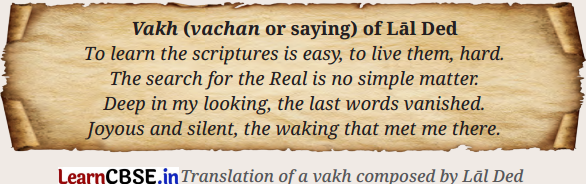
Lal Ded says that it is ‘easy’ to learn scriptures but ‘hard’ to live them. What is the difference between knowing a rule and actually following it? Can you give an example from your daily life? (Page 6 7)
Answer:
(Suggestive Answer)
Knowing a rule simply means memorising or understanding an idea in our mind, which requires very little effort. However, actually following a rule demands true discipline, practice, and self-control, especially when we face real-life temptations or challenges.
As a 9th-grade student preparing for my mid-term tests, I know the rule that I must put my smartphone away and focus completely while studying. Yet, putting this into practice daily is hard because of constant notifications and distractions. Living the rule requires real willpower beyond just knowing what is right.
Question 2.
What do you think made hundi a safer and more convenient choice than physically transporting money across long distances? (Page No. 74)
Answer:
The hundi was a much safer and more convenient financial instrument because it functioned like a modern bank cheque, eliminating the need to physically carry large amounts of heavy cash across long trade routes. Travelling with heavy amount of cash often exposed merchants to extreme risks of robbery and theft.
Instead, a hundi allowed traders to deposit money in one region and securely redeem the bill of exchange at their destination through a trusted, widespread network of money-changers called sarrafs and their local agents, known as gumasthas. This system made long-distance commercial transactions remarkably secure, efficient, and hassle-free.
Question 3.
Identify some cultural and economic pillars that exist in any community (places of faith, traditions, business, and trade, etc.). How do you think these contribute to resilience within a society facing invasions/external pressures? (Page No. 76)
Answer:
Places of Faith (Temples and Hospices): Temples and khanqahs (rest homes) served as both spiritual centres and economic institutions. They protected community wealth, offered credit, and preserved religious identity, helping societies quickly recover after foreign invasions.
Socio Religious Traditions: Movements like Bhakti fostered deep solidarity by uniting people across caste and gender divisions using regional languages like Tamil and Bengali. This shared cultural identity provided the moral and social strength needed to stand up against external political pressures.
Financial Networks: Traditional credit instruments like the hundi, managed by money-changers (sarrafs), kept capital flowing safely without carrying cash. This financial reliability ensured that trade and commerce continued uninterrupted during military conflict.
Merchant Networks: Nomadic traders like banjaras and commercial agents (gumasthas) maintained vital trade routes between rural areas and cities. Their ability to move essential commodities and food supplies prevented complete economic breakdown during wars.
Together, these cultural traditions and economic networks formed the backbone of Indian society. By uniting people spiritually through shared faith and keeping trade flowing through reliable financial systems, these pillars ensured that communities did not just survive external invasions, but also preserved their identity, heritage, and long-term stability.
Let’s Recall
Question 1.
You have already learnt about the foundation of Maratha power and the rise of Chhatrapati Shivaji in your Grade 8 textbook. Part I. Think hack to his struggle and the ways in which he built and strengthened his kingdom. What do you remember about the strategies and institutions that helped the Marathas establish their power? (Page No. 58)
Answer:
Chhatrapati Shivaji laid the foundation of Maratha power through innovative military tactics and strong administrative institutions. His strategic vision enabled the Marathas to build a resilient state that effectively resisted major imperial forces.
Forming Alliances and Administrative Institutions:
To consolidate Maratha power, Shivaji focused on forming alliance systems with local chieftains (Deshmukhs) and neighboring regional rulers. He backed this diplomacy with strong central institutions, including the Ashta Pradhan (a council of eight ministers) and fair revenue systems, establishing a resilient and independent Maratha state.
Protecting the Territories:
A crucial early strategy involved abandoned fort capturing across strategic hill passes. Shivaji took control of neglected or vulnerable strongholds, such as Torna and Rajgad, and rebuilt them into secure bases. These hill forts protected the local population, stored essential military resources, and served as defensive strongholds during long military sieges.
Guerrilla Warfare:
Chhatrapati Shivaji effectively used guerrilla warfare against larger imperial armies. Taking advantage of the knowledge of the rugged terrain and dense forests of the Western Ghats, the Marathas launched swift surprise attacks on enemy supply lines and retreated quickly into mountain strongholds before the enemy could counterattack.
Let’s Map
Question 1.
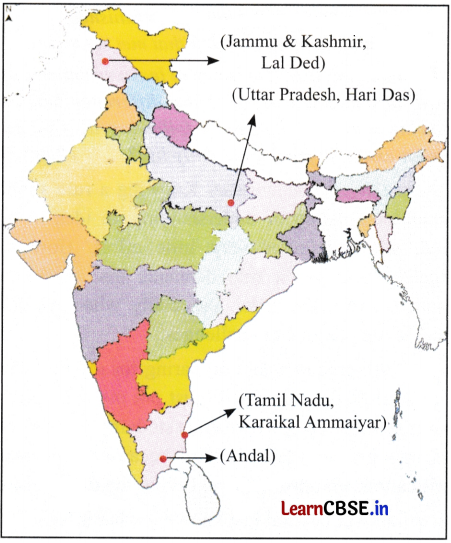
On a map of India, locate and label the mjULtjA present-day states associated with the saints Wmm mentioned in the above infographic. Also, find and mark a saint front your own state who is not on the list. Are you familiar with any songs, poems, or verses composed by these saints? Share with the class and explain what it means or what you like about it. (Page No. 67)
Answer:
(Suggestive Answer)
On the outline map of India, I have located and marked Jammu & Kashmir for Lai Ded, Tamil Nadu for Karaikal Ammaiyar and Andal, and my home state of Uttar Pradesh for Hari Das. Hari Das was born in Vrindavan in 16th century. He is a renowned musician-saint and was the guru of Tansen. His devotional songs enriched the Bhakti tradition.
Class 9 SST Part 2 Chapter 3 Question Answer
Questions and Activities (Pages 77 – 79)
Question 1.
Choose the most appropriate answer.
Resistance and resilience are closely connected because:
(a) Resistance always involves warfare.
(b) Resilience enables communities to endure difficulties and sustain resistance.
(c) Resistance is possible only when a kingdom has a large army.
(d) Resilient societies avoid all forms of conflict.
Answer:
(b) Resilience enables communities to endure difficulties and sustain resistance.
Question 2.
Why and how did groups such as the Sikhs, Marathas, and Rajputs assert their political power and identity during periods of changing political authority?
Answer:
During periods of changing political authority and imperial expansion, groups like the Sikhs, Marathas, and Rajputs asserted their power to protect their local autonomy, culture, and religious traditions. As central control weakened or became oppressive, these regional communities sought self-rule to defend their land and socio-economic interests, developing strong regional identities rooted in shared heritage and resistance against foreign domination.
They asserted their political authority through strong military leadership, strategic organisation, and socio-religious unity. The Marathas built their power using political allies, strong fortification, guerrilla warfare tactics and capturing strategic hill forts under Chhatrapati Shivaji. The Sikhs organised into military groups (,misls) and unified under the Khalsa brotherhood to resist central rule. Similarly, the Rajputs relied on strong fortresses, regional alliances, and warrior traditions to establish independent kingdoms.
Question 3.
Why did some Rajput rulers decide to negotiate alliances with the Mughal power?
Answer:
Some Rajput rulers chose to negotiate alliances with the Mughal power mainly to safeguard their kingdoms and maintain political stability. Recognising the immense military strength of the Mughals, diplomatic agreements helped prevent continuous warfare, devastating invasions and destruction. By accepting Mughal authority, Rajput rulers were able to retain control over their ancestral lands (jagir) and internal governance. Additionally, these alliances offered them prestigious administrative positions (mansabs), military honour, and political influence within the expanding empire.
Question 4.
Imagine a market in a port town of India such as Surat, Masulipatnam, or Puducherry. You are a foreign trader from Italy or France and want to make a deal of cotton textiles. How would you secure the product in the local market? Whose help would you seek and what kind of challenges would you face in terms of language, quality of product, prices of commodities, etc. ?
Answer:
(Suggestive Answer)
As a French trader arriving in the port town of Masulipatnam, my goal is to secure high-quality cotton textiles. To guarantee my shipment before the monsoon season, I would use the daclni system, giving cash advances to local weavers through commercial brokers (gumasthas). I would also seek help from local money-changers (sarrafs) to convert European currency and issue hundis for safe financial transactions.
However, trading in Masulipatnam presents several challenges. The language barrier requires hiring local interpreters (du bashes). Furthermore, maintaining consistent quality across hand-woven textiles demands strict inspection of every bale. Finally, the price competition from rival English and Dutch merchants, along with fluctuating local taxes and exchange rates, makes negotiating fair prices extremely difficult. To negotiate fairly, I would carefully explore the local market myself to gather prevailing price ideas instead of relying solely on recommendations from my own brokers. This direct research would help me offer fair terms that reflect true market value.
Question 5.
Watch any video at the given link (https:// www.indianculture.gov. in/forts-of-india/tales-of- forts) and analyse the various functions of forts and fortresses. How did rulers perceive the importance of forts in terms of strategic concerns.
Answer:
Forts in historical India were not just royal residences, but essential military and government centres. Rulers viewed forts as crucial tools to protect their borders, control trade routes, and display their power.
Strategic Military Defense:
Rulers perceived forts as unbeatable defense strongholds that cannot be conquered easily by invaders. Built strategically on hills, coasts, or deserts (like Mehrangarh and Janjira), forts utilized natural geography to offer wide surveillance, guard territorial borders, and effectively repel enemy invasions.
Administrative Seat and Symbol of Power:
Forts served as the primary royal residence and central seat of governance. They symbolised the political authority, prestige, and power of the ruler while providing a safe, fortified environment to hold court and execute state policies.
Economic and Resource Security:
Forts protected vital trade routes, granaries, armories, and state treasuries. Rulers relied on them as secure supply hubs during long military sieges, ensuring economic stability and community endurance.
Question 6.
What architectural changes occurred in temple construction during the period under study? How do these changes reflect upon the resilient nature of Indian civilisation?
Answer:
During the period from the 11th to the 16th centuries, temple architecture in India underwent significant changes as communities adapted to repeated invasions and threats of destruction. Temples were increasingly constructed in less visible locations, often hidden along narrow lanes, with entrances that did not open onto main streets. Their outward appearance was deliberately simplified, with many designed to resemble ordinary houses rather than grand monuments. Tall shikharas and detailed exterior decorations were frequently avoided, giving rise to the style known as haveli temples.
These architectural adjustments reveal the resilient nature of Indian civilisation, as local rulers, merchant guilds, and religious communities found creative ways to preserve sacred centres and ensure continuity of worship despite political upheavals and external pressures.
Question 7.
A kingdom has limited military resources but possesses fertile agricultural land, strong local support, and detailed knowledge of its terrain.
Explain two ways in which these resources could contribute to the kingdom’s resilience when faced with a threat.
Answer:
A kingdom with limited military resources can survive powerful threats by using its natural and human resources effectively. Fertile land, loyal subjects, and local geographical knowledge build a strong defence through economic endurance and strategic warfare.
Sustained Endurance Through Agriculture and Community Support:
Fertile agricultural land ensures a reliable food supply for soldiers and citizens during prolonged enemy sieges. Furthermore, strong local support guarantees a loyal population that actively hides provisions, guards borders, and resists foreign rule. Together, these resources keep the state stable and prevent internal collapse during crises.
Strategic Defence Using Local Geography:
Detailed knowledge of the terrain enables the kingdom to practice guerrilla warfare against larger invading armies. Local forces can hide in familiar forests or hills, execute surprise ambushes, and disrupt enemy supply chains. Using the landscape as a natural weapon compensates for smaller troop numbers and weakens the enemy.
Question 8.
Consider the following statement: “A tradition becomes more resilient when people can carry it with them.”
Do you agree? Explain using examples from the Bhakti tradition.
Answer:
(Suggestive Answer)
Yes, I agree with this statement because the Bhakti tradition survived and flourished precisely because it did not depend on rigid temples or fixed locations. Bhakti saints rejected costly or hollow rituals and formal institutions, choosing instead to share spiritual devotion through simple oral verses, songs and kirtans in local regional languages like Tamil and Bengali. For instance, Lai Ded in Jammu and Kashmir expressed her philosophy through easily remembered poetic verses called vakhs, while Sant Kabir Das taught inner purity through short dohas. Because ordinary people could easily memorise, sing, and carry these teachings wherever they went, the Bhakti tradition remained deeply resilient across generations.
Question 9.
Voices from the Past
Choose any two of the following and write a short first-person account explaining what resilience means from that person’s perspective:
- A Bhakti saint
- A Rajput soldier
- An Ahom commander
- A Maratha administrator
- A merchant
- A Jat leader
Answer:
(Suggestive Answer)
A Maratha Administrator
As a Maratha administrator under Swarajya, resilience, in my perspective, means keeping our homeland, people, and hill forts secure against constant imperial threats. True strength lies in strategic organization – ensuring our fortresses are well-stocked with food and ammunition, managing fair local governance, and keeping our communities united. Even when facing vastly larger invading armies, our resilience comes from leveraging our rugged terrain, protecting our regional identity, and staying committed to self-rule.
An Ahom Commander:
As an Ahom commander defending the valleys of Assam, to me, resilience means using our native land and rivers as our greatest weapons against vast invader armies. True strength is not measured by troop numbers alone, but by our deep knowledge of the Brahmaputra River, dense forests, and monsoon climate which we can sincerely use during a difficult warfare. Even when facing massive foreign forces, we rely on swift naval tactics, clever earthworks, and the absolute unity of our people. Outnumbered as we may be, our unyielding spirit guarantees that our motherland remains unconquered.
Question 10.
Design a Fort: You are a military architect advising a ruler. Draw a simple, labelled plan of a fort that includes the following:
Residential complex
Defensive walls
Water source
Food storage
Escape route
Watchtower
Administrative area
Now, write a few sentences explaining how your design would help the kingdom withstand a long siege:
Answer:
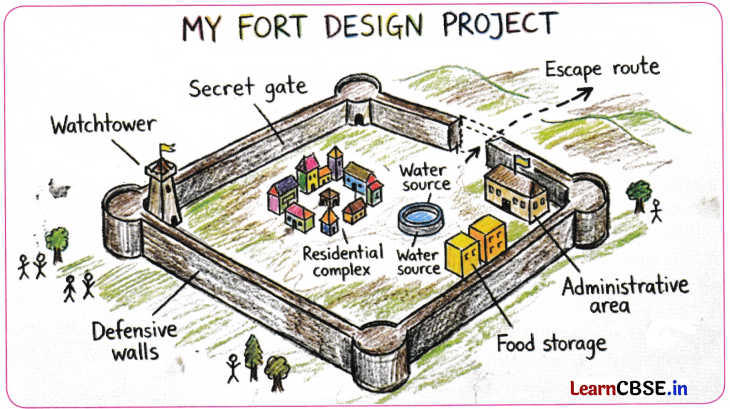
My fort design includes self-sufficiency features to survive a long siege. The central well guarantees a constant water source for everyone inside. The massive granaries for food storage ensure no one goes hungry. I have also included a central administrative area to manage resources, govern the people, and coordinate defence. The high defensive walls and watchtower provide strong defence against attacks. The hidden escape route allows secret movement for messengers to seek outside help, increasing our endurance.
The post Resistance and Resilience 1000-1700 CE Class 9 Question Answer SST Part 2 Chapter 3 appeared first on Learn CBSE.
📚 NCsolve - Your Global Education Partner 🌍
Empowering Students with AI-Driven Learning Solutions
Welcome to NCsolve — your trusted educational platform designed to support students worldwide. Whether you're preparing for Class 10, Class 11, or Class 12, NCsolve offers a wide range of learning resources powered by AI Education.
Our platform is committed to providing detailed solutions, effective study techniques, and reliable content to help you achieve academic success. With our AI-driven tools, you can now access personalized study guides, practice tests, and interactive learning experiences from anywhere in the world.
🔎 Why Choose NCsolve?
At NCsolve, we believe in smart learning. Our platform offers:
- ✅ AI-powered solutions for faster and accurate learning.
- ✅ Step-by-step NCERT Solutions for all subjects.
- ✅ Access to Sample Papers and Previous Year Questions.
- ✅ Detailed explanations to strengthen your concepts.
- ✅ Regular updates on exams, syllabus changes, and study tips.
- ✅ Support for students worldwide with multi-language content.
🌐 Explore Our Websites:
🔹 ncsolve.blogspot.com
🔹 ncsolve-global.blogspot.com
🔹 edu-ai.blogspot.com
📲 Connect With Us:
👍 Facebook: NCsolve
📧 Email: ncsolve@yopmail.com

😇 WHAT'S YOUR DOUBT DEAR ☕️
🌎 YOU'RE BEST 🏆